Many media brands are now active on TikTok, the world’s fastest-growing social media platform. News brands see the platform as an opportunity to attract and engage younger audiences who are less likely to go directly to their websites or apps.
However, many media brands are holding off due to concerns with the platform’s Chinese ownership, as well as reservations about the platform’s environment for news. Reuters Institute’s new report, How Publishers are Learning to Create and Distribute News on TikTok, examines news media concerns and identifies how they can deliver professional content with influencer-type authenticity.
Methodology
Reuters Institute interviewed 20 news organizations and individuals from companies among the top news brands in 44 countries. Interviews included large, digital-only, socially native brands and some individual creators and activists. Reuters also tracked publisher usage activity across more than 40 countries.
Many news brands are using TikTok to engage younger cohorts. Reuters’ Digital News Report 2022 shows that half of all global news organizations (49%) produce content for TikTok. Indonesian (90%), Australian (89%), Spanish (86%), French (86%), U.K. (81%), and U.S. (77%) publishers have the highest TikTok adoption. Overall, 40% of 18-24s and 28% of 25-34s use TikTok for any purpose, and 15% of 18-24s and 10% of 25-34s use it for news.
Regardless of concerns, news publishers use TikTok to build relationships with younger audiences and experiment with new vertical video formats. Others, like the Czech website HlídacíPes.org, use TikTok to help improve news literacy by identifying disinformation and explaining how to use open sources of information. Further, the Washington Post sees fact-checking and verification as their social strategy. They encourage users on TikTok to tag them to help to verify false footage.
Approaches to news content on TikTok
Reuters identifies two main approaches to news content on TikTok: a creator-first strategy and a newsroom-led approach.
The creator approach looks to a core team for content coverage. At the Washington Post, Dave Jorgenson leads the creative team trying to create light and fun videos that match the brand values of their news organization. While they try to keep a light and comedic tone in their videos, part of the TikTok DNA, they also create more serious stories. The French, Le Monde, also uses a creator approach on TikTok. Their mission is to explain the news by deploying different creative techniques using metaphors, drawings, fake video games, and acting.
The newsroom-led approach uses the whole newsroom and looks at TikTok as another distribution channel. For example, The Economist uses high-quality video to tell the story. Their mission, to explain geopolitics and economics, appeals to younger audiences. Liv Moloney, Head of Social Media, describes their strategy, “We’ll never be the first to tell you something’s happened, but we might be the first to explain it to you or explain it the best.”
Vice World News also uses a newsroom approach and focuses its TikTok content on short explanatory videos about international news. Vice’s content strategy blends news explainers, on-the-ground reporting, and listicle formats – adapting the content to the shorter attention span of TikTok users.
TikTok presents its problems with content distribution:
Transparency about the removal or blocking of news content especially given Chinese ownership and the potential for censorship.
Better monetization of content and compensation for the content value. While short videos are not the best advertising vehicle, publishers would like the ability to put links to their websites or apps, which currently is limited.
More detailed and timely demographic information is needed about who has viewed posts, with more data about how particular posts perform.
News organizations use TikTok to engage and build relationships with younger audiences. While many are concerned with its ownership and that short-form videos can marginalize important news stories, they are testing the waters. Importantly, news brands need to look to new technologies and platforms to reach new audiences, and while challenging, experimentation is key for growth.
From audience analytics to programmatic advertising and automated story creation, media companies have used Artificial Intelligence (AI) for some time. However, this technology is rapidly maturing and opening up new creative and business possibilities that media executives need to be aware of.
ChatGPT, an AI chatbot, is the current poster child for this robotic reckoning. Garnering a huge amount of column inches in recent weeks, the application can provide detailed answers to questions and prompts. Along with other AI-generated innovations like the portrait app Lensa and OpenArt – a gallery of works created by AI – these tools have inspired the latest wave of discussion about the implications of this technology.
Amidst copious innovation and optimism, concerns have also surfaced around AI-generated content, consent, bias, labeling and regulation, as well as the impact on labor markets. None of these issues are going to go away any time soon. Nevertheless, while media companies and policymakers navigate this unfolding landscape, the roll-out and adoption of AI continues to gather pace.
Artificial intelligence at work in the media
With AI having a real moment right now, this is the perfect time to explore the ramifications for media companies. Here are six uses of AI technologies that need to be on your radar:
1. Driving engagement
One of the most common ways publishers are using AI and machine learning is through AI-powered algorithms which personalize content recommendations.
This can help increase engagement and keep readers on your site for longer. That’s particularly useful if time on site is a key performance metric. Of course, it can also enable you to serve more adds to your audience too.
Personalized recommendation technology has long been the mainstay of platforms like Amazon, Spotify, and Netflix. Now it’s becoming increasingly common for other forms of content too.
One early proponent, The Washington Post, uses AI to personalize the news that they deliver based on readers interests and preferences. It’s an approach they’ve been using for some time across their app, newsletters and now the homepage.
Sign up page for The Washington Post’s “For You” newsletter, highlighting the personalized nature of this product (Dec. 2022)
As Digiday explains, the Post offers a personalized “For You” section on the homepage that taps into information provided during onboarding. At sign-up, subscribers or registered users can select their topic preferences. Recommendations are further augmented by your reading history and other performance data.
It’s an area the Post looks set to double down on, as they and other outlets seek to move to a more tailored content offering and away from the “one size fits all” approach of yesteryear.
One of these models, dynamic paywalls, deploys AI to change free article limits. As a result, users hit the paywall at different times, based on their behaviors and other indicators that help to determine a consumer’s propensity to pay.
“Piano has seen visitors subscribe after a single pageview. Others take much longer to make the decision to convert, while some aren’t likely to ever subscribe at all,” Kaufman observes. In response to this variance, he argues, we need “smarter, more satisfying automation.”
AI can help. New York Media and Neue Zürcher Zeitung (NZZ, Switzerland) are just some of the publishers to adopt this model. They have used AI to determine individual paywalls, based on variables including geography, consumption habits and visit behavior, as well as subject matter and the device being used. Expect more publishers to follow suit.
3. Creating content
Many early newsroom experiments with AI focused on the potential to craft stories that typically follow a predictable formula.
One of the earliest to leverage AI for content creation, The Associated Press (AP) has been using AI since 2014 to generate summaries of earnings reports from publicly traded companies. This allows them to quickly and accurately provide readers with key information, freeing up reporters to do other work. “Prior to using AI, our editors and reporters spent countless resources on coverage that was important but repetitive,” their website notes, adding that this “distracted from higher-impact journalism.”
Alongside freeing up reporters, the technology has allowed AP to create more of this content. Automated story generation has enabled AP to increase the volume of these corporate stories by a factor of 10.
At a simpler level, AI is also being used to liberate resources otherwise hoovered up by resource-heavy work such as interview transcriptions.
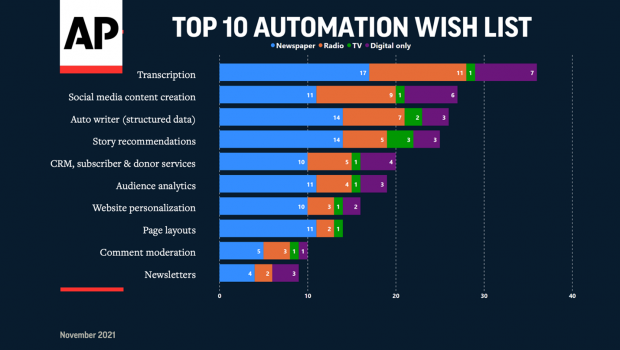
AP is currently working with local newsrooms to help them increase their use of AI tools. In a survey asking what would be the most useful use of this technology, automating transcription came top.
Image: via AP
4. Distributing content
A further potential benefit of AI can be seen in its ability to support publishers in their desire to get material in front of audiences – wherever they may be.
POLITICO Europe has used AI to convert two of their popular newsletters, Brussels Playbook and London Playbook into daily podcasts. The audio option gives subscribers another way to consume this content on the go.
This type of technological solution can help publishers manage their resources more efficiently, as well as distribute content to different platforms in a timely and cost-effective manner.
A further mainstream iteration of this idea is also being developed by Google. Dyani Najdi, Managing Director of Video and Display EMEA, has highlighted how the tech giant is experimenting with a tool to reformat landscape videos for YouTube. Viewers will see videos in square or vertical formats, with the shape automatically determined by how you are accessing the platform.
Although currently only available for certain video-ad products, it’s not a big leap to imagine this being used for other content in the near future. If it is, that would be a huge time-saver for many publishers. A further boon is the possibility of this technology opening up new distribution avenues, without the time and expense of repurposing everything.
Where we go from here: two trends to keep an eye on
The manner in which AI is being employed is constantly changing. Its possibilities have sparked discussion about the implications for education, journalism and other creative work, as well as the wider knowledge economy.
Within that, here are two key AI-trends for publishers to closely follow and potentially adopt.
1. Leveling-up content, and ad, personalization
Based on their interests and preferences, AI can personalize the news that publishers deliver to readers. Its usage is only likely to increase and become more ubiquitous.
More than 9,000 publishers use Taboola’s recommendation platform. Earlier in the year, they announced that AI functionality had been added to their homepage techstack. The company said that in beta testing companies such as McClatchy, The Independent and Estado de Minas in Brazil, had seen a 30% – 50% increase in clickthrough rates for homepage sections personalized by Taboola.
Alongside content, AI can also be used to deliver a better ad experience. Publishers like Condé Nast are using machine learning to find patterns that can lead to more personalized and contextual ads. In a cookie-less future this type of approach will be essential if ads are to be targeted and relevant.
2. Improving and streamlining workflows
With cuts being seen across the media landscape, a key challenge for publishers in 2023 will involve maintaining output levels (never mind launching new products and verticals) with fewer staff.
AI may help here, given its ability to be used for A/B headline testing and other forms of predictive analysis. It can also tag and generate content such as business, sports and real estate stories. Or, as seen at Forbes, provide detailed prompts for writers.
It can further support social media and off-platform strategies too. The South China Morning Postsaved resources akin to work done by 3.9 full-time employees by using AI to streamline its social media management.
Meanwhile, in Germany, Frankfurter Allgemeine Zeitung has used AI to help editors understand which stories to put behind the paywall. This matters given their freemium model, and the need to balance free content that drives subscriptions with premium subscriber-only content that readers value.
The big picture
This list of uses is far from exhaustive. To it we can also add important developments such as the ability of AI to help address inequalities (through the automatic creation of audio articles, and work to measure gender disparity in news coverage), as well as the rise of automated fact checking and many others.
Although no one knows how this technology will play out, it’s clear that AI can play a valuable role in helping publishers with their operations. As a result, it is no surprise that key activities unlocked by this technology – such as data analytics and automation – are among the top investment areas for publishers in the coming year.
Previously, as the Knight Foundation has found, “when we talk[ed] about AI in newsrooms, we seem to lean heavily on the newsgathering part of the process and maybe do not pay as much attention to the product or the business side of the ecosystem.”
In 2023, that may begin to change, as we see an overdue shift in the thinking about the role that AI plays in supporting the strategic needs of publishers.
From shaping the content you see (Pink News’ positive news filter), to aiding with translations of new international editions (Le Monde’s digital English language product) and improving your SEO (Summari and other tools), AI is here to stay and increasingly integral to publisher strategies.
Against a challenging business backdrop, as outlets begin to focus more on areas like product, subscriptions and retention, AI’s contribution to a publisher’s success will become more prominent and important than ever.
With a highly competitive streaming landscape, many content brands are adopting hybrid business models. Disney+ and Netflix now offer lower-priced ad-supported tiers, and Paramount+ and Peacock offer FAST services to deliver real-time streaming of channel-based linear content. Notably, AVOD and FAST channels serve as growth strategies for many content providers in that they offer low-cost options that attract viewers.
A select number of top services—such as Pluto, Tubi, Peacock, and The Roku Channel—currently dominate the market. However, given that there are now more than 300 OTT channels, how can streaming channels differentiate to appeal to viewers and make inroads into the growing market? Quickplay, an OTT cloud business that enables personalization for sports, media, and entertainment, partnered with the research firm Park Associates to explore this question. Their report, Personalized Virtual Channels: Maximizing FAST Engagement, examines new ways for media companies to maximize the monetization of consumer viewership, particularly through the promise of personalization.
Hybrid streaming marketplace
As cord-cutting continues, and internet-connected device penetration of Smart TVs and media devices grows, OTT usage is the new norm for consumers. Eight in ten (80%) U.S. internet households subscribe to an OTT video service, 49% subscribe to four or more, and 33% use an ad-supported OTT service in the last 30 days.
As reported in DCN’s The Rise of and Best Practices for AVOD and FAST, the adoption of AVOD and FAST grew faster (55%) compared to SVOD (28%). Park Associates identifies “free cost” as the top reason consumers use AVOD (49%), followed by “content consumers like” (31%).
Consumers are attracted to the free offering of AVOD and FAST, with 38% stating that they do not mind viewing advertising on a free service. However, 41% of ad-supported customers do say that they dislike viewing video content with commercials, and 40% are dissatisfied with the frequency of ads.
Personalized virtual channels
First-party data collection is already in place with many content services requiring users to opt-in for data collection in exchange for a more personalized user experience. While other providers may not require an account, they often ask consumers to register to offer personalized favorite channels and recommendations. Content preferences and location (i.e., zip code) feed content recommendations – think local news, weather, and sports.
The report recommends combining cloud-based technology and programmatic operations to allow owned and operated brands to offer ad-supported personalized virtual channels. FAST platforms are cloud-based. They do not have channel or format restrictions and are easily adaptable for personalized virtual channels.
For the content provider, personalized virtual channels maximize the lifetime value of content libraries by extending content shelf life. Further, reusing existing libraries and programming rights can also help offset content acquisition and encoding expenses. For the consumer, personalized virtual channels deliver a lean-back experience while enhancing individual content preferences in a stress-free navigation environment.
Importantly, the data containing information on viewer preferences and habits allows virtual FAST services to deliver progressively smarter and more relevant content. The more engaged the viewer, the higher retention and, ultimately, the more effective advertising. It’s a win-win for all involved in the value exchange.
Personalized virtual channels’ delivery of personally relevant content yields higher content engagement and lower viewer turnover. They offer a better viewing experience for consumers while delivering new opportunities to monetize viewership.
You’ve put in the hard yards, integrated an effective Digital Experience Platform (DXP) with engagement and moderation solutions, and finally established a safe space for your audience. With a community framework in place, and a moderation solution in action, you can use your newfound spare time to give due praise to the golden geese of your flock: the user generated content (UGC) contributors.
First things first. You need to answer some questions: Who are the high energy User Generated Content Contributors eager to publicly make their mark? Can their contributions be used as aspirational behavior for other more passive users? If so, what are some ways to go about this that don’t feel disingenuous?
Positive reinforcement is a sure way to encourage users further down your audience funnel and strengthen retention.By putting the contributions of your community up on a pedestal, you reward those ultra-valuable UGC Contributors with recognition. However, you also broadcast to your community and beyond the kind of behavior your brand values and celebrates.
There will be clear ROI once you’ve integrated a solid UGC contributor element to your existing audience-first content strategy. You should experience ample revenue gains (in both ad and subscriptions). You will also foster a consistently expanding community of users steadily flowing through your audience funnel.
In order to determine how best to integrate UGC Creators into your strategy, you’ll need to first consider what tools and techniques are available to you. Then, consider how to optimize the efficacy of UGC Content. And, most importantly, how to do it in a way that uplifts your brand and drives its success.
Highlight user comments
On a smaller day-to-day basis, implementing a pinned comment strategy is a great way to highlight members of your community as well as set the tone for budding conversations.
In some cases, having your editorial/content team kick off the discussion in the comments section with a pinned comment as a conversation starter can lead to immediate engagement and user contributions. Once those user comments roll in, swap out your comment with a user contribution that endorses your brand values, sets the tone, and encourages others to join in.
Editor’s pick
A useful strategy is to think about where you can reach different audiences at different stages of the audience funnel. For example, if your editorial team sends out a newsletter, including a piece of UGC in an “Editor’s Pick” segment is a great way to show you value the contributions of your community members. It gives registered members a reason to bring their own opinions and perspectives to the table in the hopes of being featured as well.
To reach audiences that may not be signed up for newsletters, building these Editor’s Picks into readily available on-site content can inspire registered users and connect with as of yet unregistered visitors. Sharing these contributions with a broader audience has the potential to, once again, establish an aspirational behavior for other users to strive for and improve engagement.
Badges
Not unlike highlighting what your UGC Contributors have shared, badges are a way for you to distinguish between different types of users engaging with your content and help foster a unique community specific to your site. Rewards beget rewards in this case, as users who have put in the time and energy to earn a badge of their own are far more likely to keep up their efforts and stay active and engaged.
Harness the unique value of UGC
At the end of the day, the audiences that seek out content and invest their time, energy, and money into your publication are the bread and butter of the publishing world. Now more than ever their involvement in the content creation process could easily be considered a collaboration. Not only do their unique data offerings help publishers steer nearer to providing pitch-perfect content, but their content contributions have the potential to help boost subscription and ad revenue. Not to mention their enthusiasm has proven to be contagious and drives abundant audience growth.
When we celebrate our audience members’ loyalty and contributions, we demonstrate how much we value them, and strengthen our connection. That, in turn, allows us to learn more about them so that we can continue to provide them with the high-value interest focused content that they deserve.
Although COP27 has finished for another year, and the environmental torch may have been momentarily passed on by politicians, sustainability remains an important issue. For example, the International Publisher Alliance (IPA) recently staged its second Sustainability Summit in Frankfurt, and Cannes Lions this year was dominated by discussion of the carbon footprint of digital media. With the significant and continuous increase in resources and energy usage to run digital services, the need for publishers and their monetization partners to become more aware of their digital carbon footprint is expanding.
Additionally, the call for action from within the digital ecosystem is growing louder. Lip service may have been an acceptable solution at one point, but it just won’t cut it with today’s more savvy marketers. Who, as part of their own net-zero commitments, are demanding to know the environmental initiatives of their media partners.
At the same time, publishers are also caught between those advertisers who still prefer ‘spray n’ pray’ campaigns, which may deliver on basic media metrics but also significantly increase a publisher’s emissions by making the supply chain more complex.
So, how should publishers approach this tightrope walk of balancing revenue with their environmental duties? The answer lies in having these discussions with adtech and advertising partners, leveraging available technologies, and exploring how current media strategies can be made more sustainable. Thankfully, being responsible on this aspect need not come at the detriment of business outcomes.
The battle against climate misinformation
The most important thing publishers can do in the fight for sustainability is make sure that they are not perpetuating climate misinformation. A recent report by Climate Action Against Disinformation found that 23% of the U.S. population believes that climate change is a hoax. It also found that those who read the news more often were less likely to believe in climate change misinformation than those that did not consume news at all. To this end, it is imperative that reputable publishers look to remove both climate disinformation as well as engage and educate advertisers who carry these messages.
The progress of measuring sustainability
When it comes to trying to map out publishers’ material contributions to carbon emissions, the problem is that the overall picture is tied up within the myriad partnerships that make up digital media. For example, while the energy required to load a page is relatively transparent for the publisher running the website; what is not, is the computing and networking resources required to produce the ads on that page. Indeed, a recent study found that the carbon emissions of a website running digital advertising can range anywhere between 55 grams to as high as 4,782 grams. From data centers to design and delivery, the web of production is complex and a huge factor in the emissions of digital media.
This lack of visibility is compounded by the fact that there is still no agreed standard for reporting and measuring carbon emissions in digital. While some solutions are becoming increasingly popular, how exactly digital advertising’s carbon footprint should be measured, and what should be measured, is an ongoing and slow process. That said, recently IAB Europe established a new Sustainability Standards Committee, bringing together motivated parties towards establishing these standards and reducing the amount of carbon produced by digital media.
While this works in the background, there are means available which provide holistic and granular insights over digital carbon footprints. It is up to publishers to start exploring these methods with their tech partners. The more that can be measured, the more that can be understood, and the more that publishers can grow together with their partners. This includes available carbon calculators, which can be used to interrogate the emissions produced by client campaigns running in a publisher environment.
Choosing high-quality, low-carbon outcomes
Addressing this carbon cost is also in line with improving media productivity overall, and should be viewed in conjunction to delivering media results and business outcomes. For example, if a campaign contains lots of impotent impressions, then this means there is carbon being wasted along the supply path. It also means that this inventory is not performing as it should. Indeed, 15.3% of ad spend accounts for inventory that generates a huge amount of carbon, yet offers no business value. These ‘spray n’ pray’ approaches can also be damaging to the customer experience of that publisher environment and significantly damage brand impact – a lose-lose scenario for all involved.
Instead, carbon KPIs should be thought of both qualitatively and quantitatively, in relation to achieving responsible business outcomes for partners and the publisher environment. Attention is an invaluable metric for success here. For example, choosing to carry clients which advertise with less ads but which have high-quality formats, which are not intrusive and which are contextually-relevant, can be more attention effective than loads of boring ads that the user ignores. Not to mention that multiplying the number of low quality impressions vastly increases the amount of supply and server-side auction processes.
Choosing sustainable partners
Publishers looking to partner with advertisers who deliver these high-attention, creative and interactive ad formats should also consider the carbon footprint of these quality formats. For example, if two campaigns perform similarly, but one has assets which are less taxing for the device running it, with a lighter design or no ‘dead space’, the leaner format will reduce the amount of emissions the ad experience is responsible for. Likewise, exclusively partnering with tech providers who do not resell any media inventory will reduce the impact of these impressions being duplicated in multiple auctions.
By leveraging quantifiable outcomes and collaborative tools for measuring carbon KPIs with their partners, it will be much easier for publishers to start actioning sustainable strategies at scale. As part of a wider push for a more responsible approach to media, including refusing to publish climate disinformation, these strategies can be easily tied to improving efficiencies overall. Indeed, by rejecting spray n’ pray ad partners and instead championing those who deliver attention-grabbing campaigns, publishers will see their inventory performance improve while their carbon footprint reduces.
It’s been another breakneck year for the media industry. Every year at Media Voices we round up the biggest moments from the past 12 months, and explore how they impact publishers. This year was certainly not short of industry-defining events, and Media Moments 2022 summarizes these across 10 chapters, from advertising and subscriptions to newsletters and emerging technology.
Stepping back from the big moments of cookie delays, Twitter takeovers, and bumpy ad markets, there have been a number of developments this year which have the potential to shape publishing strategies in 2023 and beyond. Here are seven key themes from the report that will inform your approach moving forward:
1. Adblocking has returned to an all–time high
The days of adblocking causing sleepless nights for publishers seemed to be long–gone. Between the demise of third–party cookies and vigorous blocklists costing huge amounts of revenue, executives in the ad department have had plenty of other things to worry about.
Unfortunately, adblocking needs to move back up on the agenda. It has returned to levels last seen at the peak of the phenomenon in 2018, with 290 million web users actively blocking ads worldwide, according to the 2022 PageFair Adblock Report. This is an average of 21% across all geos and verticals. Solutions to tackle the problem are in short supply, and are likely to remain so unless it is prioritized again.
2. Streaming accounts for the majority time spent with TV
In August, streaming officially topped cable as the most popular method by which people in the U.S. consume television content. According to Nielsen, which runs a monthly Gauge study of TV consumption, streaming now makes up more than one–third (34.8%) of all television consumption, overtaking cable (34.4%), and far ahead of broadcast (21.6%).
Unsurprisingly, streaming powerhouses like Netflix, YouTube, Amazon Prime Video, and Disney+ are leading the charge. However, this is a notable milestone for streamers across the board. It marks a major shift in how audiences – especially younger people – engage with what we’ve traditionally thought of as television content. This opens more opportunities for publishers in the video space to get well–told stories in front of audiences. But it also means that the video landscape is more fractured than ever.
3. Local news can be profitable on just reader revenue
The past five or so years has seen local news start–ups grow all over the world as access to publishing and revenue tools has opened up. Some have shown real promise this year, offering tantalizing glimpses of a sustainable future for local publishers.
In the U.K., The Manchester Mill, a Substack–based local news publisher, reached profitability last month with just 1,600 paying subscribers. The two–year–old brand says they are profitable off annualized subscription revenue of around $164,000. Founder Joshi Herrmann has launched two sister titles off the back of its success: the Liverpool Post and Sheffield Tribune, which are at 650 and 900 paying subscribers respectively.
For local news to truly thrive, we will need to move beyond models of just one or two reporters per city. But the early green shoots of success are encouraging.
4. There’s no sign of subscriptions decline…yet
Following Netflix’s Q2 subscriber tumble, many analysts have forecast a downturn in subscriptions. As economic pressures begin to bite, almost 30% of consumers polled by Toolkits and the National Research Group said that they planned to reduce the number of online subscriptions they hold.
But the second half of 2022 has shown that the subscriptions market is resilient. Netflix saw a spectacular bounceback in Q3, adding 2.41 million new subscribers and beating its own and analyst expectations. Publishers are seeing continued growth too: AOP members reported digital subscriptions growth at almost 15% over the last 12 months. Some have reported record performances, from the New York Times’ 9 million subscriber milestone to The Economist posting its most profitable year since 2016 on the back of 1.2 million subscribers, and total subscription revenues accounting for more than 60% of its revenues.
We may yet see a downturn depending on how pressures on consumers play out over winter. But for now, people are happy to pay for content they find valuable.
5. Email newsletters are an unexploited revenue opportunity
Email may be one of the oldest forms of digital communication, but as a revenue driver it is still very under–used by mainstream publishers. Despite the wave of Substack–led paid newsletter creators over the past few years, few publishers have attempted anything similar themselves.
A recent report from WAN–IFRA highlighted the opportunity gap around email newsletters. 48% of publishers they surveyed did not monetize their newsletters. Of those that did, advertising and exclusive sponsorships were used by 32% and 16% respectively. Significantly, newsletters were used as part of a subscription bundle rather than standalone offering were used by 30% of publishers.
Quartz is one publisher who dropped its paywall entirely this year. Interestingly, they still kept the membership scheme, and instead have a suite of premium emails they send to members. “We found that 75% of Quartz members read us primarily through email, so we’ve been putting more of our best stuff directly in their inboxes,” said CEO Zach Seward.
When it comes to advertising, I wouldn’t wish the ad tech that plagues the rest of the internet on our email inboxes. But the tech to improve the advertising experience in email via personalisation and segmentation is getting there. Now, we just have to behave responsibly with it. Newsletters have a reputation as a premium engagement method for a good reason.
6. News headlines are in a negative spiral
Following the headline findings from the Reuters Digital News Report about the growing issue of news avoidance, there has been much discussion this year on how to rebuild trust with audiences. As publishers compete for attention online, they have found ways of standing out and getting readers to click and share content. But this isn’t necessarily positive.
One study in particular from PLoS ONE showed just the extent to which media headlines have become increasingly negative over the past two decades. The research showed headlines expressing anger were up 104% since the year 2000, fear, 150%, and sadness 54%. This isn’t because the world has got worse, even if “permacrisis” is the word of the year for 2022. Rather, negative and emotionally–arousing headlines are more likely to attract clicks and attention, which in turn means more revenue for publishers.
It’s a difficult cycle to break. The sheer amount of competition for attention means that it’s understandable publishers have to find ways of breaking through the noise. But the long–term effects of stoking outrage and despair on a near–constant basis are just beginning to be recognized.
7. Some emerging tech is good to jump on early. Others, not so much!
Publishers who tried early experiments in NFTs have been richly rewarded. From digital covers to archive images, NFT projects have generated millions for brands like TIME, The Economist, Forbes, and Playboy over the past few years.
However, the bottom has since fallen out of the NFT market, driven by the tough year cryptocurrency has had. NFT trading volumes collapsed 97% between January and September this year. So it’s not surprising to see publishers like CNN wrapping up their NFT marketplaces and projects.
Caution in other areas, however, is wise. Apart from a couple of publishers like Vogue testing metaverse experiences, it has been mainly consumer brands rushing to the space.
Audiences so far have not followed. Meta had aimed to have 500,000 monthly active users for its flagship platform Horizon Worlds by the end of 2022. By October, they had revised that figure down to 280,000, although the current tally is allegedly less than 200k. Other metaverse platforms are also struggling; audits on Sandbox and Decentraland have shown that user numbers are small. Platforms seeing success like Roblox are primarily built for gaming. As yet, there is little justification for publishers to lever themselves into the metaverse at great expense.
Trends and strategy
What is more evident when compared with previous years is how quickly things can crash. We suspected when authoring last year’s edition that, for example, that the NFT bubble would burst. We couldn’t have foreseen that would happen just months later.
Instead, innovation – whether that be audience-building, revenue generation or product – is to be found in formats that have been around for decades. Podcasts, newsletters and apps have been used by publishers of all shapes and sizes this year to deepen relationships and reduce churn. The key is to be where your audience is with a product that they need. And so far, you won’t find them in the metaverse.
Despite industry angst over the impending demise of the cookie, the fact is that third-party data was never that reliable to begin with. These two factors have made publishers sit up and think about their data strategy.
Should they rely solely on first-party data? Or should they look to augment with second-party data? (Second-party data refers to another company’s first-party data from their own subscribers, app users, website visitors etc., but with personally identifying information removed.)
For those looking to enhance their first-party data by tapping into other sources, data clean rooms are proving an increasingly viable solution. In fact, over a third of publishers are more likely to use them than marketers (48% vs 37% respectively).
What’s more, in an attempt to dispel confusion over them, IAB Tech Lab has announced plans to release its first Clean Room Standards by the end of 2022.
But how can you tell which clean rooms provide the high-quality, privacy-compliant data you need to inform your most important ad ops or revenue decisions? How easy is it to invite your brand partners to collaborate? And can you actually activate your campaigns from within a data clean room?
Here are the main characteristics that you should look out for in a clean room:
1. End-to-end data management workflow
As anyone who uses any management software will know – from project management to data management or finance – there’s nothing more infuriating than having to log out of one system and into another to manage your workflow.
Therefore, having an end-to-end workflow in one place is crucial for efficient operations. Opt for a solution that gives you complete control of your workflow and has easy integrations with your existing data automation software.
2. Purpose-limited “rooms”
The whole idea of a clean room is to create a safe, secure, and purpose-limited environment for second-party data. What we mean by “purpose-limited” is that you only have access to the specific type of data you need, rather than a whole bunch of data that is likely irrelevant. For instance, you can open a clean room for targeting, or one for measurement, or perhaps attribution, and invite your trusted partners to access the (anonymized) data. In each case, the data gets specifically matched to your use case.
This is in the consumer’s interest, as they know that their data will only ever be shared for the purposes for which they have given explicit consent (according to legislation such as GDPR or CCPA). However, it also means that, as a publisher, you only get the data you really need to make informed decisions.
3. Interoperability
The problem with certain data clean rooms today is that all participants must subscribe to (i.e. be a customer of) that clean room. Naturally, this can limit opportunities to collaborate (or it requires unnecessary time/expense to set each party up as a fully-fledged customer of the data clean room).
For instance, as a publisher, you will likely be looking to collaborate with your brand advertisers on projects such as creating ad campaigns for targeting, or creating analysis matches for forecasting purposes. But at the same time, you don’t need the hassle of persuading them all to become a customer in order to join your clean room.
Therefore, interoperability is an important feature of a clean room and you should look for a provider that has an open data infrastructure, allowing you to invite your brand partners to collaborate at will.
4. Activation
Gaining access to relevant data, and collaborating with your partners, is half the battle. But what happens when it comes to activating your data for campaigns? The ability to easily integrate with programmatic and other ad delivery systems – for instance GAM, The Trade Desk or DV360 – is just as important as getting access to the data in the first place. Without this activation functionality, you’ll need to build your own integrations, requiring huge engineering resources.
Therefore, you should look for a clean room provider that allows you to connect to these pre-integrated platforms, activate your campaigns, and start targeting your audience. These activities should all occur directly from the clean room, without actually moving your data.
The best place to begin is with your own first-party data. But for many publishers, augmenting with second-party data can provide deeper insights into the target audience. As long as you partner with a data collaboration platform that includes interoperability and activation capabilities as standard, the process shouldn’t be as daunting as it might at first seem.
About the author
Navid Nassiri joined Switchboard as Head of Marketing in 2021. Switchboard’s data engineering automation platform aggregates disparate data at scale, reliably and in real-time, to make better business decisions. In his role at Switchboard, Navid is focused on driving growth and brand awareness through innovative marketing strategies. Navid is a seasoned entrepreneur and executive, including leadership roles at PwC and NBCUniversal.
Social media platforms offer journalists a path to audiences and sources. They also give them a way to build their personal brands. However, social media also includes risks such as “dark participation.” We’ve all witnessed forms of dark participation, from hateful comments, manipulation of forums, and copious misinformation.
Journalists are often the target of online harassment. In many cases, these attacks specifically target African American, Latino, LGBTQ, Arab-American, Muslim, and Jewish reporters. As journalists face more online harassment, newsrooms are setting social policies to support and protect journalists from increasingly intense online abuse. But many journalists report concerns about social media’s policy development process in the newsroom.
And, while both groups face the highest risks, they have little control in setting social policies. Newsroom managers developing social media policies tend to be predominantly older, white men who are less active on social platforms.
Methodology and findings
Miller and Nelson interviewed 37 U.S. journalists. The interviews included 22 women and 18 journalists of color. By exploring the relationship between newsroom management and the journalists’ own experiences on social media, three key themes emerged:
Problems with newsroom social media policies.
Adjust policies through better representation within newsroom leadership.
Positive impact with better representation.
Newsroom demographics
Journalism lags behind the national averages regarding the representation of diverse employees. A 2018 Pew Research Center noted that 77% of newsroom employees and reporters (editors, photographers, and videographers, in broadcasting and internet publishing industries) are non-Hispanic whites, compared with 65% of the U.S. Population. Further, among newsroom employees 30 and older, two-thirds are male, compared to slightly more than half of all U.S. workers.
Disconnect
Given the demographic composition of the newsroom, there is a disconnect between journalists who are active on social media and those setting social policy. Many social media policies often limit journalists’ comments because of concerns of bias.
Interviewees explain that anti-bias social media policies set by management often have a narrower lens and view social practices of demographically diverse journalists as biased. For example, some newsroom managers view the statement “black lives matter” as political and biased. Among younger and more diverse journalists, this statement mostly asserts equality.
Interviewees report feeling isolated when targeted with hateful comments because of their racial background. While some claim management is sympathetic, they report that those in leadership roles have limited empathy to understand the situation. Social media policies are also criticized because the policies for lacking depth in terms of protecting both the organization and the individual journalists.
Recommendation and positive change
Most interviewees suggest that younger and more demographically diverse journalists, especially those active on social media, should be included in developing newsroom social media policies. This starts with hiring more demographically diverse journalists in roles across the newsroom, especially in leadership positions.
Journalists with different roles and backgrounds working together allow for new conversations and offer more applicable social media policies, including to:
protect both organizations and journalists,
identify how to respond to social media harassment against their journalists; and
offer a more equitable response plan to accusations of bias against journalists on social media.
Miller and Nelsen conclude that “better representation in newsroom leadership hinges on a larger structural shift in newsroom culture that values representation, equity, and inclusion not just as a journalistic value, but as an organizational value.”
Increasing the diversity of newsroom journalists can reshape newsroom culture and allow organizations to better address mistreatment on social media. It also offers a stronger and more empathetic support system. it sends a message to journalists that they are not only important enough to be included in the decision-making, but a priority and asset worth protecting.
As the fight for attention and viewership intensifies, more media companies have diversified their strategies to include ad-supported models. This allows them to scale their advertising offerings and capabilities within the OTT streaming category.
What’s up with OTT?
OTT, short for “over-the-top”, refers to the streaming of media over the internet. According to a study by eMarketer, 1.88 billion people around the world will use sub OTT services like Netflix, Disney+, and Amazon Prime Video. However, that same report also mentions that fewer than 50% of internet users worldwide are watching programs via OTT, which proves that there is much opportunity for growth in the category.
Historically, OTT and streaming companies primarily focused on subscription-based models. However, as subscriptions plateaued, ad-supported revenue models have gained traction and become more mainstream. This broadens the reach of streaming to the many consumers who are unwilling to subscribe to content, but still want to view it.
OTT’s impact on advertising trends
OTT streaming models are impacting advertising trends in several ways. First, given the proliferation of offerings, there is increasing competition for ad dollars. We are starting to see this competition now, particularly as ad spend and targeting costs increase across the market.
As the market evolves, inventory quality is also quickly becoming a hot topic. From a pure supply basis, do providers have enough inventory to reach targeted audiences at scale? The irony of targeting is that as targeting specifications increase, addressable inventory starts to decrease.
Additionally, when it comes to scaling, it happens in two ways: one is through actual ad sales based on inventory and that inventory being sold directly by the OTT platform. The other way is though parent companies and alternate organizations selling premium inventory on behalf of the media or streaming platform. When this occurs, all that remains to be sold are the remnants, thus raising the question: what does one do with the remaining inventory? With this comes a deeper discussion of fragmentation of inventory and data, which will impact omnichannel planning and overall scalability for many teams.
Advertisers are leaning into OTT streaming as a critical part of their digital media mix to extend their marketing reach and increase ROI. As competition for ad space elevates across streaming and OTT channels, we will see agile media brands continue to develop new, unique ad products that will be sought out by advertisers to bolster their omnichannel strategies.
Opportunities for OTT advertising success
While all streaming media companies have their own content and audiences, not all can come up with new, innovative ways to appeal to advertisers. To succeed in an ever-evolving ad monetization market, media brands must develop new ways to package their content and reach audiences based on unique user data points like content consumption preferences, to avoid becoming commoditized.
Additionally, top OTT streaming companies are working to elevate their ad models to create non-intrusive and enhanced user experiences while also keeping their ability to scale advertising models and targeting capabilities, which helps ensure success for their advertisers.
Advertisers that want to target niche audiences at scale, when and where they spend their time, will be looking to streaming and OTT companies to fulfill their needs. Ad-supported OTT streaming models are becoming increasingly more mainstream as consumers take advantage of the lower-priced option. This results in a larger user base, which in turn provides a better opportunity for advertisers to reach their target audiences at scale.
Therefore, media executives need to remain agile and prepare to accommodate these shifting strategies of advertisers that will include an increased ad spend within the OTT streaming category. By implementing an ad-supported streaming model and developing new ways to reach segmented audiences and engaging content packaging, media companies will be able to do just this. And the result will be increased ad inventory and diversified revenue.
As OTT streaming media platforms enhance their capabilities with AI and automation of their workflows, their targeting and success rates will increase. This will make OTT the ideal platform for advertisers to leverage when expanding their omnichannel strategies. Ultimately OTT streaming ad-supported models present a prime opportunity for media brands to expand product offerings and diversify revenue through niche audience targeting, premiere ad space packages, and scalability for their advertisers.
Some publishers are evaluating the impact of a Twitter implosion on their website traffic. By Apr 2023, Meta will be sunsetting Instant Articles after seven years of serving fast news and meandering listicles. Who knows if Google AMP will have a similar destiny? It’s not unlikely.
In Jun 2020, New York Times left Apple News over a lack of reader connection. “Core to a healthy model between The Times and the platforms is a direct path for sending those readers back into our environments, where we control the presentation of our report, the relationships with our readers, and the nature of our business rules,” wrote COO Meredith Kopit Levien in a memo to NYT employees. “Our relationship with Apple News does not fit within these parameters.”
The platform problem
It makes you wonder if promoting articles to audiences on platforms is really worth a publisher’s while. As a publisher, distributing content via audience platforms sounds like a good strategy to “meet audiences where they are.” However, it’s laden with inherent risks.
First of all, there are way too many platforms: BuzzFeed, Medium, Apple News, Google News, Facebook, Instagram, YouTube, TikTok, Spotify, Apple Music, Netflix, Amazon Prime, etc. And let’s not forget the fact that audiences, formats, and platforms change. For a publisher to port audiences from one platform to another or maintain audiences on multiple platforms is almost impossible.
Then there’s the fact that, as platforms grow in size, the share of revenue per publisher is bound to decrease over time. The math is simple: As more publishers join the network, the user’s share of time spent on any one publisher’s content decreases and hence the revenue-share for the publisher decreases.
Hence, the best strategy for every publisher is to leverage any audience platform with the express goal of building a direct relationship with audiences they find there. Then, they need to focus on ensuring that these audiences are monetized through direct-to-consumer (D2C) models as quickly as possible.
Individual creators and journalists are the earliest movers breaking free from walled gardens and there are clear lessons for publishers. Let’s uncover some examples of individuals who have leveraged their audiences inside walled gardens to eventually build direct consumer relationships and monetization models.
Mr. Beast
Jimmy Donaldson has officially broken the record for the most subscribers for an individual male on YouTube with his channel Mr Beast. It has amassed an unbelievable 112,193,139 subs, as verified on 17 November 2022.
For direct-to-consumer monetization, Donaldson has moved his audiences offline. Leveraging the trust he garnered on YouTube, he is now selling them burgers, chocolate bars, and merchandise.
Nas
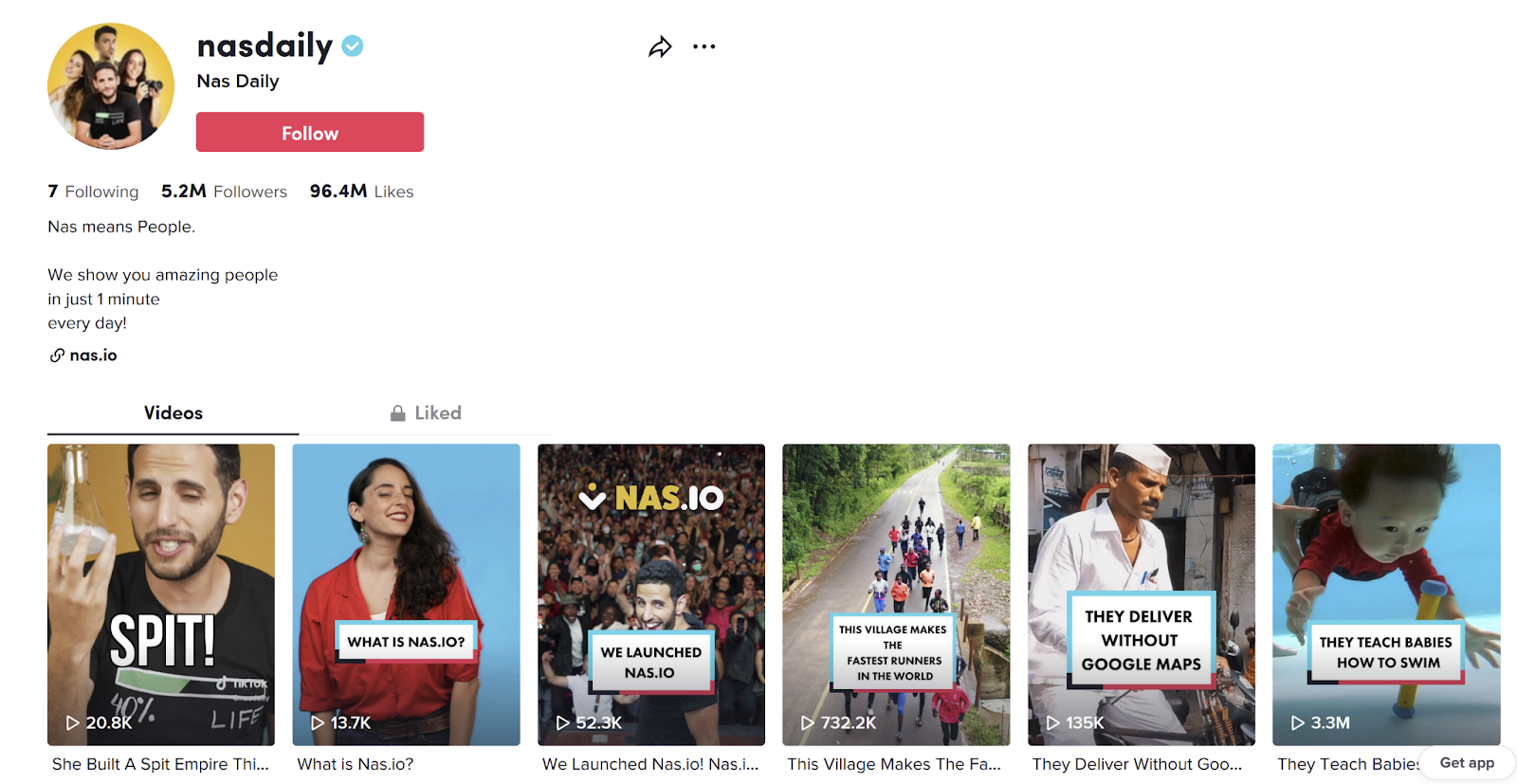
Nuseir Yassin is an Arab–Israeli vlogger who is most notable for creating over 1,000 daily one-minute-long videos on Facebook, TikTok, and Instagram under the page Nas Daily.
Leveraging his fandom with aspiring creators, Yassin found a way to capitalize his own learnings to offer services, courses, and community platform to advertiser brands and up-and-coming creators. He has found the path to directly monetize his audiences outside the walled gardens.
Glenn Edward Greenwald
Glenn Edward Greenwald is an American journalist, lawyer, and author of four New York Times bestselling books on politics and law. He has won numerous awards for his investigative journalism.
After working as a journalist at Salon and The Guardian, Greenwald co-founded The Intercept in 2013 along with Poitras and journalist Jeremy Scahill. He resigned from The Intercept in October 2020 over debates around editorial freedom. Subsequently Greenwald started publishing on Substack and currently has tens of thousands of paid newsletter subscribers with whom he has a direct connection.
Key takeaway
The walled garden of an audience platform provides a springboard for early experimentation and finding your niche as a publisher or creator. But without the ability to build a direct relationship with your audiences, you risk eventual irrelevance on the audience platform.. Finding unique ways to directly monetize your audiences will improve your chances of building a sustainable publishing business.
It is possible that publishers will start to offer their journalists a community management engine where journalists can develop direct relationships with their niche audience. A platform where journalists can offer merchandise, courses, newsletters (of course with publisher co-branding) for their specific niche audiences. Effectively, every journalist could be operating as a creator running mini-businesses inside the walled garden of the publisher.
About the Author
Abhishek Dadoo is a Co-founder & CEO of Fewcents, fintech-for-publishers that brings incremental reader revenue from ‘Never-Subscribers’. He is a seasoned business leader and technology product manager. He has worked in management consulting with PwC and Altman Solon in Boston, USA before moving to Singapore permanently. In Singapore, he started his own venture, Shoffr, a digital marketing solution that provides online to offline attribution for digital marketers. In 2019, Abhishek sold Shoffr to Affle, a publicly listed ad-tech company in India. After solving the advertiser’s offline attribution problem, Abhishek has now set his eyes on solving the content monetization problem for online publishers.


 / An inside look at the business of digital content
 Archive