Over the past few years, publishers have seen formerly reliable sources of traffic like Google and Facebook dry up, with no new platforms on the horizon to make up for that loss. Shifts in user behavior and changes in algorithms have left publishers scrambling to respond across both search and referral channels. And with the rise of generative AI-enabled search, the ability to find new sources of referral traffic and build a loyal audience has become even more critical for publishers.
To gain a better understanding of how traffic declines are affecting them and the steps they’re taking to address challenges, Arc XP partnered with Digiday to survey 115 publishers for the report The state of publisher traffic: Framing the evolution and impact of search and referral in 2024. We asked about the referral traffic trends they’re seeing, how those trends have impacted their revenue, and the steps they’re taking to either rebuild their traffic or find other ways to reach and grow their audience.
In this article, we’ll focus specifically on what we heard from publishers about their referral traffic from social media platforms (like Facebook and TikTok), news aggregators (like Apple News), and other third-party platforms (like Reddit).
Publisher referral traffic trends in 2023
Referral traffic is an important revenue driver for publishers, with 98% of survey respondents saying that referral traffic has a moderate or very significant impact on their annual revenue. But 2023 proved to be a challenging year for publisher referral traffic, with most survey respondents saying they experienced a 1% to 20% decline.
The publishers in our survey experienced traffic declines across the major social media channels. Respondents named Facebook as a channel where they expect continued declines (82%), followed by YouTube (67%) and TikTok (57%). Given Meta’s announcement that it will de-prioritize news content on its platforms, the decline in referral traffic from Facebook is not surprising. And across all social platforms, opaque changes to algorithms have made it difficult for publisher content to stand out among the vast array of options presented to users.
According to survey respondents, the primary ways referral traffic decline impacts their revenue are decreased advertising ROI (63%) and changes in collaborations with brands, influencers, or other publications (54%). They also cited a change in competitive positioning, change in quality of audience, and a decline in social media engagement (each named by 43% of respondents).
How publishers are responding to referral declines
When asked what challenges they face around responding to the trend of declines in referral traffic, 54% of respondents named building/maintaining strong relationships with external platforms as a challenge. This was followed by adapting to social media trends (52% of respondents). Accurately pinpointing referral sources (49%) and constantly changing algorithms and updates (46%) were also top challenges.
Despite these challenges, the publishers we surveyed are forging ahead with tactics to combat referral traffic decline, including experimenting with new forms of video content and increasing their presence across social channels. 81% of respondents said they are experimenting with live streams and long-form video content, and 70% said they are focusing on short-form original vertical video for TikTok, YouTube Shorts, and Instagram.
Long-form video content will ultimately offer publishers more control over monetization options than short-form videos created specifically for social channels. With long-form videos, publishers can incorporate in-depth reporting that sets them apart from other content sources and encourages deeper reader engagement and return visits.
The “pivot to video” isn’t new for publishers. Unfortunately, they’ve been burned before by making big bets on video content that didn’t pan out. This time around, publishers need to think carefully about what they want to accomplish with their video strategy: is it about getting advertising revenue from the videos? Driving readers from other channels to their website? Or creating longer-term audience relationships?
Surprisingly, only 56% of respondents said they are increasing direct-traffic efforts (newsletters, owned podcasts, etc.). Given the inherent unpredictability of social platforms, all publishers would benefit from thinking about how they can build more direct connections with their readers.
Publisher referral traffic expectations for 2024
When publishers look ahead to 2024, they are optimistic that referral traffic will rebound. Most of the publishers we surveyed expect referral traffic to increase by 1% to 20% this year, a trend that will likely driven by newsworthy events like the summer Olympics and the U.S. presidential election.
Publishers’ cautious optimism about 2024 might also reflect confidence in the tactics they’re implementing to combat referral traffic declines. But with platform changes and user behavior shifts it’s likely that referral traffic will never fully rebound to previous levels. Publishers will need to continue exploring ways to boost traffic across all channels, including owned channels that enable direct connections with readers.
When aspiring journalists ask me whether the media is dead, I always say no.
I remind them that while the menu might change, the hunger for news and information never vanishes. To stick with the food analogy, news these days is like UberEats: far more options are available at your fingertips.
Here’s the thing: evolution in the media is constant and ongoing.
Historically, the delivery method has evolved in this industry, from horseback to telegraph and radio to television. Cable news, the internet and social media caused disruptive waves over time. These days, news is on a 24-hour cycle that is no longer limited to cable news. And, now, Artificial Intelligence has entered the chat. (And they are here whether we like it or not.)
Newsrooms ignore the emergence of AI at their peril, as history shows that transformative technologies don’t disappear simply because they’re ignored. Remember in 1995 when Newsweek predicted the Internet would fail? It was already decades into its inevitable march to dominate media consumption.
Technology usually gets better in time, and it has only improved in my 22 years in this industry. We have a greater reach than we could have imagined. I can instantly read what’s happening in any part of this country—or the world. All from a device that fits in my pocket.
Technology and journalism will always travel hand-in-hand. However right now, a lot about the relationship is toxic. It’s not serving us and we need to do some soul searching to fix what’s not working.
Change can be a painful experience
News and information is everywhere, and everyone can share their perception of news. It’s transforming in real time and the growing pains are unrelenting.
The year started with over 500 journalists losing their jobs, according to Challenger, Gray & Christmas, Inc. About 2,681 journalism jobs were eliminated in 2023 alone. That’s a 48% increase from 2022 and a staggering 77% increase from 2021.
Circulation, viewership and listeners have steadily declined for newspapers, broadcast TV news, and public radio. Major online news outlets are trying to stave off website traffic and engagement decreases. The shift to social media platforms for news consumption is particularly noticeable among younger generations. All this before we get to the fallout from tarnished community trust and news avoidance.
Everyone is looking for sustainability.
Same old traffic metrics
Meanwhile, social media referral traffic has plummeted globally over the past two years.
The big picture: News organizations invested heavily in social media for two decades, relying on platforms like Facebook and Twitter/X, but the algorithms were not in our favor. They never loved us half as much as we loved them. We infiltrated these platforms, but social media prioritized advertising over truth and accountability.
Now, logic tells us that AI search could be a death knell for search traffic. Search has served as a major entry point for metrics that have helped newsrooms drive advertising revenue. Audiences have grown accustomed to using Google searches to find links to information. AI, however, can directly answer most questions, and it’s getting smarter by the hour.
The WSJ has reported that publishers might lose 20-40% of their website traffic when Google’s AI products are fully implemented. The loss of traffic from social media and search will likely have devastating effects on this industry.
Some local shops still rely on the same old metrics – the volume of web traffic and the value of a click or pageview – because that’s what we’ve always done. But given how much the landscape has changed, that well is drying up and we need to find a new source.
Rather than wait and see and react to the technological changes coming at us, the industry must redefine its relationship with technology and take some control. Some news organizations have come to terms with this, and others see the value in creating new revenue streams. Diversifying revenue sources is key.
But beyond that, the industry has to be more entrepreneurial and less traditional. Doubling down on the old models is simply not enough.
When we think about rebuilding the infrastructure for news, we should ask ourselves: Could we build our own pipeline to traffic? Is there a way we can empower audiences to share content by building a trusted social media platform for distribution? That’s the thing: We – the news and media industry – have to take responsibility and build the infrastructure we need to create new habits for readers.
Provide audiences with utility
The reality is that news organizations have done a decent job building brand presence across platforms, but there’s no measurement for the value of that. Unfortunately, our success is housed under decaying pillars of success. The entire model must be flipped on its ear. We must reimagine everything. That mindset is why some startups have done more than survive and become a new breed of media success story. There’s a there there.
We spend a lot of time curating audiences we already have and need to spend more of our days figuring out how to capture the ones we don’t. Live events, office hours and panel discussions center the news and make it accessible to more people. It’s a way to expand your brand in a three-dimensional way. Lean into your personalities and their subject matter expertise to establish a more potent value proposition. And recognize that not all change is bad. The trick is harnessing it in ways that attract and satisfy audiences.
We must pay closer attention to evolving media consumption habits. Some people do have shorter attention spans and want brevity. However, that’s not absolute; there’s room for it all.
We use our phones to do everything and email is a new form of currency. Delivering news to a consumer’s inbox via newsletters just makes sense. We have to develop content creation and delivery strategies that fit today’s lifestyles. And then be ready to do it again as things inevitably change.
Newspapers are going the way of the tablet—not the ones Apple makes, but the ones Moses carried when he descended from Mount Sinai. Hieroglyphics, papyrus and wood had a place in history, as did quill pens. We can appreciate Johannes Gutenberg’s contribution and still embrace all the waves of technology that followed.
Diverse perspectives
The pandemic showed us that people need the expertise journalists wield. However, at the same time we see that people increasingly value the perspectives of social media influencers over journalists. We may not like it, but this needs to teach us something. Rather than ask our journalists to be invisible or unobtrusive, perhaps we need to re-examine ways to humanize them for audiences.
The plethora of free options suggests that every media outlet needs to focus on offering more distinctive coverage. No, it shouldn’t be harmful or polarizing. But it has to be inclusive, reflecting more communities that demand to be heard. That’s why so many niche and local publishers have cropped up; to fill a void that was created by arrogance, neglect and an unwillingness to change – a poisonous recipe.
Media has to marry new technology, develop a trustworthy infrastructure for news distribution and create a steady diet of distinctive coverage mixed with utility and expertise and get back into communities.
The media landscape will look different by the end of this year (and the next, and the one after that), but you can’t point to a time in history when information didn’t matter. And you cannot point to a time in civilization when news – no matter its platform – didn’t make a difference.
If we haven’t learned anything else, history tells us we should pay attention.
Consumers value local news media, with a large majority saying that local news outlets are at least somewhat important to the well-being of their local community according to new research from Pew. Most people also say local journalists are in touch with their communities and that their local news media perform well at several aspects of their jobs, such as reporting the news accurately.
Interestingly, Republicans and Democrats both display significant confidence in local reporting, with 66% and 78%, respectively, which showcases bipartisan support. This widespread trust highlights the local media’s role in ensuring accountability and integrity in governance.
Nevertheless, the landscape continues to shift as more consumers engage with local news through online forums and social media groups. Unfortunately, these days intermediaries have moved to the forefront and diminished the direct influence – and perceived value – of news publishers. In fact, a mere 15% of Americans say they have paid or given money to any local news source in the past year – a number that has not changed much since 2018. Oddly, this coincides with the finding that a majority of Americans (63%) say they think their local news outlets are doing very or somewhat well.
Consequently, local news outlets are re-evaluating their strategies to engage audiences effectively. Addressing how local news businesses can adapt, serve their communities, reignite an interest in, and support for, news media to flourish in the current media environment remains a critical challenge for the industry.
Local news is appealing, but to smaller audiences
Around 85% of those surveyed indicate that local news outlets are at least “somewhat important” to the well-being of their local community. Similarly, a majority believe that local journalists are in touch with their communities and perform well in various aspects of their jobs, such as accurately reporting the news.
However, despite reporting significant value and trust, Pew’s trending data shows that the share of U.S. consumers who actively follow local news very closely dropped from 37% to 22% in the last eight years. Additionally, many consumers are unaware of local news’s significant financial challenges. Of these, 63% (slightly fewer than in 2018) believe their local news outlets are doing very well.
Demographics impact the perception of local news
If attention correlates to valuing local news, the industry needs to pay attention to audience behavior. A decline in attention to local news has occurred across demographic groups, though there are significant differences by age. Young adults are much less likely than their older adults to say they follow local news: In 2024, only 9% of U.S. consumers 18 -29 say they follow local news very closely, compared with 35% of those 65 and older.
Americans with higher levels of formal education are less likely than those with a high school diploma or less education to follow local news very closely. While 17% of college graduates follow local news very closely, 28% of those with a high school education or less say the same.
Among U.S. adults ages 30 and older who have not paid for local news in the past year, the most common reason they cite is that they can find plenty of free local news. This is likely influenced by the sharing of local news – or at least information about things happening locally – via social platforms. However, as platforms “distance themselves” from the news, the likelihood of people encountering news from a publisher are increasingly diminished.
While 37% cite the availability of free alternatives, the most common reason given by Americans ages 18 to 29 is a lack of interest: 46% in this group say the main reason they don’t pay for local news is that they are not interested enough in it.
Local news consumption shifts to streaming
Streaming offers a viable outlet for local news. With nearly 40% of U.S. households reachable only through streaming TV, local news can deliver a converged linear and streaming advertising strategy to access the total TV audience in a local market. This shift to streaming enables personalization in local news content while catering to individual viewer preferences. It also allows local broadcasters to monetize local inventory across a broader spectrum of premium publishers, reinventing the advertising paradigm.
The evolving landscape of local news presents challenges and opportunities for the future of journalism. While digitization transforms how news is accessed and consumed, local news’ fundamental role in informing communities remains unchanged. Local news outlets can find new and direct paths to the consumer by adapting to changing consumer preferences and embracing digital innovation. By leveraging technology and engaging more interactively with their audiences, these outlets can enhance their relevance and sustain their crucial societal role.
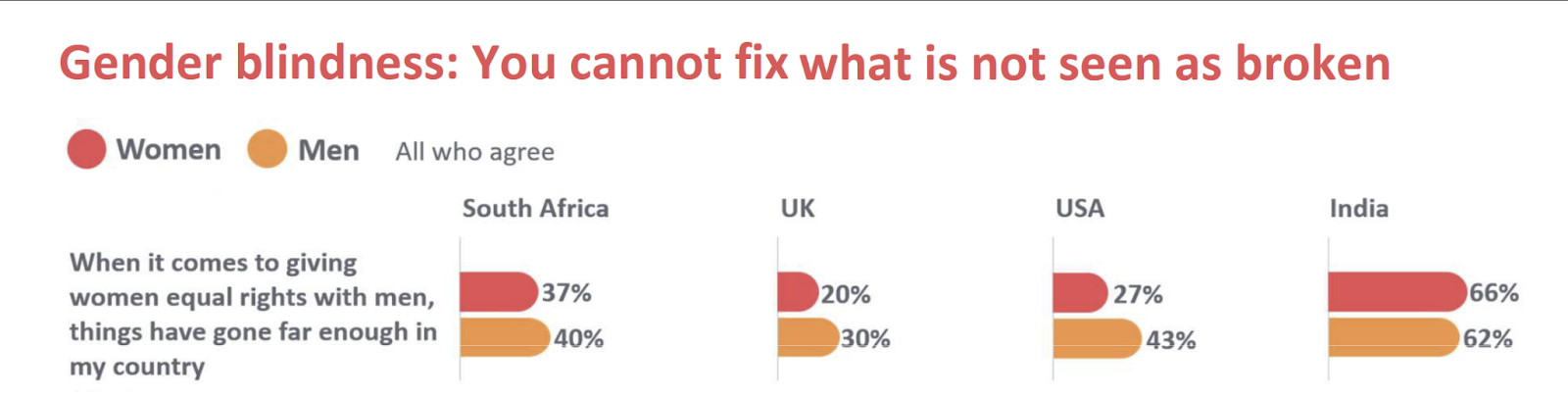
Something is shifting with Gen Z. Data from Gallup shows that in the US, women aged 18 to 30 are now thirty percentage points more liberal than men. That gap opened after decades of a roughly equal spread of worldviews. As media organizations seek to attract, engage and retain younger audiences, understanding what drives them and accurately representing them will be essential. However, as the news media struggles with increased polarization on many fronts, it appears that gender equity is rising on the list of contentious topics.
This divide is a result, and signal of, something more than young women simply becoming increasingly liberal. Research from King’s College London in February showed that, specifically when it comes to attitudes to masculinity and women’s equality, there is a growing division. In some cases, young men today are no more supportive of action on gender equality than older men, despite generally being more socially liberal.
A growing number of people – one in three in the UK– think that gender equality has been “solved.” Yet when it comes to the news, women’s perspectives remain “firmly niche,” according to The Missing Perspectives of Women in News report. “The proportion of people who believe that feminism has gone too far, that equality has been achieved, that’s growing across all groups,” the report’s author and researcher, Luba Kassova told us. “Gen Z young men are leading though: A higher proportion of them seem to think that.”
Women’s expert voices remain significantly muted in high-profile news genres such as politics, where men’s share of voice is up to seven times higher, and the economy, where men’s share of voices is up to 31 times higher. It’s not just female expertise that’s lacking: In 2019, the coverage of gender equality issues constituted less than half a percent of all news coverage in the U.S.
But do news organizations have a role to play in building understanding around gender issues, and closing the gap in attitudes between young men and women? And if so, where do they start? Kassova shared some context around these issues and steps newsrooms can take.
Including missing perspectives
Kassova’s first piece of advice is that newsrooms need to build on the work many already have underway to make sure that those perspectives which are not usually heard, including young women, are part of their coverage. “The more male-dominated the coverage is, the more it becomes a fertile ground for the view that everything is fine, because the news agenda doesn’t reflect the perspectives of women, who tend to be marginalized,” she explained. She notes that her research has shown for every female voice, there are three male voices in online coverage.
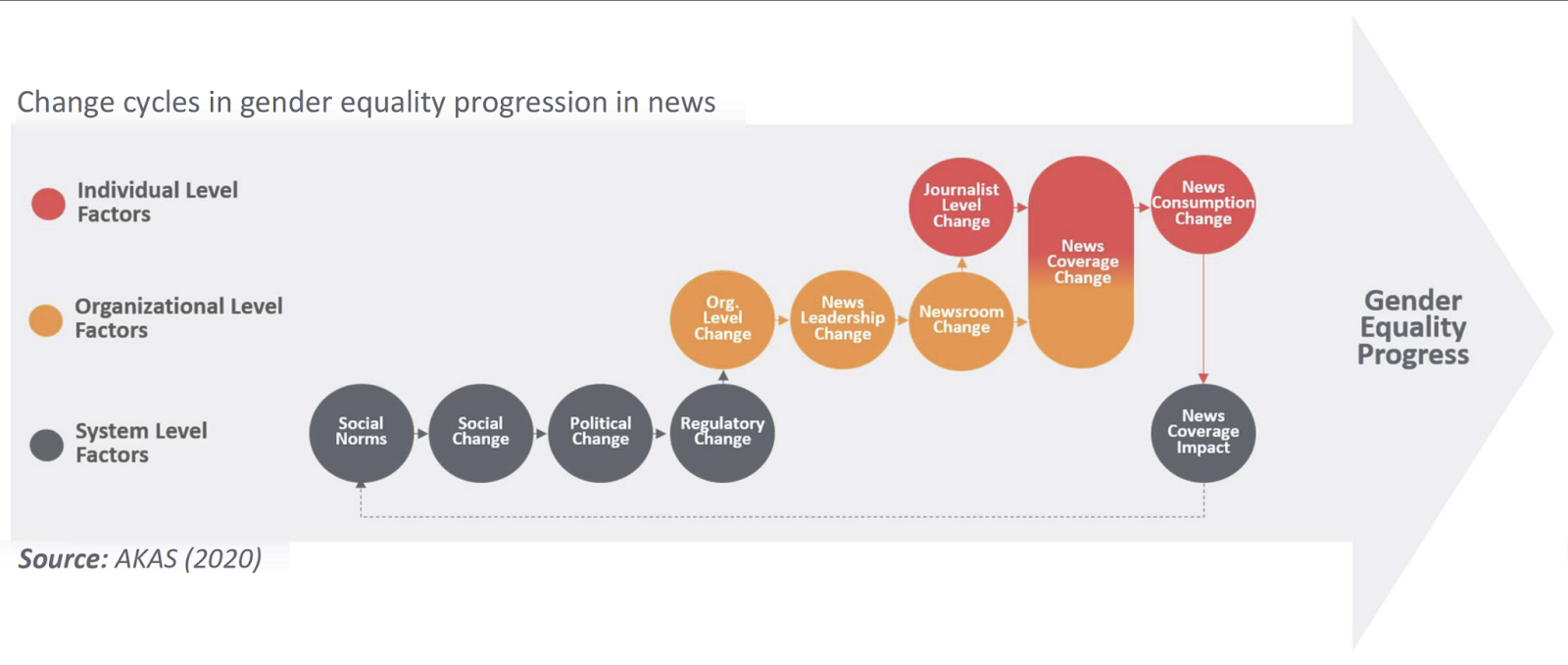
There have been concerted efforts among many organizations to improve diversity across the board, with Kassova’s research showing that a third of women hold top-level leadership positions in newsrooms. However, this hasn’t provided the critical mass previously thought necessary to improve women’s visibility in the news. “The relationship between the number of women in organizational resources, in newsgathering and in news outputs is not linear,” despite previous hypotheses, her report states.
The biggest issue, which particularly impacts younger people, is the culture in newsrooms and news leadership. It continues to be dominated by men who are older, white, educated and richer (MOWERs). “A more homogenous group of people who set the tone, set the culture, set the rules of what constitutes a story, which stories should be prioritized,” said Kassova.
She says that this really inhibits progress when it comes to serving young people. “All these biases lead to substantive organizational challenges, including the under-representation of young editors and reporters, the intersectional invisibility of young female employees, and content of reduced relevance to young audiences,” she recently wrote in Press Gazette.
One starting point when it comes to what to cover is addressing the very strong misunderstanding among people of all ages about what feminism and gender equality is. “There’s a mis-perception that it’s a zero-sum game, where women are elevated at the expense of men,” Kassova pointed out. “There are plenty of publications fuelling that narrative by using condescending terms when they cover either young people, or young men,or men in general. And that doesn’t help.”
“What’s really important is for journalists to educate society as to what it actually means; that it’s not a zero-sum game. There’s so much research that has been done to show that where there is a higher level of gender equality, everyone – including men – tend to be happier, more prosperous, safer… So it’s really important for journalists to act as a conduit for truth and to raise awareness of what feminism means, and what equality means.”
Countering the damaging zero-sum perception involves talking to both feminists and anti-feminists. Kassova explained that journalists covering gender are much less likely to engage with the male perspective of what men find to be troublesome in the narrative around gender. But digging into that can actually unearth some different perspectives and build bridges with reluctant audiences.
“Young people live in different worlds because the social media that we construct for ourselves presents different worlds,” she said. “The only way to bridge that is to reflect people’s different perspectives. And there isn’t enough of that happening. The ideology that we carry too often dictates the sources that we speak to. I think we need to be very mindful to counteract them, to present different perspectives so that everyone feels heard.”
As a practical example, this can be exploring how the millennia-old patriarchy has impacted both men and women. Although women are by far the biggest victims of the system, men suffer from it too. By not engaging with that, we end up with a situation where social issues like the #MeToo movement are presented as a men vs. women conflict.
“We have to stop that,” Kassova highlighted. “You can only achieve gender equality if dominant genders and all genders surrounding work and move in the same direction. What’s happened until now in many feminist narratives is men and women are pitted against each other, very often seeing men purely as perpetrators, and women as victims. And there isn’t a more sophisticated narrative.”
“The way to deal with it is really to be equitable, and to cover issues with compassion rather than judgment. There is not enough solution-based journalism and there is not enough understanding.”
Involve younger audiences in news coverage
With some parts of the news industry contracting significantly, age is something that news leaders have prioritized. But although there is an acute understanding that change needs to happen, this hasn’t always been approached tactically.
“One of the perennial questions strategically is how do we bring younger audiences in?” said Kassova. “But there the conversation tends to be around, how do we make the output that we’ve already thought about, the stories that we’ve already crafted, more attractive to audiences? There isn’t enough self-reflection to look at, what are the organizational barriers that lead us to produce content that is disengaging?”
This links back to the MOWER leadership issue highlighted earlier. The average age of a journalist is 47 in the US, and 43 in the UK, so there is already a generational mismatch between those who produce the news, and those who they want to consume it. But the answer is not necessarily to flock to TikTok.
“What’s really important is for news organizations not to think just about what platforms they go to, but what are the perspectives that haven’t been heard?” explained Kassova. If the structural and cultural issues within newsrooms are addressed, and marginalized perspectives prioritized, the rest will fall into place.
For those who aren’t persuaded by the need to cover underserved audiences, there’s a strong economic incentive too. “Covering more diverse perspectives, and having more equitable coverage leads to increased revenue, because it brings in new audiences,” Kassova pointed out. “There is about $11 billion waiting to be won by the news industry given the consumption gap that exists at the moment: around 11 to 12 percent. If the industry closes this gap by one percentage point a year, then in the next five years, there’s an additional $11 billion to be made.”
We need news coverage that is compassionate and equitable
Polarization in society can be driven by and inflamed by the media. Newsrooms have an important role to play in highlighting women’s perspectives and stories, as well as counteracting some of the misunderstandings and zero-sum arguments around feminism. If these voices aren’t heard, divisions in society, and among younger people, are only going to grow.
“I am a big proponent of equitable coverage and compassionate coverage,” Kassova concluded. “It’s really important because that’s the only way we can actually break the polarization that happens on so many levels; intergenerational, intragenerational societal polarization, global polarization. I think compassion is the glue that will bring us back together.”
One point Kassova was firm on is that more research needs to be done around Gen Z and their attitudes. There may well be growing diverging views within the genders as well, and as an industry, we need to work to understand the drivers of these changes, particularly as we work to build our audiences – and news leaders – of the future.
It has escaped no media executive’s notice that women’s sports teams are on a rampage. However, media leaders may not be investing in coverage of women’s sports and athletes proportionally to the value they deliver.
The 2024 women’s Final Four game between Iowa and UConn garnered the largest audience for any basketball game in ESPN history. More viewers tuned in for the women’s NCAA championship than the men’s – by over four million viewers. Disney sold out of ad inventory going into the Final Four, with women’s March Madness advertising revenue doubling from last year. Women’s Final Four games commanded ticket prices 47% higher than those for men’s games (although not in proportion to seats available); and Indiana Fever rookie Caitlin Clark is currently finalizing an eight-figure deal with Nike.
The stars are not just shining on women’s basketball. The National Women’s Soccer League signed the largest media deal in women’s sports history in November 2023, and Women’s College Volleyball recently shattered an all-time attendance record. More female athletes than males now represent Team USA at the Olympics and they have been winning proportionally more medals.
Influence goes both ways
Support from sports franchises is critical to the development of women’s sports, but so is media attention and investment. While teams and athletes lend their fame to media companies and advertisers, the reputation and popularity of teams and athletes are also influenced by media coverage. Decisions about which Olympic events get covered and which athletes get interviewed impact public perception of female athletes and sports.
The study A Quarter Century of Prime Time’s Summer Olympics examined how women’s sports were framed for audiences over the past 25 years. Researchers analyzed 311 hours of NBC primetime Summer Olympics coverage and found female Team USA athletes were underrepresented in media coverage in proportion to medals won. Representation has soared in recent years though, with equal screen time given to men and women. In fact, two thirds of the athletes and coaches interviewed by NBC at the Summer 2021 Olympics games were female- indicating that women athletes are attracting more than their share of fans.
However, the study found that at the 2021 Olympics, only 24% of the non-athlete sources interviewed – such as anchors, reporters, commentators, and analysts – were female. The sports media field is still largely male dominated, even as interest in female athletes rises. Improved gender equality among sports reporters, commentators, and others in media positions adjacent to athletics could help grow interest around women’s sports even more. It also positions media companies to better take full advantage of audiences’ increased interest.
Female sports superstars drive views
The explosion in women’s NCAA basketball viewership can be attributed in part to fandom for athletes such as Iowa Hawkeye’s Caitlin Clark (now with Indiana’s WNBA team, Fever) and South Carolina Gamecock’s Kamilla Cardoso (now with the WNBA’s Chicago Sky). Interest in the WNBA Draft soared to an all-time high after the record-breaking season, quadrupling the number of viewers for this year’s draft over last year.
Superstars like Clark and Cardoso are bringing home the bacon for those who invested in them. As recently pointed out in an NPR interview, when Clark declared for the WNBA draft, Indiana Fever’s average ticket price doubled. Teams across the WNBA saw bumps in ticket sales at or near sellout levels when Clark is slated to be in town.
Some worry the “Clark Effect” had an outsized impact on the spectacular ratings this past season. However, new stars are on the horizon. Stellar freshmen players include USC Trojan’s Juju Watkins, Gamecock’s MiLaysia Fulwiley, and Notre Dame’s Hannah Hidalgo. Viewers who admired their skills this season are likely to be tuning in next season to follow their progress.
The fandom factor
As fans rally around rising stars of women’s sports, new research emphasizes the importance of fandom among young viewers. According to the 2024 Digital Media Trends by Deloitte Center for Technology, Media & Telecommunications:
35% of young people surveyed say sports team fandom is important to their identity.
Gen Z participants were especially likely to cite fandom as a component of their identity- whether they identified as fans of a sports team, movie franchise, music artist, or video game.
People who consider sports fandom important to their identity were more likely to engage with sports content.
About 10% of those surveyed were dubbed “M & E super fans” – people who consider fandom for a sports team, musician, video game, film, and TV series all important to their identity. These super fans were more likely to pay for streaming subscriptions and on-demand entertainment services. They were also more likely to use multiple social media platforms. While these super fans can have a higher churn rate, they may be attracted to cross-platform experiences and cost-saving bundles, according to Deloitte.
Fans contribute greatly to media hype-building and the development of cross-media franchises. According to the Deloitte study, media companies can leverage the power of fandom in multiple ways.
Seek deeper engagement with and understanding of fans. This might involve more granular interactions via online group forums and discussions.
Discover burgeoning fandoms, nurture and learn from them.
Consider the intensity of fan bases, not just their size. A smaller group of passionate fans may wield more influence than a larger but more casual audience.
Once fandom is established, viewers often remain loyal even when their favorite athletes are off their game. The interest in gymnast Simone Biles and skier Mikaela Shiffrin is proof of that. Even after Biles had to withdraw from much-anticipated 2021 Olympic events due to “twisties” and Shiffrin was disqualified from her two best events at the 2022 Olympics, viewers remained glued to coverage of them, and both continue to thrill fans and score lucrative endorsement deals to this day. As one fan tweeted supportively when Shiffrin had to opt out of the 2024 World Cup Giant Slalom in Australia, “You owe us nothing, Mikaela. Save it for the Olympics.”
Women’s athletics: more than a passing fad
There are many signs that escalating interest in women’s sports is more than just a moment. With fandom increasingly important to young audiences, and female athletes tearing it up on court on field, media and entertainment executives will do well to evaluate their investment in women’s athletics.
Media execs can deepen their investment in women’s sports by bolstering gender equality in adjacent media positions, evaluating their coverage of women’s events and athletes, and nurturing the fandom ecosystem. As Laura Correnti, founder and CEO of Deep Blue Sports + Entertainment, put it in an interview for NPR: “If you build it, they will come.”
Young news consumers understand the value that news can play in their lives, but are often disinterested in it or frustrated with how it’s being delivered to them. It isn’t a surprise that news brands tend to focus on older consumers with larger disposable incomes. However, no one can deny the importance of engaging and building future audiences.
A new report from FT Strategies and Medill’s Knight Lab, “Next Gen News” aims to help news media producers understand the needs and behaviors of younger news consumers so that they can better serve these news consumers. particularly as they come to dominate content consumption in the future. The report also points to the fact that we frequently see the behaviors and preferences of younger consumers eventually adopted by older ones as well, which gives their attitudes additional weight.
Emerging behaviors of young news audiences
The research finds that the next generation of news consumers exhibit four key emerging behaviors:
1. Digital simul-tasking
They fluidly transition between dissimilar tasks (messaging friends, buying things, playing games, catching up on socials, listening to a podcast) while they’re on their phones.
2. Sensemaking via digital discourse
They rely on the personal opinions of others in digital contexts to frame and understand the news.
3. Filtering through trusted networks
They seek out sources of information from people that they know, or feel like they know (e.g. their favorite creator), in real life.
4. Sophisticated searching
They have honed their own sophisticated search skills on social media platforms and in online communities to avoid information overload.
What young consumers need to navigate news
To navigate information, the research found that younger audiences also adopt different modes of consumption which can occur throughout the day to satisfy different news needs:
Sift
They need simple, low-effort ways to keep up with and discover relevant news.
Substantiate
They need straightforward ways to follow up on and verify news that has sparked their interest.
Study
They need access to content that educates, upskills and inspires them (when they want to dive more deeply).
Socialize
they need information that they can share that makes them feel current, connected and socially validated.
Sensemake
They need different perspectives and other accessible ways to process and understand complex topics.
The ideal news experience for young audiences
Most news producers operate under the assumption that young audiences’ news consumption takes place on mobile phones and is primarily accessed through social media and video. While the research points out that this approach is not wrong, they found that it lacks the level of nuance required to build significant audiences for the future.
After extensive experiments and interviews with 45 young news consumers, the researchers found that that the ideal news experience for the 18-25 year old respondents revolved around three important factors: trusted source, personal significance and desired storytelling.
Rebuilding trust with young news audiences
For most media organizations today, the issue of trust is of particular concern. Traditionally news brands have relied on trust signals that lean into brand and credentials and actually avoid any personal information about the makers of news. However, younger news consumers may be more inclined to trust reporters over monolithic brands, particularly if they are more transparent about who they are. In fact, it might be beneficial to news organizations to help journalists build their personal brand.
The report suggests that media brands might better make use of the lived experiences and personal stories of journalists and other subject matter experts to build deeper connections with the next generation. However, they point to the difficulties of achieving this without undermining journalistic notions of balance and fairness.
News that matters to young audiences
Deciding what stories matter most has also long been the provenance of news providers. It is common to assume everyone is interested in “hard news” (or believe that they should be) and therefore over-index on reporting of topics like politics, international affairs, economics, and science. It is important to recognize that while younger news consumers know that these are important topics, they are bombarded with content and seek out a personal connection to information to give it relevance that will allow it to rise above the noise.
By adopting a broader definition of news that incorporates infotainment and giving more space to “soft news” topics, news brands can better engage younger audiences and provide entry points into more difficult topics that serve different life stages. These audiences want to understand how a piece of news directly impacts their life and those around them. They also appreciate context and explainers that help to bridge gaps in their knowledge. And they want to feel that they can take action; that they are part of a solution working with their community on big social, political, and economic issues.
Storytelling formats that engage young news consumers
Historically, news producers have sought out singular and uniform formats that would attract younger audiences, such as the industry-wide “pivot to video” in the 2010s. However, the research found that format preferences were dependent on several factors, not least the mode that consumers were in. For example, those in the Sift mode may be more likely to look for short form videos or TLDRs, while consumers in the Study mode are more likely to consume long-form podcasts.
To meet the needs of younger audiences, news producers must acknowledge that there is value in a diverse portfolio of formats that match an individual’s preferences or situation (time of day). In other words, they must not default to any one storytelling structure that doesn’t align the kinds of emerging styles and formats that are growing in popularity. And it is critical that news organizations adopt an experiment-led approach that allows them to validate audience demand.
The time to act – to attract young news audiences – is now
Certainly, we have seen that consumer behavior and expectations shift as each generation matures. However, the authors of the “Next Gen News” report point out that news producers can’t afford to wait to build relationships with younger audiences. Instead, they need to make the effort to meet them where they are now to be perceived as a trusted ally moving forward.
It is critical to understand the shifting information consumption trends shaping the expectations of younger news consumers. By developing trust-based relationships on their terms, news brands can engage and interact with these audiences now. This requires adapting to the information environment they live in, and adopting an open, experimental mindset that maintains the values of quality news while adapting to serve the next generation of news audiences.
n the rapidly evolving digital landscape, content producers constantly seek new ways to engage with audiences and promote their brands. That’s especially important right now as traffic continues to fall from sites such as Facebook and Twitter/X.
One weapon in their arsenal with some powerful potential is LinkedIn, a site that may offer a higher likelihood of referrals and engagement than some publishers have historically considered.
2. LinkedIn users tend to be millennials and professionals
LinkedIn is typically described as a social network for business professionals. As a result, it doesn’t yet attract much of Gen Z, but it is a site they transition to as they enter the workforce. Worldwide, 60% of users are in the advertiser-friendly 25-34 age bracket.
In the USA, a 2023 survey by the Pew Research Center found that 40% of 30-49-year-olds had used the site. That’s on a par with Pinterest (40%), TikTok (39%) and WhatsApp (38%) and some way ahead of Twitter/X (27%) and Snapchat (30%), platforms many publishers continue to invest considerable energies in.
3. Around 1 in 5 American users harness LinkedIn for news
Further data from Pew finds that 17% of U.S. adults using LinkedIn regularly get their news on the platform. Interestingly, in contrast to other social networks, LinkedIn has the greatest gender parity among news consumers.
Its news audience is not huge, c.5% of U.S. adults. However, this is on par with Snapchat (4% of the total adult population) and WhatsApp (3%).
The site also offers a more educated demographic, 60% of regular news consumers on LinkedIn have a college degree, and just over half (53%) of their users enjoy a household income over $100k per annum. For many media companies, these are appealing demographics.
Many media companies will already be using some of the most obvious functions on LinkedIn. This includes posting job ads, sharing company news and creating business landing pages.
Those functions will continue to be useful. However, they only scratch the surface of some of the wider potential the site potentially affords publishers and creators.
Tactics for publishers to try on LinkedIn:
1. Publish newsletters
Image via The Economist on LinkedIn. Screenshot 3/18/24.
“In the past year, LinkedIn has seen a 150% increase in the number of newsletters being published by publishers and journalists on the platform,” Axios reports.
These newsletters might be native to LinkedIn, offer a remix of content produced elsewhere, or simply be republished on the platform. Audiences can read them on the site, or have them emailed to them. Either way, they can potentially reach large, professional, audiences. Users have more than 450 million newsletter subscriptions on the platform. That’s up 3x year-on-year.
The Wall Street Journal’s Careers & Leadership newsletter, for example, has nearly 3 million subscribers and over 100 editions on LinkedIn. With the WSJ’s company page enjoying 9.7 million followers, that’s a high percentage of users who are digging deeper.
Another LinkedIn behemoth, The Economist, reaches over 3.1 million weekly subscribers with its “week ahead” newsletter, while Harvard Business Review’s Management Tip of the Week reaches over 5 million subscribers with a short article that takes just 1-2 minutes to read.
The pandemic demonstrated the potential for publishers to livestream events. Although we have seen a renewed interest in the ability of in-person events (particularly to diversify revenues), many media companies have retained an online component. Some media providers, like Harvard Business Review, continue to run live events that remain 100% virtual.
The Forbes Sustainability Leaders Summit & sponsor list, via Forbes
Online-only, or hybrid events, are more inclusive, helping to overcome geographic boundaries. But they also present additional income streams.
Forbes, for example, attracted several blue-chip sponsors for their Sustainability Leaders Summit last Fall. If you were unable to attend in person, you could view a live stream on various platforms, including LinkedIn, sponsored by Toyota.
Events, newsletters and posts by a company – or its staff – offer multiple means to engage with users on LinkedIn. Aside from blasting them with news and information, they’re also a space to dig beyond the analytics to garner insights from your audience.
As Meredith Turits, the former editor of BBC Worklife – a vertical that includes the Worklife 101 newsletter – explained to Nieman Lab last year “content that does well is, of course, shared and clicked on, but some of our most important insights come from the comments on the newsletter,” she said. “We’re always looking at conversation in the comments or shares.”
These audience insights can shape future editorial efforts. Moreover, by sharing content that stimulates discussion and offers insights from LinkedIn members, publishers can act as a convener for conversation. That’s an approach in line with the goal of many publishers to move beyond scale by developing direct relationships with audiences.
“Don’t treat it as a traffic play, full stop,” Turtis advises. “One of the things that’s most unique about LinkedIn is that people want to talk, and will talk — it’s UX makes that easy and encourages it.”
4. Drive referrals, subscribers and registrations
Posts on company pages, the feeds of the people who work at them, as well as newsletters published on LinkedIn, can all play a role in encouraging audiences to dig deeper.
USA Today’s weekly consumer news newsletter, The Money, breaks down stories from the past week, and includes links to other USA Today stories. It also highlights that you can sign up for a daily newsletter offering more of the same, more often.
Other outlets, like CNN’s PM Plug In, lean into when audiences might be using LinkedIn. In this instance, providing “a weekday newsletter to catch you up on important news you may have missed during your busy day.”
Meanwhile, Business Insider uses the platform to offer a “shorter version of our flagship newsletter,” which they then encourage readers to sign up for.
The Economist ends their newsletter with a registration link offering three free articles a month, as well as linking to their main subscription page.
Collectively, these approaches demonstrate some of the different ways that publishers are using LinkedIn to support their wider engagement and revenue strategies.
5. Humanize your brand and staff
In some instances, LinkedIn may be your first engagement with a company. A good initial impression can matter, therefore, in terms of attracting potential consumers, subscribers and prospective employees.
Because of this, some media companies are making their LinkedIn presence more personal and approachable.
The Editor’s Digest, a newsletter from the Financial Times, sees an editor pick their top stories from the FT that week. Each hyperlinked newsletter is simply signed off by the author using their first name (e.g. Patrick, or Roula). It offers a casualness one might not expect from such an august brand, even if I personally would love to know their surname and job title!
Elsewhere, Nicholas Thompson the CEO of The Atlantic publishes a monthly newsletter that highlights his picks of The Best Things To Read. Most of this content is from places outside of The Atlantic, increasing its usefulness and making it feel much less like a PR exercise. Thompson also posts casual hot-take videos on different topics, which also makes him – and by osmosis his publication – more accessible and relatable.
Moving forward
According to Daniel Roth, LinkedIn’s Editor in Chief, the platform works with 400 preferred news partners to help maximize their work on the site. These efforts, as Axios reports, include sharing trending topics with partners so that they can tap current audience interests, as well as featuring content on LinkedIn News.
However, for content creators not in this club, there are still multiple things you can do to leverage LinkedIn more effectively. Journalists can get free training on how to use the platform, as well as a free premium membership. They can also use the platform to promote their work, and the work of others, as well as engage directly with audiences.
Your digital and social teams can – and should – do that too. Newsletters, events and posts can create high-quality, relevant content that resonates with LinkedIn’s professional user base. In doing this, outlets may reach new audiences as well as serve existing ones. That can drive traffic and engagement, increase subscriptions and take-up of other products.
Image via Reuters Institute for the Study of Journalism
As a result, according to the Reuters Institute for the Study of Journalism, more media companies are investing in LinkedIn. A survey of 314 media leaders in 56 countries, revealed that four in ten (41%) of executives said they would be putting more effort into the platform in 2024. This is only just behind the proposed prioritization in YouTube and Google Search.
As Sara Fischer the senior media reporter at Axios recently put it, “LinkedIn alone won’t be able to make up for the dramatic reduction in traffic referrals from social media sites to news publishers, but it does offer outlets and journalists a platform to meaningfully grow their audiences amid a broader tech crackdown on news content.”
Put another way, as the tech journalist Ryan Broderickoutlined earlier this week, “the traffic firehose days of the 2010s aren’t coming back. And LinkedIn is not the secret to infinite pageviews.” But, he adds, “finding a home for news publishers in 2024 isn’t about finding a perfect fit, but rather finding one that’s close enough.”
For some content creators and media companies, that might just mean leaning more into LinkedIn in the year ahead.
In Hollywood, where creativity meets commerce, diversity is a central theme, not just on the screen but also behind the scenes. Box-office numbers demonstrate the power and profits wielded by audiences of color and women: People of color dominated opening weekend sales for 14 of the top 20 films in 2023, while while female moviegoers dominated sales for three films in the top 10, according to the latest Hollywood Diversity Report.
UCLA’s annual Hollywood Diversity Report, now in its eleventh edition, offers insight and guidance for the industry in representation, inclusion, and profitability. This report examines diversity within Hollywood’s top films and TV shows, showcasing the realities between demographics and the bottom line. It delves into dimensions such as race, ethnicity, gender, age, sexual orientation, religion, and disability status. The study offers a better understanding of Hollywood’s diverse landscape using data from sources like The Studio System, Variety Insight, IMDb, comScore, and Box Office Mojo. The report provides valuable insights into the industry’s efforts to reflect society’s diversity by tracking data and their correlation with audience preferences.
Cast diversity
Despite the demonstrated success of diverse casts, the report highlights disparities in gender representation. Despite significant gains, women’s share of top theatrical film leads declined to 32.1% in 2023 from 38.6% in 2022. This decline underscores women’s ongoing challenges in securing prominent roles within the industry.
Moreover, the report delves into the representation of individuals with disabilities, an area that has historically received less attention. While the report shows some progress, adults with disabilities remain underrepresented as theatrical film leads in 2023. Only 7.1% of all top theatrical film roles include actors with a known disability.
Further, the report uncovers disparities within racial and ethnic groups and gender identities. While certain groups, such as Asian and MENA (Middle East and North Africa) individuals, approach proportionate representation, others, including Black, Latinx, and multiracial individuals, continue to face significant underrepresentation.
Budget allocation and financial performance
Budget allocation also emerges as a factor affecting diversity within the industry. The report underscores the correlation between diversity and box office success, revealing that films with casts featuring 31 to 40% BIPOC (Black, Indigenous, and People of Color) enjoy the highest median global box office receipts. Notable titles include Barbie, The Hunger Games: The Ballad of Songbirds & Snakes, and Shazam!
However, films with BIPOC leads are also likelier to have the smallest and largest budgets, highlighting the uneven distribution of resources and opportunities for diverse talent.
In addition, BIPOC audiences emerge as a critical demographic for the industry, with most opening weekend domestic ticket purchases by BIPOC moviegoers for seven of the top 10 and 14 of the top 20 films in 2023. Additionally, films featuring casts where more than 30% of the actors are BIPOC account for nine of the top 10 and 15 of the top 20 films at the global box office.
Global distribution and the importance of intersectionality
The report also sheds light on disparities in global distribution and representation, revealing that top theatrical films with Black and Asian leads are less likely to have distribution in China compared to other racial and ethnic leads. However, films featuring Latinx and multiracial leads are more likely to have distribution in China.
Moreover, the report highlights the importance of intersectionality. Films featuring casts from 41% to 50% BIPOC post the highest median domestic box office, and those with casts from 31% to 40% BIPOC dominate the international markets. These findings challenge the notion that “diversity does not travel,” emphasizing the global appeal of diverse storytelling. As the industry continues to navigate the dynamics of diversity and representation, this report serves as a vital resource for understanding Hollywood’s evolving landscape. Overall, the report offers insights into the state of diversity in Hollywood and the challenges in achieving true representation. Looking closely at this data shows that having various types of people in movies and TV contributes to their popularity, and profitability.
From Google to Facebook and Instagram to TikTok (and so many more), publishers have spent the last couple of decades chasing their audiences from one platform to another—only to be betrayed by changing algorithms and shifting platform priorities. For years, popular wisdom held that you had to go where the audience is. Now, despite the fact that audiences (particularly younger ones) seek out news and information on social platforms, those platforms are “backing away” from making that content visible. But regardless of a media brand’s position on social media, search has remained the undisputed path to traffic.
Now, publishers face a whole new threat: generative AI search. Years of fine-tuning search engine optimization strategies may all be for naught as Google embraces AI-driven answers in lieu of links to relevant content. Meanwhile, Gartner predicts that traditional search engine volume will drop 25% by 2026 as users shift to AI chatbots and virtual agents for their answers.
The Wall Street Journal reports that publishers expect a 20% to 40% drop in their Google-generated traffic if the search giant rolls out its AI search tool to a broad audience. So, what are media executives supposed to do in the face of yet another shift in the technology landscape that threatens to put them on the outs once again? There’s really only one solution: devise a plan to regain control of their audience relationships once and for all.
Discovery: a problem as old as algorithms
AI search has yet to reach its full potential, but referral traffic is already taking a hit. AI-driven search results that fail to link to the content they scrape from is just one part of the problem. Searchers are often satisfied with AI “answers” and have little need to click through for more. And platforms from across the web are trying to keep more users within the walls of their gardens, and that means the likes of Facebook and Google have gone from partners in traffic acquisition to the opposition.
“We’re seeing an industry in real crisis,” says Jim Chisholm, a news media analyst. While Chisholm says he is not seeing evidence that AI is impacting traffic just yet, that does not mean publishers are not already feeling the squeeze from elsewhere.
Liam Andrew, Chief Product Officer at The Texas Tribune, says that while his team expects generative AI to impact search traffic, they are still waiting to see a substantial impact. The bigger problem facing the Tribune now is social media traffic or the lack of it.
While social platforms across the spectrum are pulling the rug out from under publishers, our old friend search is slowly changing the rules of the game. “Search is still working,” Andrew says. The Texas Tribune sees that explainers and guides still drive traffic and even subscriptions. However, other sites have not been so lucky.
Back in October 2023, Press Gazette found that of 70 leading publishers, half saw their search visibility scores drop—and 24 of those saw double-digit dips. That was the result of one update—more bad news is certain to follow as new updates make their way to the masses.
AI bots: To block or not to block
Publishers may be preparing for a more significant battle when it comes to traffic. However, right now, there’s another fight on their doorsteps: bots are crawling their sites and using their work to train the AI poised to steal their traffic. Some are already taking steps to stop the free—and possibly illegal—use of their content. The Reuters Institute found that 48% of the most widely used news websites across 10 countries blocked OpenAI’s crawlers by the close of 2023. Far fewer—just 24%—blocked Google’s AI crawler.
For Andrew and The Texas Tribune, blocking AI crawlers is not a major concern. They already have an open-republishing model and are used to seeing their content scraped and used on other sites (often without the requested attribution). “It improves our readership and impact, but we compete with ourselves for SEO,” he says. He also says they see versions of their stories on news sites where the content is entirely AI-written. However, it is “not affecting our core audience traffic,” according to Andrew. So — at least for now — The Texas Tribune is not planning to block the bots.
Meanwhile, Google is reportedly paying publishers to use its AI tools to write content. While in the short term, this may offer (smaller) publishers relatively small sums as well as an easier way to create low-lift content, like other Google News Initiative (GNI) projects, there’s an underlying concern that Google is not focused on publisher health in the long term.
Developing a direct-to-reader strategy
As Andrew and the product team at The Texas Tribune look toward a less search-dependent future, they are changing strategies. For 2025 and beyond, “we are not going to be focusing on a really good SERP [Search Engine Results Pages] unnecessarily,” Andrew says. Instead, they’ll focus on products built directly for readers.
“Newsletters have been part of our model for over 10 years. It’s nothing new, but we’re continuing to see success with it,” Andrew says. Not only do the newsletters still drive traffic, but they also drive conversions. Subscribers become members at a higher rate, vital to a publication that does not depend on paywalls for revenue.
DCN conducted an informal survey on concerns around the impact of AI search on traffic, and while the sample size may not hold up to scientific scrutiny, it was clear that newsletters are a crucial tactic for publishers looking to own their audiences. Other stats suggest this is a good move. Storydoc research found that 90% of Americans subscribe to at least one newsletter. That number goes up for younger audiences as 95% of Gen Z, Millennials, and even Gen X receive newsletters, compared to 84% of Baby Boomers.
Experiment with engagement approaches
The solutions to the Google problem don’t end at email, though.
“We also have a big robust event system,” Andrew notes. The Texas Tribune holds dozens every year. They range from “pre-gaming the Texas primary” to deep dives into transportation in the Austin/San Antonio area. They gather experts and pundits to share their expertise on topics that interest readers. The team also live-streams these events — a universally important tactic for engaging younger, more diverse audiences. These events also turn out to be effective for converting casual readers into subscribers and members.
Andrew alluded to products his team is working on that are still under wraps. Still, it’s clear that, like many publishers, The Texas Tribune is preparing for a future when search no longer drives most traffic.
Chisholm thinks mobile apps are another excellent direct-to-reader strategy, and research backs this up. Pew reports that “A large majority of U.S. adults (86%) say they often or sometimes get news from a smartphone, computer or tablet, including 56% who say they do so often. This is more than the 49% who said they often got news from digital devices in 2022 and the 51% of those who said the same in 2021.” Cultivating a relationship with readers through their mobile devices—where you can use push notifications and other native capabilities to grab their attention—will likely be one of the many tools publishers must deploy going forward.
“I’ve been in the news industry – which I love – for 48 years. Now we are at a crossroads,” says Chisholm. “Either we choose the road to recovery, rebuilding relationships with our readers, or we continue down the road we are on, subject to algorithms, more confusion between legitimate news and social media infested with AI nonsense.”
Social platforms and creator-generated content are undeniably popular among audiences. In particular, digital-native platforms and individual creators resonate strongly with younger demographics, who increasingly consume content on mobile devices. A newly released study, 50 Richest Content Creators, highlights this dynamic and the rise of digital content creation. The report examines the earnings, follower count, efficiency, and platform preferences of the top 50 creators, offering a comprehensive view of the growing creator economy.
From June 2022 to June 2023, the top 50 social media content creators collectively earned $700 million. With a combined follower count reaching 2.92 billion, these creators average an impressive $239.68 per 1000 followers. Digital media companies must examine creator-generated content and identify what appeals to their target demographics. Understanding this appeal and relevance is crucial for media businesses to capitalize on new content opportunities.
Top performers and platforms
The study highlights TikTok, YouTube, and Instagram as these influential creators’ primary platforms. TikTok emerges as the frontrunner, commanding 40% of the total followers (1.2 billion), followed by YouTube at 24.8% (724.8 million) and Instagram at 22% (642.2 million). Interestingly, most creators are millennials (56%), followed by Gen Z (40%) and Gen X (just 4%).
Jimmy Donaldson, also known as MrBeast, is the highest-earning creator, earning $82.3 million and having 377 million followers. Others like Rhett & Link, Preston Arsement, and Ryan Kaji follow closely, each earning $35 million and having follower counts of 51 million, 39 million, and 36 million, respectively.
Elliot Tebele, the founder of FJerry LLC and a prominent figure in meme culture, expands beyond content into business ventures ‒ board games and Jaja tequila. He has a total of 25.6 million followers across platforms and earns $1,172.20 per 1,000 followers, amounting to $30 million in earnings in 2023. Tebele’ brand extension and business ventures showcase cross-over opportunities in other business verticals.
Diving into the creator economy
The report highlights key areas for media companies to explore when navigating the creator content ecosystem. Examining each area will help formulate a media brand’s creator content strategy to best align with evolving consumer behaviors and preferences.
Platform preference: Understanding why top content creators favor certain platforms shows the shifting dynamics of social media. User trends, engagement, and content consumption highlight the potential for audience reach and monetization.
Generational trends: Identifying the breakdown of top creators by generation sheds light on the demographics of content creators and their audience. Marketers can use these profiles to target their products and services to specific demographics.
Economic impact: Analyzing content categories will help identify broad and niche categories and new opportunities. This will also provide earnings by top content creators.
Monetization metrics: Analyzing “Earnings per 1K Followers” to provide information on how effectively creators monetize their content and audience. This metric is a clear and powerful sign of a creator’s talent in turning their audience into valuable financial returns because getting the most value from followers is crucial.
Global perspective: While the data predominantly focuses on creators from the U.S. (representing 80% of the top 50 creators), understanding these trends can be crucial for international expansion.
Embracing and leveraging creator content enables media companies to enhance their competitiveness within the digital landscape. Careful analysis, identification, and alignment of appealing creator content can deepen audience engagement and loyalty. Furthermore, creator content presents opportunities for revenue generation through partnerships and sponsorships, providing avenues for diversifying revenue streams.
The proportion of people avoiding news content is alarmingly high. According to the latest Reuters Institute Digital News Report, the public self-reports high levels of selective avoidance: 36% of people in the surveyed markets avoid the news “sometimes” or “often.”
That has implications for news organizations seeking to grow, engage, and inform audiences. That, in turn, limits the ability of those titles to hold power to account.
Rasmus Kleis Nielsen is Director at the Reuters Institute for the Study of Journalism at the University of Oxford. He is also the co-author of a new book entitled Avoiding the News: Reluctant Audiences for Journalism, which delves deeper into the causes of and solutions to news avoidance in greater detail.
In an interview about the book, he tells me that the idea arose from his work on the annual Digital News Report. “We noticed that in the United States almost 10% say that they use news less often than once a month or never. And as someone who believes firmly in the importance of journalism, and who used to think that everyone engaged with the news… I just kept staring at that figure.”
So, he set out to learn more, asking “Who are these people? Why do they say they use so little news? And how do they navigate the world without it?”
He found that, while the impact of public disengagement with newspapers’ missions are the most obvious consequence of news avoidance, it has less immediately apparent implications for media business models. It presents challenges around propensity to pay for news, keyword blocking – and that does not begin to account for the societal impact of citizens choosing to avoid essential news and information.
His research also found a variety of causes for news avoidance among the public, whether that was selectively or constantly. Nielsen says that the majority of news avoiders do not avoid media in general. Rather, there is something specific about news content that repels them.
The psychological impact of negative news
One of the most prominent is that news content can create psychological stress among sections of the audience who are ill-equipped to deal with it. Whether that is as a result of wider social pressures in their lives or simple exhaustion from work, Nielsen says a proportion of respondents believe they have no mental availability to engage with news content:
“What they often seek from the media is something pleasant, something that can help them recharge and renew, as they face another day of often very demanding tasks that they have to take on to provide for themselves or families.”
That is exacerbated by a perception that news content is primarily negative. The adage that “if it bleeds it leads” is undeniably true – perhaps ever more so in the age of social media. However, the trade off for news publishers is that a subset of the audience will disengage from negativity entirely.
So when the news is perceived to be overly negative audiences will choose to avoid it. That feeds the perennial problem of keyword blocking among advertisers, who also seek to avoid association with that negativity – even when the coverage is entirely warranted by a need to inform the public.
Blacklisted, by readers and advertisers
Nielsen acknowledges that news avoidance is not a phenomenon that exists in a vacuum. It feeds into those other issues like keyword blocklists: “We could probably write a whole separate book about advertisers avoiding the news. But at the end of the day, publishers who are relying on advertising will have to consider the reality that much of the public and many advertisers aren’t interested in being next to pieces of journalism that they regard as being divisive and depressing and perhaps not that valuable.”
In Avoiding the News Nielsen and his co-authors acknowledge that, in the case of people’s attitude to media, “perception is reality.” But in line with their recommendations to publishers, they also suggest potential solutions to these issues, one of which is to take a more positive approach to coverage to prevent that disengagement:
Neilsen says that “there is a good case to be made that that media literacy has been very focused on helping people be critical, which is important. But there is a companion [argument] that it’s about helping people be affirmative, about making decisions about what’s good enough in a world of imperfect choices of information.”
Payments, perception, and representation
Another prominent cause of news avoidance is that the public – still – does not feel represented by the news. They do not believe it is either by or for them. Nielsen explains: “There is a very clear sense amongst many of our interviewees that news isn’t for people like them, that news is for people who are older, who identify as male, for people who are well off.”
He likens it to the way that some people say classical music or contemporary art is something that’s “perfectly fine for other people, but it’s not really for people like me.”
That, too, has implications for media business models. An increasing number of media organizations seek to build out subscription models. However, the perception of a lack of representation shrinks the total addressable audience, limiting the potential for converting significant numbers of readers to members or subscribers.
It goes back to what Nielsen describes as a discussion around “identity and ideology.” He notes that the belief that news is not representative is not universal, nor is it unique to either left- or right-leaning audiences. Instead it comes from a wider societal sense of disenfranchisement: the perception is stronger among right-leaning people in the U.S., but among left-leaning people in the U.K. Nielsen attributes this in part to the fact that the U.K .press is perceived to skew right more generally.
However, he points out that “In the U.K., in the U.S., large parts of the public are disenchanted with politics, and they see news as intertwined with politics not in an independent from it. And that sense of alienation from politics in turn informs their relationship with journalism.”
As a result the authors of Avoiding the News say that one potential solution is that the industry needs to recognize that it currently does not speak to as wide an array of people as it could: “It is within the power of journalists and editors to think about ‘what are the sources that we feature?’ ‘What are the topics that we feature?’ ‘How do we write about communities near and far?’ And ‘is it worth more proactively trying to address these very vocal and consistent and long standing concerns many parts of the public have?’”
Community engagement and games we play
Another factor in news avoidance lies in sections of the public not being part of any “news communities.” Nielsen explains that “They don’t get any social affirmation or reinforcement, the way that many white collar people with high levels of formal education move in circles where they’re constantly affirmed that engaging with the news is important and it makes us kind of a better person. It’s not only right, it’s also righteous.”
For news organizations whose audience acquisition and retention strategies rely on bringing audience members into their own news communities, that presents a problem. It is one thing to introduce someone who already interacts with other people around news content into the fold; it is another thing entirely to create that behavior in people.
Membership-based organizations like the U.K.’s “slow news” brand Tortoise rely in part on using their engaged members as ambassadors for the brand.
However, as the success of the New York Times’ cooking and games apps make clear, news content is not the only thing that draws new audience members into the fold. Adjacent products like crosswords – which make community high scores etc. part of their appeal – are ways to sidestep this issue and potentially engage those audiences at a later date.
This time, it might really be personal
News avoidance has risen in priority among media companies’ priority lists over the past few years. On February 27th in the U.K., a House of Lords committee into the impact of technology on news saw it raised as a problem that needs to be overcome, for example. While much of that concern is predicated on the impact on the efficacy of journalism, the subtext is that news avoidance is contributing to media companies’ revenue woes.
Nielsen says that while a lot of the reasons for news avoidance are societal and structural rather than as a direct result of media companies’ decisions, there are still actions editors and journalists can undertake to mitigate it:
“I know that many journalists and news organizations feel a bit uneasy about ideas of personalization. [But] if news media and journalists want to serve everybody, they probably need a more differentiated offer including packaging things for people who may want to hear some things that did not go wrong in the world yesterday before we get to things that [did].”
Ultimately many of the potential solutions presented in the book lie in doubling down on journalism’s promise: to represent the whole public, not just the most affluent members of society, and to ensure that readers and viewers feel that representation.
Nielsen says: “I also would just invite journalists and editors to read some of what citizens told us in our interviews as we feature in the book, because I think on closer inspection, some journalists and editors may admit that people have a point about some of their criticisms of journalism.”
As publishers look for ways to accelerate audience growth, engagement, and monetization in 2024, they have a multitude of options for driving change and innovation. Last year I worked with Nick Nyhan, Managing Director and Co-Founder of Upside Analytics, to develop a model for roadmapping the innovation journey in the publishing industry. As part of that effort, we uncovered some key strategies and ideas that publishers can use to accelerate their organizational velocity in the coming year across three areas: audience growth, audience engagement and monetization.
Grow audience reach
Most publishers are already working on the obvious top-of-funnel audience growth strategies, like social media and SEO. But we identified some opportunities beyond those obvious strategies that we encourage publishers to consider.
Idea #1: Add new sites or apps for specific audience segments
Breaking your audience down into sub-segments is a critical tactic for any publisher. When you’ve identified sub-segments with strong subjects of interest, you can build on that knowledge with more advanced strategies for targeted growth in each segment, including adding new properties.
A great example of this is Gray Television, one of the largest broadcasters in the U.S. Gray owns a large number of television stations across the country, and they decided to launch “City Weekend” sites in each of their local markets featuring location-specific lifestyle content on events, food, art and culture. This segmentation-based strategy helped Gray expand its audience, increase traffic, and boost ad revenue.
Following Gray’s example, you could identify a segment of your audience that’s very interested in sports, or local business, or any other specific topic, and introduce a microsite that’s easy to market to that audience.
Idea #2: Create mobile apps for fans
Your brand’s power users – the segments of your audience that engage with you the most – are also the most likely to download your mobile app. To take your mobile strategy to the next level, tailor your mobile app to hyper-engage your power users.
This presents the opportunity to align other elements of your business with your mobile strategy. For example, you can use your website mainly to attract, engage, register, and then drive new users to your mobile app, where you can employ additional strategies to keep them engaged.
Increase audience engagement
Once you’ve gotten your audience onto your site, you need to get them to stay there and have longer session lengths. More content views and more time on site equals more affinity to your brand.
Idea #3: Cater to multi-scenario consumption
People don’t just ingest news while sitting at a computer. They could be stuck in traffic and want an audio option. They could be on the go in a subway and need an offline mode. Some people want to save stories and listen to them later on audio or watch on video when they’re sitting in front of their TV at night. There is a lot of churn going on across all of these modalities, so publishers need a strategy to consciously cater to different audience scenarios for consuming content.
At the simplest level, this might involve letting users create reading lists of stories they can access later. At the most sophisticated level, you could have a completely native team building a custom OTT app. In between are opportunities to experiment with and test modalities for various content consumption scenarios, from podcasts to mobile to TV “sit back” options.
Idea #4: Use AI to suggest related stories
Generative artificial intelligence (AI) presents an exciting opportunity for publishers. In its current state, AI is well-positioned to take on some of the more tedious or repetitive tasks in content creation workflows. For example, AI-powered tools are emerging for auto-summarization and auto-tagging.
Your content creators like to write and create content. Maybe they don’t mind summarizing. But nobody likes tagging—so why not let AI tools do that work? Auto-tagging for text, video, images, and captions makes it easier to suggest related content to your audience, keeping them on your site longer and increasing the amount of content they consume.
Monetize by segment
Before you start trying advanced monetization strategies, make sure you have the basic building blocks in place. That includes the ability to enable and measure customer loyalty, clear calls-to-action across all of your properties, and an optimized checkout process. Beyond those basics, we identified some innovative strategies publishers are using to monetize audience segments.
Idea #5: Provide special content consumption options for subscribers
As I covered in the last section on audience engagement, your audience is consuming your content in many different scenarios, whether it’s sitting in front of a computer, on a mobile phone while on the go, or in front of their TV at night. Providing special consumption options that cater to these preferences can be used to entice people to subscribe.
For example, The Irish Times uses a text-to-speech provider to convert most of its stories into an audio version. A small headphones icon appears in the corner of these stories to indicate that an audio option is available—but only for subscribers. The Irish Times incurs a cost associated with doing the text-to-speech conversion. However, by enticing higher value users to subscribe, this cost is balanced out by the revenue gain.
Idea #6: Try a freemium approach
With a freemium strategy, publishers offer a selection of content that’s available without a subscription, but make higher-value content available only to subscribers. Readers are able to see headlines and short snippets of the high-value premium content featured amongst the free content, enticing them to subscribe to get full access.
We believe that sports-related content, especially if it’s local, will be among the highest value content that publishers can offer in the future. Sports-related stories would therefore be a great candidate to offer as premium content in a freemium model (and also a great testing ground for new monetization approaches).
Ultimately innovation for media companies comes down to having the courage to try, whether it’s one or more of these ideas, or any other tactics for growing your audience and increasing your revenue. We recommend crafting a one pager that outlines the new ideas you’ll test in 2024, including where you are today, where you want to go, and the KPIs you’ll use to measure your progress. Then share that document throughout your organization and take the next steps on your media innovation journey for 2024 and beyond.