In an era of fragmented, news-hungry consumers, it’s become increasingly challenging for brands to cut through the noise and reach their target audience. New competitors and new strategies have forced established players to reassess their businesses and take action. This has resulted in new partnerships, products, and strategies that are yielding exciting results.
One strategy that is gaining traction is podcasting. According to a Pew Research Center survey conducted in July 2021, around a quarter of U.S. adults (23%) say that podcasts are how they get news, at least sometimes. One of the most successful brands in this space is FOX News, whose audio network is currently number 11 in Podtrac’s list of top publishers.
Launched earlier this year, FOX Audio Network combines all of FOX’s leading news, sports and entertainment podcasts into a diverse portfolio that aims to capitalize on the collective power of its large audience. With a catalog of more than 40 on-demand news podcasts, the network delivered record high numbers in 2021, with nearly 180 million unique downloads and 29.9 million unique listeners. A growth of 18% and 15%, respectively, from the previous year.
Interestingly these numbers run counter to research from Reuters, which found that news fatigue is setting in. Less than half (47%) of the Americans in the sample were very, or extremely interested in news, compared with 67% in 2015.
“Post Covid our podcasts are still showing year on year growth, in terms of unique listeners and downloads,” says John Sylvester, Vice President of FOX News Audio.
Two-pronged attack
So what is Fox News Audio’s strategy to keep its audience engaged in a world that may just be tired of news in general?
“We take a two-pronged approach to our news podcasts,” explains Sylvester. “First, we aim to satisfy the needs of our listeners by taking an ‘anytime, everywhere’ approach across multiple platforms. FOX News Audio continues this journey. So whether they are working out, or walking a dog, our podcasts make sure they are staying connected.
“Second, we provide a full gamut of information in the news space. This includes hourly news updates to longer news podcasts, such as FOX News Rundown, which is a deep dive into the news story of the day. There is also weather, business, tech – every need is covered, throughout every aspect of their day. FOX News Audio offers a total solution.”
Their strategy is bolstered by a loyal fan base. Fox News averaged 1.4 million total viewers in July of this year, and was the only basic cable network to exceed the one-million viewer benchmark. It also has the largest audience among 25-54 year olds, averaging 200,000 total demo viewers and 281,000 during primetime. This demographic is coveted by advertisers, and also the key demographic for podcast listeners, making their podcasts a highly attractive marketing tool.
“We create every type of content for every type of advertiser out there,” says Sylvester. “By creating the FOX Audio Network we have provided a unique opportunity for them to reach our broad and loyal podcast audience.”
Perfect brand extension
The network’s advertising is managed by its advertising sales team. However, in a bid to maximize its potential FOX has teamed up with Megaphone, which hosts all content. Since its launch in 2015, Megaphone has been one of the leading podcasting platforms, and in March last year it was acquired by Spotify. With its publishing and monetization tools, the platform better empowers FOX Audio Network to monetize, measure and maximize FOX’s podcast content.
One of those tools is a service called Megaphone Targeted Marketplace (MTM) which tracks listener behavior and pairs it with Nielsen Media Research Segments, to insert targeted ads into podcasts. This innovative technology has seen a backlash, however, as audiences have balked against tracking. As a result, certain blocklists have added Megaphone to them. This means listeners cannot play podcasts if they use certain privacy tools and tracker blockers.
However, Sylvester says dynamic ad insertion hasn’t been a problem in Fox Audio Network’s podcasting space. Their revenue is still heavily driven by advertising, which is built on the loyalty of their audience.
“Our podcasting platform is the perfect brand extension for FOX News fans, and they trust our news and content,” says Sylvester. “We offer a best-in-class product, with a fair and balanced perspective.”
Unlike the viewability challenges often associated with digital video, satellite TV, and cable, these advertisers can rest assured that the vast majority of consumers actually listen to ads on their favorite podcast. An impressive 80% of listeners tune in to all, or most of every podcast episode they start. Furthermore, almost half of these ‘super listeners’ believe that podcast hosts actually use the products/services mentioned on their podcasts. Advertisers are making the most of these engaged listeners by creating relationships with podcast hosts and onboarding them to their service or product.
Trust also comes from the careful selection of the podcast host. While it may seem obvious, many brands neglect the importance of having a clear host for their podcasts. Ideally, brands should consider a host who has industry expertise, can speak to the target audience, and can bring something unique to the table. Bringing in established names, such as Bret Baier, Will Cain and Martha MacCallum, is another key element of FOX Audio Network’s strategy, to attract and retain big audiences.
“Podcasting is a very intimate experience,” says Slyvester. “Our audiences connect with the host on either a daily or weekly basis, which creates trust. They learn to understand their ideology, and rely on them to bring them interesting, relevant content.”
Multi-channel approach
According to Sylvester the main challenge FOX Audio Network faces is to “distinguish yourself and your brand from the robust content out there.” Aside from creating varied, quality content, Sylvester says the key to growing and monetizing your audience is to expand into a multi-channel marketing strategy.
“It’s vital to look at all platforms out there and create monetization levers across all of them,” he advises. “We have partnered with satellite radio, terrestrial radio, audio apps, smart speakers, and more to make sure we really are everywhere, anytime. It’s all about creating multiple areas of monetization opportunities.”
Given that more than half of Americans (56%) say they never get news from podcasts, Sylvester believes there are still opportunities for growth for this nascent industry. One exciting growth area is with video podcasts, which offer a great way to differentiate a brand and attract new audiences.
“We are starting to utilize video as part of our podcasting strategy,” says Sylvester. “Video gives us the opportunity to populate the social media space, so it’s another way to market our podcasts and reach that 56% which is not yet listening. It’s often when consumers discover a podcast on video platforms, such as YouTube or TikTok, that they are then converted to subscribers of the podcasts.”
Certainly, FOX News benefits from its massive audience numbers and the significant investment it is making in its audio strategy. But there are lessons to be learned for organizations of all sizes and at different phases of audio experimentation. Their audio network provides a useful example for brands trying to navigate the ever-growing podcast landscape and reach their target audience in a unique way.
Fox News has done an impressive job of leveraging its brand power to expand into the podcasting space. Indeed, the network has managed to replicate some of what has made it so successful in prime time, while also carving out a unique space for itself in this new medium. Their podcast strategy raises the network’s profile, which helps it grow its overall audience while deepening brand loyalty for existing ones.
When brands connect to consumers through advertising content, it has an impact beyond selling products. Consumers are highly aware of what brands say, and what corporations do to support diversity, equity, and inclusion. Pragmatically, inclusive marketing makes sense, but how well is “purpose” integrated into the brand experience? A new report, LGBTQ+ and the future of CX from DISQO and Do the WeRQ, explores how people factor brand purpose into their purchase journey decisions.
DISQO and Do the WeRQ surveyed more than 9,000 people to explore the consumer experience with LGBTQ+ advertising content.
Marketplace
LGBTQ+ is the fastest-growing minority segment in the U.S., with an estimated $1.4 trillion in annual spending. The Human Rights Campaign Foundation (HRC) used U.S. Census Bureau data to estimate that at least 20 million U.S. adults identify as LGBTQ+. That’s nearly 8% of the adult population. Additionally, about 21% of Generation Z in the U.S. identify as LGBTQ+.
Getting involved
This research shows that nearly three-quarters (74%) of people believe brands should get involved in social issues like DE&I, racial equality, gender equality, and social economics. Brands involved in diverse communities are recognized by consumers. Approximately 37% of participants in this research recall seeing LGBTQ+ ads outside of content made specifically for the community. Forty-seven percent of participants recall seeing ads within LGBTQ+ content. Those identifying as LGBTQ+ are more likely to recall seeing ads in content made for them (57%) but are less likely to recall seeing them in mainstream content (33%).
Almost half of those surveyed (46%) agreed or strongly agreed that advertising is adequately inclusive. More than half (52%) said LGBTQ+ ads felt “authentic.” Notably, 64% of people identifying as LGBTQ+ agreed that ads depicting their community felt authentic. However, older consumers are less likely to say that more LGBTQ+ content should be created.
Consumers recognize that brands are influential, and many want to see them exercise this power in support of the LGBTQ+ community. Eight in ten (81%) participants identifying as LGBTQ+ said that brands have some or a lot of influence. Close to half report that brands are essential in bringing about LGBTQ+ progress.
When asked if they ever think about a company’s social and political activities when making a purchase decision, 85% said they did. Less than 15% of people said they never considered this when purchasing.
Generationally, those under 44 years of age are more likely to align a brand’s social influence with their wallets: 18-24 (58%), 25-34 (58%), and 35-44 (57%). Further, 22% of those under 24 said they “always” think about where a brand or company stands when making purchase decisions, 24% for 25-34 and 25% for 35-44. The percentages decline as age increases, with only 12% of people 65+ saying they have these considerations.
Targeting content to LGBTQ+ is growing; this year, fewer people report “not seeing” any LGBTQ+ advertising versus last year (7% versus 20%). The line of cultural margins is shifting, and representation across media platforms offers more racial equality, gender equality, and social economics. LGBTQ+ visibility goes far beyond shout-outs in June. More representation of LGBTQ+ in advertising shows consumers that you see and value them.
In the past few years, talk of cryptocurrency and NFTs have hovered around the media landscape like a dark, disorienting cloud for some, and a shiny, new opportunity for others. Through the market’s ups and downs, NFTs have manifested in a variety of ways that have had differing financial, sociocultural, and even environmental outcomes.
Bold multinational players such as Adidas, Coca-Cola, and Samsung drove excitement with splashy NFT launches that engaged their consumer audiences in unique and unexpected ways. Soon, other industries and brands followed suit. Publishers such as TIME, Sports Illustrated, and Forbes got in on the action relatively early as well, with creative executions particularly suited to their specific heritage or editorial voice.
By the end of 2021, quarterly trading volume for NFTs reached $10.67 billion. However, it wasn’t long before “crypto winter” set in in early 2022, with a collapse in currency values and a simultaneous decline in NFT transactions and prices. This headwind created a sort of existential crisis for brand marketers: was the NFT explosion a frivolous trend that would burn out as quickly as it arrived? Or would NFTs become a permanent fixture of brand marketing and consumer engagement?
Interestingly, the downward market pressures in crypto began to drive inspired innovation for NFTs that made them more sustainable, authentic, and consumer-friendly than ever. As prices and hype started to wane, NFTs began to evolve beyond overpriced collectibles into true tools for connecting communities, driving sustainability, and extending the ethos of brands.
Publishers are now in a position to learn from the successes and failures of previous projects. They have the opportunity to take advantage of NFTs in ways that drive editorial innovation, generate revenue, and connect readers with one another in special ways. As publishers explore how they can take advantage of blockchain this year, here are the top three NFT trends for publishers to look out for in 2023:
NFTs as a “passport” to unique experiences
Paid subscriptions are nothing new for publishers. However, leveraging NFTs as the mechanism for unlocking special content or experiences is a trend we’ll see more of in 2023. NFTs are already being used by organizers as conference passes, concert tickets, and membership club cards.
For publishers specifically, NFTs can be leveraged to elevate subscription models. NFTs can still serve as fun collectibles, however they can further act as a unique “passport” within the brand’s ecosystem to unlock various areas of content or access on their websites, apps, events, and beyond. Using NFTs as a pass will garner consumer loyalty and make owners feel like they’re ‘part of the club.’
Launching NFTs with brand sponsors
Advertiser support is the lifeblood of most digital publishers. However sponsors have yet to get in on publishers’ NFTs. With the industry’s growing interest in NFT projects and an increased willingness from sponsors to explore innovative initiatives, publishers have an opportunity to launch exciting NFT drops with the support of brand sponsors.
Publishers and their sponsors can make use of NFTs for contests, sweepstakes, scavenger hunts, and other engaging challenges to gain brand loyalty and recognition for both the publisher and the sponsor. There will likely be a convergence with the ‘free NFT’ trend as well, whereby a publisher can offer free NFTs to readers, all made possible by the advertiser. This gives publishers a sponsorable offering that makes the advertiser the ‘hero’ in the eyes of readers and collectors.
NFTs creating a new sense of community
Not only can NFTs give readers a fresh experience when interacting with a publisher’s content, they can also serve to form a sense of community between collectors who share similar interests or accomplishments. For example, publishers can tap into their brand’s heritage and history to develop NFT collections that excite and connect lifelong readers around their legacy of magazine covers, iconic photography, and more.
Going further, publishers can reward certain passionate community members with NFTs that connect them with like-minded readers. Imagine, for example, if The New Yorker awarded all Cartoon Caption Contest winners past and present with an NFT that granted them access to a community of fellow contest winners. Through these micro-communities, NFT-holders can express themselves creatively while simultaneously building relationships with other members. Building on this trend, several publishers are even building their own NFT marketplaces and ecosystems to drive brand engagement that is holistically aligned with their brand’s ethos, vision, and sense of community.
Reimagining publisher monetization opportunities in 2023
As we look to 2023, pervasive economic uncertainty and continued media fragmentation is on the horizon. Publishers are looking to new innovation and engaging strategies to stay afloat in this uncertain future, and by considering and leveraging NFTs, they can monetize content, engage audiences, and involve sponsors in ways that feel exciting and productive. The year ahead will be an interesting moment to see how publishers respond to the economic environment while taking advantage of technology trends that bring consumers and brands closer together.
Content may want to be free, but that’s not always a sustainable business model. So, what content are users — especially the highly coveted younger demographic — willing to pay for, and why? It’s a broad question but one that’s worth trying to answer.
Massive amounts of time and money have been spent trying to figure this out. So we are aggregating many of the most salient data points to find out what younger generations are opening their virtual wallets for — and what they can do without.
Gaming
Gaming is hugely popular among all generations — especially for young people — and it holds more meaning than mere entertainment. According to 2022 research by Deloitte, 80% of U.S. adults report playing video games, and the practice is almost universal among younger adults: a whopping 96% of Gen Z and Millennials identify as gamers. The study on media trends in the United States, United Kingdom, Germany, Brazil, and Japan found that these young adults play 11 hours per week. 57% of Boomers and Mature audiences identified as gamers in the same survey, reporting an average of six hours per week gaming. Gen Z adults rank video gaming as their favorite entertainment activity in all countries surveyed.
More than three-quarters (78%) of U.S. gamers in Deloitte’s study report that the practice relaxes them; 61% said gaming helps them express themselves. In addition, 59% agree gaming has helped them through a difficult time, and 53% say gaming keeps them connected socially. These numbers show video games’ importance to people’s lives, especially the more immersive, complex games.
Gaming also leads users to discover other media content. For example, in Deloitte’s survey, 51% of U.S. and 71% of Brazilians said they often discover new music while gaming. While online immersive gaming worlds like Second Life are typically free to join, gamers often choose to spend money on branded virtual goods or even physical merchandise bought in-world. In-game live events such as music concerts are popular, with a quarter of U.S. gamers attending an in-game event last year. According to Deloitte, 82% of those attending live in-game events have made a purchase because of the event. Worth noting is that 65% of the purchases were digital goods, and 34% were physical merchandise, an indication of the overlap between real-world and virtual selves.
Over half of Gen Alpha and Gen Z players have spent money on a game over the past six months, according to a recent report by Newzoo, and 33% of them did so on a mobile device. While young users appear less likely to pay upfront for games on mobile devices due to the prevalence of free games, they are likely to spend money in-game for virtual goods such as currency, gear, or characters. Newzoo reports these are a particular draw for young users, with 93% of Gen Alpha and 91% of Gen Z gamers reporting having made such purchases over the past six months.
According to Voxburner, the most popular games among Gen Z are Minecraft (76%), Call of Duty (73%), and Fortnite (68%). Roblox and Animal Crossing are also popular. While the mobile versions of these games are free or low-cost to install, companies are raking it in via ads and in-app purchases. For example, Fortnite made over $9 billion in its first two years, even though it is free to join and optional purchases such as skins are aesthetic with no impact on gameplay.
Streaming Video on Demand (SVOD)
Perhaps habituated by customizable gaming experiences, younger audiences seem to be customizing their video streaming experience — at least when it comes to spending. As a result, younger users of SVOD services are more likely than older users to churn through services — by joining and then canceling, sometimes repeatedly, according to Deloitte.
The study found Gen Z consumers are especially sensitive to more expensive services, engaging in “churn and return” — repeatedly canceling and rejoining. This behavior enables them to acquire desired content — like a new season of a favorite series — while avoiding paying for a service when they aren’t using it. In the U.S., 35% of Gen Z users and 38% of Millennials surveyed had canceled and renewed streaming video services during the last 12 months, compared to just 7% of Boomers and older generations.
Similarly, a Morning Consult study demonstrated users of all ages prefer ad-sponsored content that is free or lower cost to higher subscription costs — and Gen Z adults are the most cost-averse when it comes to monthly fees. Only 16% of Gen Z adults surveyed spend more than $30 a month on streaming services, compared to 31% of Millennials. These findings suggest ad-funded tiers could cut churn rates, as subscribers are unlikely to cancel a service with no monthly fee.
Research also suggests that combining media offerings is appealing to younger users. For example, 51% of Gen Zs and Millennials in Deloitte’s survey indicated they would stay with their SVOD subscription if it included gaming, a music service, or another SVOD service.
Social Media
While social media platforms offer free admission, time spent there often leads to purchases. Deloitte found 70% of people in the U.S. say they follow an influencer, and more than half of Gen Z and Millennials say these influencers sway their purchasing decisions.
Social media ads are highly targeted and personalized. More than half of American respondents, 72% of Brazilians, and about 40% in the United Kingdom, Germany, and Japan surveyed by Deloitte say they see ads on social media for products or services they have been seeking. Additionally, 39% of Japanese respondents say that shopping is among the top three activities they engage in on social media.
News
Research by The Knight Foundation found most U.S. Gen Z and Millennials surveyed (65% and 64%, respectively) said it is fair to pay for news, at least under some circumstances. Only 39% of Boomers agreed. About half of Gen Z and Millennials say it is reasonable for news organizations to charge for events; 37% of Gen Z respondents say it is reasonable to charge for exclusive or special content.
Although Gen Z through Gen X report paying less attention to all forms of news compared with the national average, more Gen Z and Millennials say they are willing to pay for news in the future, compared to older generations (22% of Millenials versus 12% of Boomers). Conversely, younger audiences were also more likely to agree that news should be free for all users via government funding and/or private donations: 30% of Gen Z agreed news should be free, compared to 17% of Boomers. Gen X and Boomers are more likely to agree it is fair to support news through advertising (38% and 31%, respectively) than Gen Z (20%).
Research from the American Press Institute’s Media Insight Project showed Gen Z and Millennials are more likely to pay for streaming services that include news content (57%) than pay for news directly (28%).
According to the Knight report, 52% of Gen Z — compared to 45% of Boomers— say they look elsewhere for news content when encountering a paywall. About twice as many Gen Zs (10%) as Boomers (6%) and the Silent Generation (5%) say they try to find the story on social media instead. In addition, boomers (29%) and Gen X (33%) are more likely to skip the news story altogether when encountering a paywall compared to Gen Z (21%). So while younger adults may believe it’s fair for news organizations to charge fees, they also appear to think it’s fair game to try to evade those fees by seeking similar content elsewhere.
Key takeaways for media companies
Young consumers avoid paying for costly subscriptions by churning through the service. Therefore, SVOD companies should explore low-cost or free ad-supported tier options less likely to be dropped by frugal users.
Young people tend to be committed gamers willing to spend money on in-game enhancements. So bundles and perks that include gaming could help SVOD services — and other media companies — retain more subscribers.
While younger generations believe it’s fair for news providers to be publicly funded and/or charge for unique content, they also seek news elsewhere when faced with paywalls. A twofold approach of bundling subscriptions while enabling premium single-serving content to be purchased ala carte may succeed with younger users who expect interconnected experiences with optional or customizable payment options.
Younger audiences may be highly sought after, but their preferences are pretty straightforward. Publishers paying attention to these desires can build packages that cater to them and build a loyal audience for years to come.
We’re in the busiest — and traditionally, the most profitable — weeks of the year for retailers and publishers alike. And while we’ve seen plenty of unusual conditions over the past few years, the 2022 shopping season is creating a whole new set of challenges.
Publishers can typically rely on strategic diversification to broaden their earning opportunities and mitigate the effects of economic uncertainty. However, the current market conditions are wreaking havoc on two of the most common income streams for publishers: programmatic advertising and affiliate marketing.
Advertising: Our research found year-over-year programmatic ad rates were down across the board in Q3 2022. In the US, CPMs were down 15%-20% versus 2021. The drop was even sharper in the UK, where the death of Queen Elizabeth in September prompted many brands to pause their ad campaigns.
Affiliate: During the same period, affiliate conversion rates in the U.S. were 25% lower than 2021 and a full 50% below 2020 levels. Earnings per click were similarly affected, as inflation continues to shrink consumer wallets.
7 tips to maximize revenue through year-end
Despite these challenging conditions, there’s still a wealth of opportunity for smart publishers this holiday season. After all, Deloitte is projecting a 4%-6% increase in holiday retail sales for 2022.
The keys to success this year? Start by understanding the current market conditions, then optimize your advertising and commerce efforts to help capture every revenue opportunity.
To maximize the value of your ad inventory, you need to optimize your pricing strategy. But first, you must understand the factors that buyers use to shape their bidding strategy — including ad attributes, page attributes, and user attributes. While each individual buyer will weigh these factors differently, knowing which variables they consider will help you set an appropriate price floor.
3. Focus on promotions
Discounts are expected to hit record highs in 2022 as retailers attempt to offload surplus inventory and attract consumer spending. With brands deliberately lowering prices and consumers looking for deals, you’ll likely find more affiliate success by offering popular products at reduced prices rather than specialty items or limited-edition merchandise.
4. Maintain high ad quality scores
Don’t dilute ad quality for the sake of increased frequency.Adding more ad units to the page or employing aggressive refresh practices will impact the rates you can earn, both short-term and long-term, as buyers will price down your inventory. Even worse, you could find your side blacklisted from future campaigns.
5. Test different commerce strategies
With constantly changing market conditions, it’s hard to predict what will resonate with readers this season. Experiment with different content strategies and be prepared to pivot quickly when you find something that works. Test a variety of content elements, including link placement, product photos, and content length. And give your audience convenient, flexible ways to shop — like shopping galleries and price comparisons — to make holiday buying as painless as possible.
6. Grow ad deal revenue
If you have existing relationships with ad buyers, leverage them to maximize revenue. Ask demand partners which audience segments, context, and inventory most appeal to them, and then package up deals to hit their objectives. If you don’t have direct buyer relationships, talk to your SSP partners. Make sure they add you to all applicable deals based on either their own measurement criteria or signals you can send from your site.
7. Keep up with ever-changing affiliate deals
This year, merchants will be pulling out all the stops to entice consumers to buy, so deals will change often during this critical time. Make sure you have up-to-date information on all the latest promotions, deals, and coupons to optimize your affiliate efforts this holiday season.
The takeaway
Whether your monetization strategy is focused on advertising, affiliate marketing, or some combination of tactics, the 2022 shopping season offers plenty of opportunities — if you know where to look. Stay nimble and keep on eye on the data to maximize your revenue opportunities. Here’s to a successful holiday season and a profitable New Year!
About the Author
Rebecca Cole is Vice President of Marketing for Sovrn, a publishing technology platform that provides advertising tools, technologies, and services for content creators to build their businesses, remain independent, and thrive on the Open Web. Rebecca has more than two decades of experience driving increased attention through purpose-driven content. She has held communications positions in tech, energy, and consumer brands and was a journalist and editor. Rebecca has an undergraduate degree from The University of Iowa and a master’s degree in journalism from The University of Colorado Boulder.
“Only journalism will save journalism,” says Juan Señor, an award-winning journalist andPresident of the Innovation Media Consulting Group.It is heartening that, as he points out, “people have rediscovered journalism.” Its importance has been cemented over the past several years, he says, “starting with The Trump Bump. Then the pandemic. Now we have a war.”
Señor argues that high-quality, distinctive reporting produced during these tumultuous periods has had an impact. Now, he says publishers need to “keep this momentum going.”
This is a point he emphasizes in the latest Innovation in News Media World Report*, which Señor co-edits. He and fellow editor Jayant Sriram write that “we need to build from this position of strength, even as the media world at large is in a period of unprecedented flux.”
How can publishers do this? Based on our conversation with Señor, and his latest Innovation Report, here are fiverecommendations for publishers as they look ahead to the uncertainties of the New Year.
1. Keep your foot on the subscription gas
“The key thing is to press on with subscriptions,” Señor recommends. He is bullish about reader revenue, stressing the subscription spike many publishers have witnessed in the past few years. “People know they have to pay for news,” he says, “so be the one that they pay for.”
FIPP’s new Q3 Digital Subscription Snapshot finds that “growth for most brands remains healthy, with period-on-period gains of 5% or more for many.” But growth is slowing, cautions CEO James Hewes. Gains are “significantly down” from this time last year, “when low double-digit growth might have been expected each quarter.”
The cost of living crisis, coupled with rises in many subscriptions, may all be contributing to this. FIPP also points to a maturing of this market. That means that “it is inevitable that growth percentages will begin to decline.”
Despite this, Señor urges publishers to stay the course. “Keep pushing [subscriptions] first and foremost as a strategic priority,” he says, “even if it means heavy discounts.”
A key factor behind this rationale is the cost of attracting new subscribers, which is typically more expensive than keeping new ones. That’s one reason why many publishers are increasingly investing in efforts to reduce churn.
The habitual, relationship-based, nature of media consumption also matters. As economic conditions improve, you may be able to nudge up prices or upsell existing consumers. That’s harder to do with audiences who have churned off.
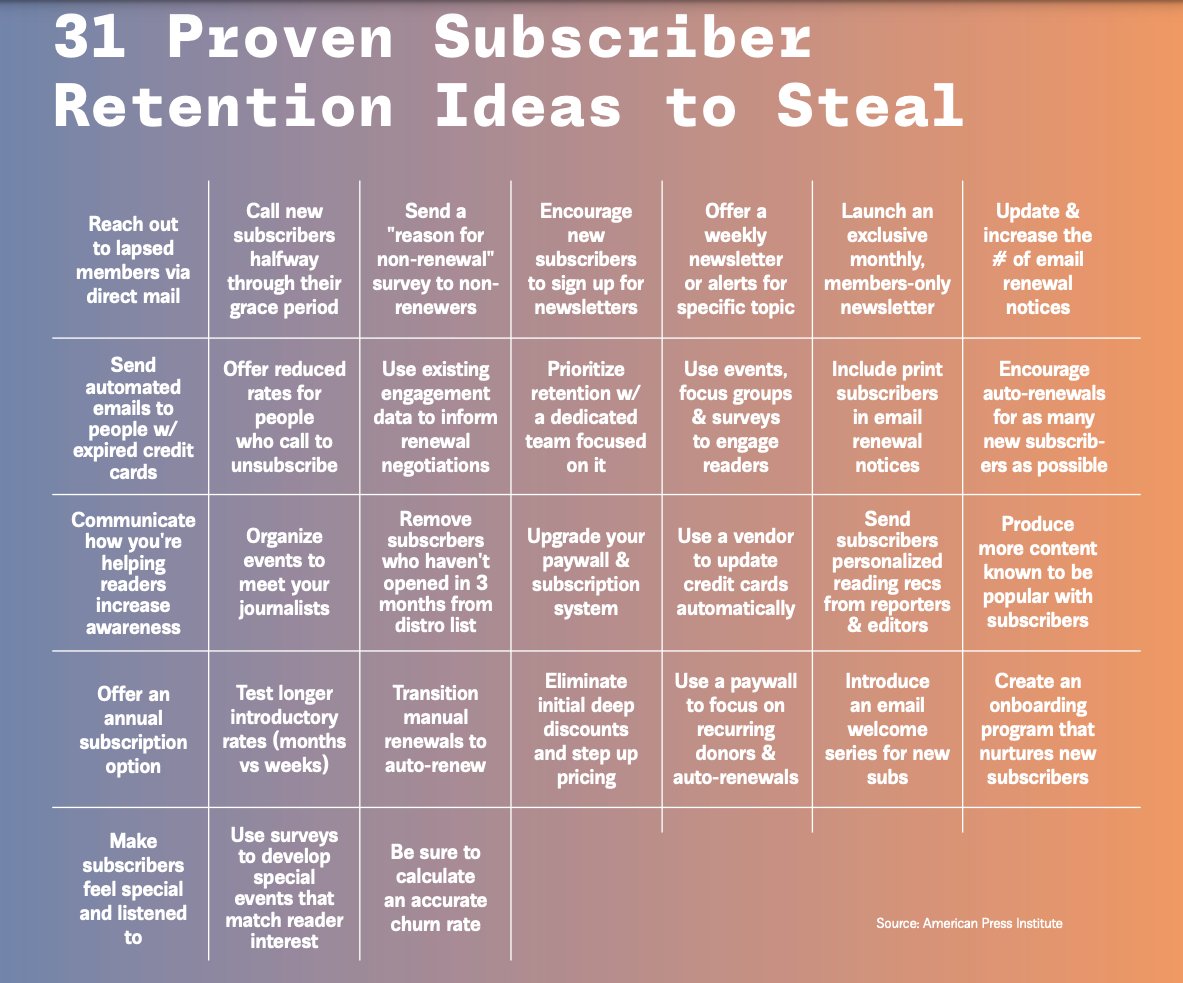
Retention tactics identified by the American Press Institute and featured in the Innovation in Media 2022-23 World Report.
2. Continue to explore opportunities for revenue diversification
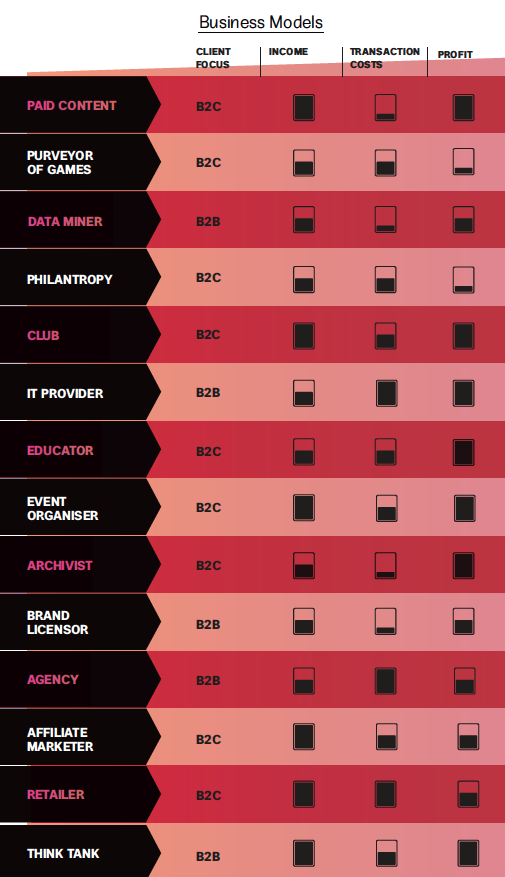
Alongside maintaining relationships with existing audiences, publishers need to continue to find new routes to revenue. To help them do this, the latest Innovation Report outlines 14 different business models publishers can adopt. Publishers can mix and match these efforts to pull together a good range of diversified offerings.
Aside from subscription-led approaches, other possibilities include a blend of B2B and B2C models such as memberships, events, affiliate marketing, and “think tank” style output. Educational activities, such as those offered by The Economist’s Executive Education program and Family Handman’s DIY University, may also be a good fit for some publishers and their audiences.
As many publishers know, if you wait long enough, then everything old becomes new again. In this regard, Señoris excited about what he describes as “the original habit-formation tool for newspapers – puzzles and games.”
The New York Times’ acquisition of Wordle is the poster child for this, having brought “unprecedented tens of millions of new users to The Times.” And, as The Innovation Report points out, “If even a fraction can then be converted to paying subscribers it would make for an excellent business proposition.”
Puzzles and games are again in vogue as gateways for publishers to capture new subscribers, generate fresh revenue streams and increase the “stickiness” of their relationships with audiences.
Nevertheless, as Esther Kezia Thorpesuggests, “offering games is not a strategy in itself … Publishers need to find ways to bring regular puzzlers into a deeper relationship,” she says, “whether that be through newsletters, social features, or additional layers to the games themselves.”
Examples of different publisher business models, from the Innovation in News Media World Report 2022-23
3. Unlock the power – and results – of product thinking
Publishers have invested – and continue to invest – considerable resources in areas such as games, newsletters, and podcasts. Much of this is driven by a belief that these ventures can serve as a gateway to your content and drive subscriptions and aid retention by deepening bonds with their consumers. Señor calls them “conversion monsters.”
These efforts reflect product thinking, which has risen to the forefront of media strategies over the past decade.
“Product thinking begins with realizing that every way people experience the news is a possible product or feature,” the Innovation Report observes.
Each of these touchpoints, of course, is also potentially monetizable.
As a result, “publishers must now become product companies and not just news media publishers,” Señor believes. That’s a sentiment increasingly applicable to revenue strategies, as well as content propositions.
“Product is changing everything,” agrees Luciana Cardoso, the Brazil-based Vice Chair of News Product Alliance’s Board Of Directors. Cardoso comments on how product is a driver for innovation “because we need to have the customer at the center of everything.”
4. Be tech-led, not led by tech
This desire to be more consumer-centric, is accentuated by the need for publishers to prepare for a world without third-party cookies. Describing this as a ”first-party data moment,” Señor says these developments are “the key to a stronger future for our industry.”
“First-party data gives us the chance to have a direct relationship, control the pricing, content and dialogue with our readers without intermediaries,” the Innovation Report states. “This is a massive shift and one we must prepare for.”
Publishers must also look to the possibilities of Web 3.0. Señor points to the availability of “journalism without browsers” as one critical dimension of this brave new digital world.
“When you look at how Condé Nast is experimenting with this, it’s very, very interesting,” he told us.
One of their titles, GQ magazine, recently launched on Discord. “The way that we are thinking about it is we are throwing a party, GQ is the host, Discord is the venue and you are invited,” says Joel Pavelski, GQ’s Executive Director of Global Audience Development & Social Media.
Condé’s approach enables them to engage with communities in private online spaces, potentially reaching new audiences and serving existing ones in fresh ways. It’s part of a “conscious uncoupling” some publishers are having with traditional tech platforms; and part of a wider shift in media habits seen within the creator economy.
Tapping into these emerging spaces and behaviors may reveal insights that can inform continued product thinking, drive subscription models, as well as support and shape first-party data strategies.
5. Invest in content, especially visual media
Despite encouraging publishers to keep a watchful eye on emerging tech trends, Señor emphasizes that organizations shouldn’t go overboard.
In terms of the industry’s wider financial footing, “the Metaverse, Web 3, none of this stuff will make the difference,” he contends. “What will make the difference is investment in journalism.”
“We need to do original reporting. A lot of people want that,” Señor says.
As part of this, he stresses the importance of high-impact visual journalism, which he believes is “absolutely essential,” and “perhaps the most exciting new field in journalism right now.”
Product thinking can also shape how – and where – these visual-first stories are told. ”This is transformative,” Señor says, pointing out how many of these efforts are driven by a “story first, platform second” dynamic.
Memorable examples, such as video Op-Ed’s pioneered by The New York Times and The Miami Herald’s award-winning “House of Cards” investigation, can also yield multiple outcomes for publishers. Impactful content can be integral to industry recognition (e.g. awards), and a key driver for unlocking new subscriptions, as well as the retention and upselling of existing consumers.
House of Cards: @MiamiHerald’s interactive investigation of the Champlain Towers South collapse is a riveting real-time multimedia masterpiece that helps make sense of the senseless tragedy that killed 98 people with corruption, incompetence and neglect https://t.co/ObrRnUL9vC
Strategic synergies: bringing these principles together
Noting that next year’s Innovation Report will be their 23rd annual publication, Señor says the examples they feature are focused on reach, relevance, or revenue. Often, these elements are deeply intertwined.
Parlaying that relevance into different spaces and products, and encouraging audiences to pay for it, remains essential if publishers are to traverse stormy economic waters and successfully navigate their way through 2023.
“Whatever you do, put all your efforts into gaining and retaining subscribers,” Señor advocates. Everything should be “about sustaining, developing, [and] amplifying your subscription strategy.”
There’s a myriad of interconnected ways to do this. This includes multiple means to generate revenues, distinctive products to attract and retain subscribers, the knock-on effect of memorable – often visually-led – journalism, as well as deepening relationships with audiences both on and off-platform; including in new and emerging digital spaces.
This consumer-centric model eschews the shiny object syndrome that many media players have been guilty of in the past. Instead, as a new year begins to loom on the horizon, focusing on solid content-led foundations should be their guiding light.
As the sun sets on 2022, publishers will once again set sail and steer a path into an uncertain future. Meeting audience needs through the trifecta of content, product and subscriptions, must be their North Star as we quickly advance into these unchartered waters.
*The Innovation In News Media World Report 2022-23 is available to WAN-IFRA members (for free) or for purchase via INNOVATION’s website.
A well-produced video can expand your audience, drive loyalty, and increase the value of your digital content. Because audience demand and expectations are so high, digital publishers are now forced to produce engaging video content faster than ever before and in much more significant quantities.
But accelerating video production doesn’t have to come at the cost of quality. A streamlined approach to creating compelling video content can be easy if you follow three steps.
1. Simplify your production
The barrier to entry with video production used to be enormous. The tools to create the content required special training and a steep learning curve. Today, new video product solutions are designed with intuitive tools and user-friendly interfaces that empower users with no specialized training to generate and air studio-quality content much more quickly.
Although sophisticated content should still have a place in your content calendar, breaking news waits for no one, and being the first to air with critical information can be a valuable advantage for grabbing viewers’ attention. In addition, you can go live quickly when severe weather strikes or threats to public safety. Finally, equipping your team with tools to create these videos will remove bottlenecks when posting content.
Also, be sure to find a tool that enables your teams to create videos using their laptops or mobile phones from virtually anywhere with an internet connection. Think of these solutions not as a replacement for professional production workstations but as a way to extend their capabilities. The tools often use a browser-based interface and cloud capabilities to access content, graphics, and production tools remotely, allowing users to report on breaking news and weather stories immediately.
2. Use pre-created templates
A repository of professional and pre-created templates can help you quickly publish updates using high-quality videos that engage audiences and build trust. Simply populate these pre-made templates with essential information so you can be the first to air when news breaks.
Consider templates that embed a customizable lower-third or brand logo. Also, look for templates that leverage a two-box format showing two speakers or one speaker alongside associated video footage or B-roll.
Alternatively, you can place the speaker in the bottom left corner, as vital information is displayed more prominently in the middle of the screen. Some solutions also offer map templates if your story relates to a specific location or geographical area.
Experiment with different templates to determine what works best across your digital platforms. You can find which templates will extend watch time or increase engagement by testing different kinds of content and formats. This information will help your team as they decide which templates to use when news breaks.
3. Add more voices to the screen
Fake news is an increasing concern for viewers in the U.S., particularly on social media. Adding expert opinions from inside and outside your organization can improve the credibility of your content while increasing overall productivity and driving new monetization opportunities.
Remote broadcasting capabilities make the process of creating meaningful content with new and diverse voices to your content far simpler. With the right tools, you can incorporate experts, thought leaders, and sponsors with the click of a button, regardless of their location.
This approach is effective across content categories. For weather, feature experts from impacted and adjacent areas to help viewers understand the extent of a weather event and respond accordingly. For sports or elections, interview local correspondents to add more context and relevance. You can also offer digital sponsorship packages such as native ads that include sponsor interviews, improve campaign effectiveness, and increase viewer satisfaction. For example, you may include a technician from a local heating and air-services sponsor to share tips on reducing energy usage in the summer.
Adding these new perspectives and insights will also help you produce unique content that may be reformatted and repurposed for different audiences and platforms, generating further revenue opportunities.
Better video starts here
Exceptional video content is essential to any good digital content strategy.
By leveraging these tips when choosing a video storytelling tool, you can accelerate your output without adding resources and attract a bigger audience and more advertisers.
About the author
Jim Politis is part of the Max Weather solutions product management team at The Weather Company, where he focuses on Max Velocity, Max Engage, and Max Social. He was first part of the Max Quality Assurance team, and over the last decade at The Weather Company, Jim has been involved with nearly every product within the Max ecosystem. Prior to joining The Weather Company, Jim served as a broadcast meteorologist in Iowa. He has a Bachelor of Science degree in meteorology and an associate’s degree in computer science from Northern Vermont University-Lyndon.
Amid growing uncertainty about the economic environment, it is wise for publishers to consider how to thrive and strengthen their revenue during the potential downturn. With economic uncertainty ahead, it is vital to understand how brands look to invest in marketing during 2023 to build a portfolio of offerings that support these strategies.
The situation
Typically marketing budgets decrease during an economic downturn. However, based on research done by Deloitte earlier this year, marketing spend has grown substantially over the last year. And, despite uncertainty at present, some bright spots stand out.
In the same Deloitte study, marketers stated they plan to increase their spending on DEI initiatives by 10.8% on average. And Hubspot reports that 83% of marketers are investing in higher-quality content. They also report that 80% of marketers expect to maintain or grow their budget for various inbound marketing activities – including content marketing, SEO, social media, and more – to reach and influence consumers at every stage of the buyer’s journey.
This data shows us that publishers would be wise to strengthen their content offering. These can include native advertising, sponsored content and even contextual targeting, all of which are ideal to help brands deliver their stories across publisher channels to reach these audiences.
The consumer perspective
Even at a potential downturn, brands seek opportunities to attract, delight, and engage. Therefore, it is essential to consider the reader and consumer preferences to support these efforts. So we must ask ourselves: what do consumers prefer?Ultimately they want to focus on the content they are trying to consume.
According to an eMarketer report, over 40% of American adults think online ads seem to be aggressively following them. And this has led consumers to take control of their digital experience, with close to 47% of internet users now using ad blockers because they think there are too many ads online, according to GlobalWebIndex.
However, according to a survey by Time Inc, close to 90% of younger internet audiences from Gen Z, millennials, and Gen X say that they prefer custom content, including native ads online, instead of traditional ads. This is an opportunity.
This data shows that consumers are actively seeking ways to improve their web browsing experience and limit the distractions from the content they are seeking. We believe this will lead advertisers to start looking for strategies that do not distract from the reader experience to reach these consumers and improve campaign performance.
A crisis of trust
Unfortunately, these days display ads just aren’t that effective: click-through rates are at just 0.05% across all platforms. This decline started years ago, and it is because consumers have lost trust in display; in fact, over 54% of users say that they don’t click banner ads due to a lack of trust.
Now, let’s look at social media. One reason that platforms like Facebook have come to dominate digital advertising is that they are able to provide advertising experiences that are seamlessly integrated into the consumers’ content. They offer opportunities for long-form editorial engagements, lower funnel activities like click-to-download, and short-form top-of-funnel branding executions, such as Instagram stories.
But the reviews of social channels are not all bright either. Consumers increasingly distrust social platforms. According to Statista, 66% of consumers express concern about the accuracy of the content they see on social media.
Even with this in mind, however, marketers are looking to invest more in short-form content. Hubspot found that 33% of B2C Marketers already invest in short-form content. While another 33% have yet to, but plan to do so for the first time in 2022.
What we see is that there is an appetite for this content. And, given growing distrust in social media, brands may be actively seeking ways to scale their efforts on the open web.
What do publishers offer to the industry? Trust
Publishers have built a robust ecosystem and relationship with their audiences. As we have said before, this trust can be utilized as a point of differentiation, especially when competing against programmatic offerings. When ad dollars are invested into more strategic initiatives, publishers must lean into the inherent trust they have built with their user base.
To thrive during any potential downturn, publishers need to create offerings that support the strategies brands are investing in for 2023. At the same time, they must maintain the inherent trust they have built with their audiences. To do that publishers must consider the following:
Privacy First
Focus on solutions that don’t rely on third-party targeting. Rather than using invasive data practices, use content to attract, delight, and engage. This allows you to provide contextually relevant advertising solutions so brands meet their customers where they are in the purchasing journey.
Prioritize Premium
Brands will look for unique ways to reach their customers, break through the noise, and remove the blindfolds of banner blindness. For digital publishers, that could mean leaning heavier on executions, such as sponsored content that allows brands to tell their stories, from new products to use cases and any DEI initiatives. Give brands the ability to scale their story beyond their audience and benefit from the trust publishers have built with their readers.
Integrate Short-form Content
As mentioned above, brands seek to invest in short-form content. To build a diverse revenue portfolio, publishers can offer solutions to run executions similar to Facebook and Instagram stories or TikTok’s short-form videos. This will allow advertisers to scale these strategies outside social channels within trusted environments.
With a downturn ahead, or not, aligning to meet brands where they are seeking to invest in 2023, will result in a win for publishers. Understand that content moves the needle for consumers. Advertising that places quality messages within trusted content will rise above the clutter. In particular, short form content offerings will allow publishers to integrate the social environment brands are seeking into the publisher site experience.
The age-old question of advertising effectiveness remains front and center in today’s media ecosystem. Given the breadth of content distribution options, how do different platforms such as streaming, mobile, and on-demand compare for building advertising engagement? Comcast Advertising partnered with MediaScience to investigate the impact of watching ads in a traditional TV environment compared to other video environments, like YouTube or Facebook feed on mobile devices.
The report, TV Makes Memories, uses three factors from academic research on memory influencers: attention, connection, and repetition. The research analyzes these three conditions to provide a framework for understanding how effectively TV and mobile environments influence brand memories.
Methodology
MediaScience recruited 188 participants to view 30-second ads in TV and mobile environments. The TV environment consisted of live TV or a streaming environment with a typical ad load viewed on a large screen. The mobile environment consisted of participants watching short-form video clips on YouTube or in a Facebook feed with ads embedded on a mobile device.
The study exposed viewers to an even mix of well-known and unknown brands, and measures included:
Biometrics Eye Tracking to quantify the visual attention to the ads by tracking where viewers are looking on the screen.
Cardiac Deceleration (slowing heart rate) to identify cognitive attention and links to memory formation.
Neurometric Intensity to gauge emotional response linked to improved memory formation.
Attention
Overall, premium content viewed in a TV environment rated more favorably than short-form video and feed-based digital. Additionally, ads viewed in the TV environment had a greater unaided recall and purchase intent than ads shown in a mobile environment. Like this study, earlier Halo Effect research and The Benchmark Series show that ads in a premium environment significantly improve advertising effectiveness scores.
MediaScience’s analysis also showed that cognitive attention improves when participants view an ad in a TV environment preceding the same ad in a mobile environment (versus two digital ads).
Ads viewed in a TV environment receive more visual attention among full TV screen viewers (71%) versus those viewing digital mobile (30%). One reason suggested is that larger screen viewing may be subject to fewer distractions. Interestingly 36% of digital viewing participants never looked at the mobile ad compared to only 6% of TV viewers.
Connection and repetition
Strong creative messaging is an essential component of memory building. The research found that participants viewing an ad in a TV environment preceding an advertisement in a digital mobile environment rate the creative message better than viewing ads exclusively in a digital environment.
Ads viewed in a TV environment in their first exposure have 3.4 times better recall than ads viewed in a mobile environment. Addition exposures build upon the original memory and experiences the viewer has about a brand. Notably, while unaided recall increases with a second exposure for both TV and digital mobile, the TV environment viewing experience outperforms mobile. Viewers of one exposure on TV were 40% more likely to recall the brand versus two exposures on digital mobile.
This research offers new empirical data on ad performance in premium content environments, especially in a lean-back TV setting. With advanced media distribution expanding, marketers must know that not all video environments perform similarly. Importantly, ads viewed in a premium TV environment have greater unaided recall and purchase intent than ads in short-form, mobile environments like Facebook or YouTube.
Despite a looming recession, this holiday season looks bright for marketers and consumers alike. And there are definitely opportunities for publishers. A third of marketers plan to ramp up promotional efforts between now and December. On the consumer side, forecasts point toward spending upwards of $150 billion worldwide on Black Friday alone, with holiday online sales climbing 3% year over year. For publishers eager to sell valuable holiday inventory, Q4 2022 presents an opportunity to capitalize on retail’s biggest season.
2022 has also seen the continued expansion of Universal Identifiers, data clean rooms, and other cookieless targeting solutions that support privacy-compliant identity-driven advertising. Privacy concerns have led marketers to embrace these technologies to keep consumers’ information safe while ensuring they have access to the latest targeted product offerings.
At the forefront of these developments is cookie-less advertising. As much as 40% of mobile web traffic is unaddressable without cookie-less solutions, making their adoption an urgent opportunity to expand the impact of marketing efforts.
To take advantage of strong consumer tailwinds building up to Black Friday, Cyber Monday, and beyond, now is the time for publishers to amplify their marketing efforts with the latest in privacy-friendly, identity-driven targeting.
Strike deals to capitalize on high demand
Q4 is the time of year when advertisers will be most eager to buy, and publishers most eager to sell. In addition, the quarter offers a unique opportunity for publishers to leverage their inventory to meet the pent-up demand of a post-pandemic economy. These circumstances come with benefits for both parties.
Brand marketers will be looking to hit their annual goals during a quarter when a large percentage of their sales are expected to come through. Retailers will have valuable inventory they need to offload before the season ends. These pressures incentivize deal-making and could help publishers snag highly valuable direct deals that could turn into lasting relationships with advertisers.
Publishers can accelerate deals and stand out from the competition by taking measures to capitalize on higher ad spend during the holiday season. For example, they may try out media formats that they would generally avoid, such as sticky ad footers that better capture audience attention. Publishers may also consider packaging custom audiences, day parts, or ad products to lure brands. By laying out how they can help advertisers hit their year-end goals, publishers can benefit from this holiday season and beyond.
Use first-party data and transparent metrics to stand out
Some marketers are facing tighter budgets given uncertain economic conditions. On the positive side, challenging times shine a light on measurable, cost-effective and privacy-friendly marketing tactics and channels. Digital media companies with first-party audience relationships and metrics have the opportunity to make the case that they offer this channel — in which case, concerns about marketing spend could become a business driver and competitive differentiator.
The key to standing out in the ad market is for publishers to make the most of the information available to them. Equip advertisers with the tools to accurately analyze results, proving to their CFO and other internal stakeholders that spending with your company is part of a strategy that drives meaningful ROI. Also, make the case that effective advertising is not just about reaching audiences at scale; it’s about reaching them in the high-quality, trusted environments that publishers provide.
Plus, if economic conditions do lead to a decrease in ad spend, there are benefits to some brands pulling back. In the past, aggressive organizations have gained lasting market share by getting in front of customers when rivals fled. In the event of mixed economic messages this holiday season, publishers who can make this case to advertisers will be the most prepared to succeed.
Experiment with cookieless audience targeting
New anti-tracking rules and regulations are an opportunity for publishers to get ahead in digital advertising. First-party data sets them up to provide audience targeting and analytics around content themes. Solutions like creative data partnerships, data clean rooms, and identity recognition can help scale offerings. These tools can allow publishers to be their own best advocates, helping advertisers target audiences in the market for their products, consensually measure impact across channels, and prove ROI.
Importantly, these solutions are not only available to digital media companies that focus on fulfilling programmatic demand. Organizations that focus on direct sales – which are enjoying a resurgence given the increased value of first-party audiences – can also incorporate identity-driven targeting and cross-platform measurement into their ad products.
With regulations like the California Privacy Rights Act (CPRA) taking effect in the new year, now is the time to start testing solutions and take advantage of the forecasted spending boom in Q4. Publishers can prepare by arming themselves with the tools to help advertisers understand the impact of their dollars. If they do that, they’ll be able to maximize the value of their rich content and first-party audiences while earning the Q4 budgets advertisers are eager to spend. And they’ll get ahead of competitors who will be scrambling to get compliant for the CPRA in January.


 / An inside look at the business of digital content
 Archive