The post-cookie era of digital advertising is approaching. Google may have postponed its plan to remove third-party cookies, but the result remains the same: industry players must prepare for a huge amount of industry upheaval. Most notably, there will be a significant drop in data availability.
Publishers – with direct access to audiences and first-party data – are widely acknowledged as being best-placed to survive in the ecosystem’s data-frugal future. But having valuable first-party data at their fingertips won’t be enough for them to flourish. Moving forward, publishers must discover new ways to optimize their offerings, enhance their monetization strategies, and heighten the value of the user experience.
With technology powered by artificial intelligence (AI), publishers can harness the capabilities needed to become digital advertising’s main providers of quality, first-party data. They will also be in a position to build of scalable, privacy-safe data solutions. By combining the power of AI with valuable first party data, publishers have a significant competitive advantage.
AI helps publishers leverage their pair of aces
Publishers were already holding a pretty good hand, with content and consent their figurative aces. Publishers build trust among their regular users by generating high levels of audience engagement and loyalty through the production of editorial content. This, in turn, helps them earn consent from logged-in users to gather and use their first-party data.
Publishers’ first-party data strategies, therefore, give them a solid basis to achieve reach with known audiences. However, it is broadly acknowledged that consented data has its limits. At best, only one in 10 users are willing to share personal information, such as age and gender. However, almost a quarter (23%) are reluctant to do so regardless of how it could improve their online experience.
Consequently, optimizing reach beyond known users relies on publishers taking different approaches to data, aside from adopting log-in walls. To increase the effectiveness of their strategies, data processing and enrichment solutions driven by AI and machine learning are vital. Publishers looking to preserve the availability of their online content will find these especially advantageous. But all publishers stand to gain from their benefits.
Predictive modeling is one of the most valuable capabilities made possible by machine learning. The removal of third-party cookies will make deterministic data less accessible. However, with consent, publishers can leverage their logged-in user attributes as a robust analytical base for predictive models. These models then allow publishers to extend addressable reach with accuracy. This helps them target unknown audiences that exhibit similar attributes to their logged-in users.
The quality of these predictive models is also very high. For example, Ad Alliance – Germany’s number-one advertising sales house – achieved 70% market reach in a campaign for e-commerce company, OTTO (up from 32% for standard run of network campaigns), with 92% accuracy in age segment targeting.
Contextual is the trump card
To boost reach and engagement even further, publishers can also feed real-time contextual insights into their data solutions to enable privacy-friendly targeting. Contextual analysis upholds user rights to data privacy by utilizing inferred characteristics rather than declared ones.
AI technologies accurately predict audience preferences based on the content they consume. This information can then be used to personalize targeting and the user experience. For example, French publisher, Le Figaro, utilized 1plusX’s real-time audience targeting, contextual targeting and first impression targeting solutions to strengthen relevance, maximize impact, and enhance the user experience, all while adhering to data privacy regulations.
Bringing users’ content consumption into the mix, publishers can then use advanced AI analytics to develop precise, interest-based audience segmentation. This further improves targeting capabilities, resulting in stronger alignment between ad content, editorial content, and user intent. By leveraging data enrichment and machine learning capabilities on top of its contextual targeting tool, Le Figaro was able to deliver precise targeting solutions to connect with first-time users. As a result, the publisher generated an average campaign reach increase of 38% across campaigns from all verticals.
Publishers play a key role in shaping how the ecosystem accesses and uses first-party audience data sets. But simply being the gatekeepers of user data won’t give them the competitive edge they need. AI-powered solutions allow publishers to support privacy-centric advertising and optimize their own revenue streams.
With the enhanced capabilities of predictive modeling, publishers can make the most of their consented data and expand their reach to unknown audiences with a high degree of accuracy. By combining this with contextual data, they can deepen the personalization of the user experience and maximize the effectiveness of targeting methods with heightened relevance. Thanks to AI, publishers can ensure they have the optimal solution to identity challenges in the post-cookie era.
With wide-ranging changes pushed within a very short time span, the publishing world had to rapidly transform many workflows and strategies during the pandemic. We saw trends accelerate and tried and true strategies hold strong.
Fastly’s SVP of Engineering Nick Rockwell (the former CTO at the New York Times) sat down with a group of senior technology leaders from four global digital publishers earlier this summer to reflect on this challenging period.
Panelists:
Jorge M. Ibarra, CIO/CTO, El Pais
Mariot Chauvin, Head of Engineering, The Guardian
Marco Kaiser, CTO, Zeit Online
Sacha Morard, CTO, Le Monde
Here are a few of the key takeaways from the discussion that publishers everywhere can leverage as they adapt to the new normal.
Traffic surged and content strategies shifted
Unsurprisingly the four news outlets all saw large traffic spikes at the onset of the pandemic. Traffic records were shattered. What may be a surprise, though, is that though it is tapering off, visitor numbers are higher overall to this day.
A closer look at viewer behavior confirmed that expected content cannibalization took place. Readers flocked to COVID-19 coverage and spent little or no time with other sections of the website. To address this, they decided to expand the coverage of Covid-19 with additional content such as infographics, which are still being referenced by news sources to this day. However, this audience behavior also drove the creation of a “Covid-19-free content” hub, where readers could educate themselves on other world news and topics.
El Pais saw the record traffic extend into other areas such as sports coverage, educational content, and even radio broadcasts.The Guardian observed a similar trend. The site experienced a 25-day streak with more than 20 million visitors. Traffic surpassed 366 million visitors in one month alone – up 50% from the previous record. Like the other participants, they are seeing sustained higher traffic levels with readers being particularly interested in culture, education, food, and crossword puzzles.
Subscriptions numbers are up. Ad revenue, less so
A common thread among the digital publishers on the panel was that they were quick to move Covid-19 news outside their paywalls. (Note: The Guardian does not have a paywall). Therefore, it might be surprising that a news outlet such as Le Monde saw subscriptions jump 3x.
Prior to the pandemic, Le Monde set a long-term goal of reaching one million subscribers by 2025. During the pandemic, they reached 300,000 paying subscribers and found themselves fast-tracked to reach their target.
Still, not all business metrics were positive. Several of the panelists which were already experiencing ad revenue declines saw this trend accelerated by the pandemic. El Pais converted to a subscription model in March of this year, which worked well in terms of timing. However, it’s too early for them to comment on the success of the switch.
Zeit Online also saw a 2-3x increase in online subscriptions during the past 18 months. Interestingly, the uptake extended into the paper version (Die Zeit). In particular, they experienced an increase in non-subscription papers sold at kiosks, train stations, etc.
Strategies remain and are reinforced
One might think the recent 18 months had CTOs and engineering teams rethink strategy. But that was not necessarily the case. All four panelists indicated that the pandemic confirmed some strategies that were already in place. However, it spotlighted outdated technology and workflows and sped-up previously planned changes.
The Guardian, for example, already had a cloud migration underway. So, things like running and maintaining systems remotely were already possible because of the programmable content delivery network (CDN) in use. Currently, they are focusing on three specific areas:
Improving SEO optimization to help secure ranking at news aggregators;
Building a fast and responsive website that can effectively compete; and
Continuing to implement tooling that can help collect data to constantly optimize conversion. They recognize the importance of understanding new audiences to find out what motivates and converts them.
Zeit Online also found that some strategies remained consistent, although acquiring new subscribers and converting trial subscriptions took a backseat. They are planning to catch up on this, though, as there’s obviously a strong desire to capitalize on the additional visitors.
As far as news aggregators and SEO optimizations go, Zeit Online is currently analyzing the long-term effect of stories being picked up. As Kaiser put it, “We saw the sheer power of platforms like Apple News and Google News. If you get your story listed there, you have a strong increase in traffic. That’s great but it’s fly-by traffic. People will read the article but then they are gone again. It’s hard to convert them. It made us look at what’s really a qualified visitor for us – someone we can convert into a subscriber. It’s an interesting question: How do we engage these fly-by visitors”
The changing needs of the newsroom
As with strategy, the pandemic accelerated the switch from legacy and stationary systems to those able to offer remote access. While a portion of these publishers’ workforce already worked remotely, it was the minority. And, for several panelists, the exercise to get hundreds of laptops in very little time was a daunting task. As many newsrooms are built on proprietary content management systems, they offer very few options for remote access at the scale needed, and new systems had to be put in place.
Interestingly, both Zeit Online and The Guardian have seen newsrooms adopt tools from engineering and other parts of the house to increase productivity and bring together dispersed teams. These include things like stand-ups, JIRA tickets, and other agile tools that for years have helped keep track of progress.
The panel offered a rare opportunity for a discussion between four of the largest European news organizations. In addition to the topics I’ve covered here, their discussion touched on topics such as online security, potential negative effects of the changed workflows, and more. (Feel free to check out the whole thing here.)
It’s obvious that the pandemic profoundly impacted digital publishing. However, it looks like the changes it triggered were not all bad. The switch to a cloud-based workflow has proven especially useful for this segment and the media workflow has likely been changed for good. It remains to be seen if the increase in subscribers will remain but with added visitor and subscriber insight as well as an increase in appreciation for quality content, publishers are rightly optimistic.
While the cryptocurrency market has been growing at a steady rate over the past few years, it has recently exploded – and shows no signs of slowing down. Estimates show the industry will hit $4.94 billion globally by 2030. That’s more than triple its size of $1.49 billion in 2020.
With such a large market, it’s a no-brainer for advertisers whether they be crypto platforms, providers or innovative merchants – to take advantage. There may be no bigger sign that the door is wide open than the fact that Google, just this summer, loosened restrictions on crypto ads after banning them in 2018. As money flows into the category and advertising becomes more accepted and possible,it presents a big opportunity for publishers to capitalize on a growing and lucrative ad market.
Meet the crypto advertisers
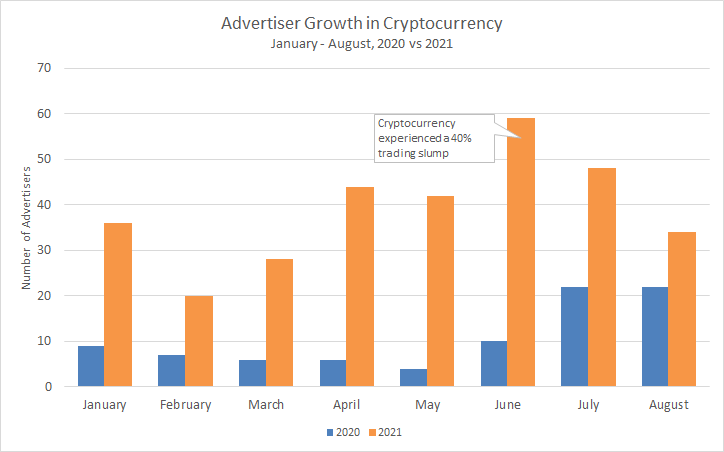
According to our own data at MediaRadar, we’re seeing that bear out. In 2020, there were just 27 digital currency companies who purchased ad digital display or print ad space. In 2021 that number increased 159%. New companies include BitYard, Anatha, BitTrust IRA, Phemex Limited, and Gemini. Existing advertisers, like Coin Mobile App, Hex.com, Bakkt Marketplace, Nexo, and Celsius Network, continue to spend. This growth will only continue and to the benefit of the overall ad ecosystem.
Source: MediaRadar
Supporting the industry is the increased credibility it has seen in recent years. We know Google has shifted its view on it, but it’s not the only major company.
Tesla invested $1.5 billion in Bitcoin back in February, and that caused the cryptocurrency market cap to surpass Google’s stock. Tesla founder Elon Musk has always been a crypto advocate – despite brief moments of doubt. In fact, his backing of certain currencies has caused them to skyrocket.
Breakthrough business
Beyond bleeding edge players like Tesla and Musk, legacy businesses like McDonald’s are now accepting crypto for payment. So, there’s a more accepting audience for crypto ads. And, with all the different cryptocurrency formats out there, it’s easy for advertisers to try and market one people haven’t tried yet. The same goes for crypto platforms.
However, in such a crowded market, how do crypto brands break through? What are advertisers doing to market crypto to the public, especially when there are plenty of people who still don’t know what crypto is or how it works? And what types of publishers are benefitting?
This year, crypto companies advertised across digital and print formats, with most spent on digital (86%). However, 14% of spend has been in print. In 2020, there was no investment in print, which marks a substantial year-to-year change.
This indicates that the industry is growing and is striving to reach a broader demographic by advertising in The Economist, Bloomberg Businessweek, Car and Driver, and The Globe and Mail. Note, of course, the audiences of these publications. They’re often more business and tech-savvy. Also, they likely follow the crypto category or are more receptive to trading crypto than the average person. Publishers that feature these audiences can win ad dollars from the growing number of crypto brands eager to invest.
Follow the money
Still, while crypto is beginning to mainstream and broaden its outreach, crypto advertisers haven’t shifted to the ultimate mass marketing channel – linear TV. There has been some experimentation, of course. However, according to our research, TV was the least popular channel for cryptocurrency companies. In comparison, the majority of advertising spend from traditional banking services in 2020 and 2021 – think Capital One, Chase Freedom, Chime Bank, and CitiBank – has been on TV ads.
Beyond the channel, the format in which crypto brands deliver their message is similarly important. One way to engage their audience effectively is with contextualized messaging. According to BuySellAds, “those in the cryptocurrency industry are more likely to engage with advertising from contextual advertising networks that display contextualized messaging and is relevant to what they’re viewing, is honest, and doesn’t utilize forms of tracking.” The best crypto ads are native and tightly aligned to the format and content. For publishers seeking to partner with cryptocurrency brands, this is critical intelligence when pitching formats and capabilities.
Moving forward, enterprising publishers can take advantage of the crypto ad explosion. With a growing number of competitors, platforms and players, there is a massive opportunity here to build business and grow revenue.
Every time there’s a big change in how Apple, Google, or Facebook works with publishers, a touch of panic can be felt in the air. Yet, we’ve all survived seismic shifts from these companies. From Facebook’s deprioritization of publisher content in 2016 to Apple’s recent iOS 14.5 release, we’ve absorbed the shock and made it through. But, as an industry, we always act like the next change might be our last. Now, Apple is specifically coming for email. It’s placing limitations on location and IP targeting that could make it more difficult to use personalization for some iPhone audiences… and the cycle repeats.
Yet, like all of the sky-is-falling fears before it, Apple’s latest move is nothing to panic about. The truth is that these changes are merely a distraction from the real work that publishers do every day to connect with their audiences through great content and great experiences. If change occurs to a specific algorithm or a particular measurement metric, that doesn’t alter the core of the business, which is to deliver value to an audience.
Embrace change for good
The old saying that “change is the only constant” is a well understood truth within the industry. But these changes tend to happen in rapid succession, making it near impossible to keep up if publishers are always in reaction mode. Nearly every year, digital experiences a seismic shift — from GDPR and other privacy regulations to pending cookie deprecation from Google. Rather than cling to what we have, we should be working to create stability from the inside out.
For example, open rate data will become skewed with the Apple iOS 15 release. It’s the core metric used to determine opportunity, in particular for advertisers. When this metric is threatened, fear rears its ugly head. If we can’t effectively track opens, should we begin to track clicks? If we do, does that mean publishers like Axios, who have a product-oriented approach to newsletters, should entirely scrap their email strategy that works? Should they start prompting their readers to “click to read” simply so they can track that user? Of course not. That fear should not determine a course of action.
Audience behavior won’t change. The desire to consume quality content in quality email experiences won’t change. The needs of our audiences must remain at the forefront of everything we do.
As an industry, one way to do that is to collectively accept that KPIs will change — on both the buy and sell side. The sooner we do, the sooner we can collectively move forward. Together, publishers can meet to determine a matrix of KPIs, and discuss with groups like the IAB which metrics are in danger and how to push up more stable metrics so that everyone, including advertisers, can move forward despite industry changes.
Stability through zero-party data
Change might be the only constant, but audiences are the only source of the truth. Both publishers and advertisers rely on audience engagement to hit their goals. Yet few use direct audience insights as a source for measurement and KPIs. The more publishers understand their audiences, the better they are positioned to create stability for the long run.
Zero-party data is the best way to make that happen. Defined as data that publishers explicitly receive from their audience as part of a clear value exchange, zero-party data is more valuable than first-party data such as search or browsing preferences.
More than ever, people are aware of the value of their own data. In a 2021 Merkle survey, 76% noted that they would be willing to fill out a short survey in order to get a better online experience. Taking a page from retail, personalization is proven to lift sales. Thrive Market, an online grocery store, weaves data collection into their entire online experience, using quiz elements to guide shoppers and then shape the content and offers they get in return.
Value remains constant
This focus on the direct value exchange between consumer and brand can be applied in the publishing world to great effect. Rather than just passively observe what readers pay attention to, more brands should be actively asking, engaging, and personalizing. The data that’s collected not only improves content personalization and audience targeting, it creates a foundation of insights that can be used to optimize reader experience. And that data is only as good as the last ask, publishers need to continually ensure they’re up to date on people’s ever-changing preferences.
Zero-party data shows how engaged audiences are, how much they’re willing to share, what they like, and what they want. For example, The Independent collected insights from subscribers in a New Year’s wrap-up newsletter that ended up producing a brand new newsletter focused on climate change. The team asked subscribers about which topics resonated the most in 2020. While the pandemic ranked at the top, they were surprised to see how many also cared about news about the planet.
Publishers have survived so much change in the digital world and we can certainly survive more. But rather than just focus on surviving, let’s actively build out a position of strength and move away from the passive, reactive moves of the past. When given the chance, people want to engage with publishers to make their experience better. Let’s own our own success, once and for all by actively prioritizing that relationship.
About the author
Allison Mezzafonte has worked in the media and publishing industry for 20 years and is currently a growth consultant, as well as a Media Advisor to Sailthru. A former publishing executive for Bauer Media, Dotdash, and Hearst Digital, Allison serves as a strategic partner to media clients.
In an advertising ecosystem that often can seem complex and opaque, digital publishers must find ways to stand out from other websites that offer advertising.
The industry has developed several resources to foster greater supply chain transparency and help publishers take greater control of their inventory, stand out for their commitment to quality and earn more revenue. It is important for digital publishers to be aware of these resources and integrate them into the selling process to maximize revenue opportunities.
Here we look at some of these resources and share how they benefit publishers and buyers.
1. Private marketplaces
Programmatic technology has made it easier for marketers to buy advertising at scale. However, not all exchanges provide them with publishers that have been vetted by a trusted organization.
Private marketplaces give buyers access to quality inventory while participating publishers also benefit from higher CPMs and by knowing the ads placed on their sites are from legitimate marketers.
You’re probably aware of TrustX, a premium private marketplace developed by Digital Content Next. It offers buyers access to inventory directly from more than 250 member publishers, bypassing resellers and intermediaries. Similar exchanges are taking hold globally including The Ozone Project in the U.K. and the Maple Network Exchange in Canada. By joining a premium private marketplace, publishers can find strength in numbers and greater exposure to buyers looking to buy inventory from quality publishers.
2. Industry programs
Several organizations have created programs to identify publishers that have taken steps to stand out, whether that’s by providing transparency, offering quality local journalism, or integrating industry standards and best practices into the buying process.
The Alliance for Audited Media’s Digital Publisher Audit is an in-depth, continuous audit of a publisher’s website traffic and business practices to verify that a publisher is effectively minimizing ad fraud risk. This new assurance solution addresses ad fraud at the publisher level and complements other industry initiatives like private marketplaces. We include all AAM-audited digital publishers on the AAM Audited Domain List, which can be downloaded from AAM’s website. It can also be found at the IAB Tech Lab Transparency Center, a resource that buyers can access to learn more about sellers and the compliance programs and industry standards they adhere to.
The Local Media Consortium is an association of local newspapers, broadcasters and online news outlets committed to quality journalism. The LMC Local News Advertising Inclusion List includes thousands of local media advertising opportunities for national brands.
And finally, The Trustworthy Accountability Group sets standards that promote greater supply chain transparency and includes organizations from across the industry including brands, agencies, publishers and tech providers. The TAG Registry lists members that are committed to increasing trust in digital advertising.
By taking part in these programs, publishers can be easily identified by media buyers who access these resources to build inclusion lists and prioritize quality partners.
3. Supply chain validation
Publishers also can use industry tools to easily gain insight into who sells their inventory and discover ways to make the process more efficient.
The IAB Tech Lab develops solutions to bring greater transparency to the supply chain through tools such as ads.txt (app-ads.txt) and sellers.json. The organization recently launched a new service that analyzes publishers’ ads.txt files to validate who is authorized to sell their inventory. Supply Chain Validation allows publishers to verify that their ads.txt file adheres to technical specifications by alerting sellers when issues arise such as an incorrect or missing entry, which can lead to missed revenue or an unauthorized sale. The service also compares the publisher’s ads.txt file to their selling partners’ sellers.json files to determine if there are any inconsistencies between the two. The results are then published in the Transparency Center and are also available from the IAB Tech Lab via an API.
As a premium publisher, it is important to integrate industry solutions into your selling strategy to stand out to advertisers. Putting the right processes in place will give your site — and your ad sales efforts —the best chance for success.
When it comes to the future, increasing user registrations and building robust first-party datasets should be at the forefront of every publisher’s strategy. Building first-party data unlocks a publishers’ ability to increase user loyalty, activate their audience, monetize their content, and improve their editorial strategy.
However, according to a recent survey from Teads, 65.3% of publishers say they are not planning on increasing the usage of logins to gather first party data. Why is that? According to the report, they’re worried about a “potential disruption of user experience.”
It’s a valid concern: 67% of customers say poor user experiences are a reason for churn.
It doesn’t have to be this way. Many leading publishers are leveling-up user experiences on their website by creating social experiences and using personalization to create a seamless registration and log in process. These publishers stand to attract and grow an audience of loyal readers. Let’s take a look at how they’re doing it.
Three tactics to engage loyal audiences
1. Give users a reason to register with immersive social experiences
Stand-out content will always drive readers to a publisher’s website. Increasingly, though, readers are looking for other ways to interact and engage once they’re done reading an article.
Today, the publishers who are creating social experiences on their website see more registrations and greater retention rates. At OpenWeb, we’ve found that publishers who create these experiences have users who spend 35% more time on-site. They are 450% more likely to return month-after-month, and drive 4x the revenue as the average user.
There are a number of ways that publishers can create social experiences. Many are adopting engagement tools like one-click polls where readers can weigh in on the article they just read. Others are producing interactive ask-me-anything style interactive forums (AMAs) with authors or journalists. Another effective social experience is hosting a comments section. When publishers invite readers to interact in quality conversations where they feel valued, they’re more likely to register and return again and again.
2. Use active personalization to provide value and keep users coming back
Users not only crave engaging social experience, they’re loyal to publishers who “get” them.
That’s why more publishers are creating personalized content experiences to drive registrations and loyalty. In fact, 88% of marketers believe that audiences now expect personalization. One of the most effective ways that publishers can provide value to their users is through active personalization, or personalization that allows users to self-select their favorite authors, topics, and more.
Readers who receive targeted content tend to stay on-site longer, return more often, and view more content. They also provide publishers with more information about their content preferences, allowing publishers to take advantage of rich first-party data insights. One of the great things about personalized experiences is that, with the right tools, just about any publisher can create them—even those without a comments section.
3. Optimize your first party data success strategy
First-party datasets will play a pivotal role in every publisher’s future. In fact, they’re absolutely critical for any sustainable strategy, particularly in light of cookie depreciation. Through exceptional user experiences, publishers will drive more registrations. This will, in turn, allow them to collect more robust and accurate first party data which ultimately enables them to provide additional value to their audiences. In other words, all roads lead to a loyal, active community.
Time to interact
So if you’re still contemplating how to navigate the cookieless future, start by evaluating your user experience and ask these questions:
What opportunities are there to create social experiences and build a thriving, active community?
How can we leverage personalization to provide targeted content experiences for readers?
With this approach, publishers stand to see more registered, active users and higher retention rates, like Salon has. Thanks to immersive social experiences on their website (including a comments section), they built a loyal community of active users—and boosted their retention rate 4X.
The bottom line? Give users exceptional experiences and see exceptional results.
About the author
Joel Bejar is the Vice President of Business Development at OpenWeb.
After two years, London Fashion Week is back with crowds, front rows, and shows. And the welcome strut of models on the catwalk brings with it the potential for great strides forward in making the industry more representative of society.
The British fashion industry has taken up a diversity initiative born in the BBC’s London newsroom but made it their own. Indeed, they’ve innovated in ways that could be trendsetting for newsrooms, content teams, and the fashion publications devoted to their work.
The partnership with the BBC’s 50:50 Project began that to the BBC’s Director of Creative Diversity June Sarpong joined the BFC’s Council. In September 2020, she became part of a newly formed BFC diversity and inclusion steering committee, which initiated the discussions of how 50:50 could be used to collect representation for the fashion industry.
Twenty design businesses signed up to use the 50:50’s data collection model at this September’s London Fashion Week. They were asked to collect diversity data from their teams represented at the event, which the BFC will collate. The results will be fed back to designers to support their future decision-making.
Katie Rawle, the BFC’s Senior Business Development Manager and co-lead for the Council’s 50:50 initiative, said, “Our initial thoughts about taking on 50:50 was how it could be empowering for designers. We’re empowering them to add further consideration to their decisions based on the data sets we give back to them.”
Sarpong believes that the success 50:50 has had within the BBC (and elsewhere) will positively impact London Fashion Week. According to Sarpong, “50:50 encourages all businesses to make more conscious choices around their teams from full time employees to the freelancers employed at shows, from models, to stylists, hair and make-up artists, communications and production teams.”
The BFC’s program adheres to the 50:50’s core principles: Collect data to effect change, measure what you control, never compromise on quality. These are the same cornerstones used by more than 100 partner organizations across the globe.
As Rawle said, collecting data to effect change for the fashion industry is all about informing designers’ future decision-making. September’s London Fashion Week will set the benchmark for them and the industry at the tri-annual event and they will then seek to improve their previous performance where necessary. The BFC has pledged to publish the industry’s data after 18-months. Critically, this aligns with the 50:50 ethos: Change not only happens – but is seen to happen.
Beyond a superficial makeover
The fashion industry has advanced the “traditional” 50-50 model in that the design businesses also collect data on their behind-the-scenes staff. This includes everyone from the design teams themselves to hair and make-up, models, production, and communications.
Yvie Hutton, the BFC’s Director of Membership and co-50:50 lead, said the decision to use 50:50 for off-camera contributors was inspired by an improvement in the editorial sphere over the last five years. She believes a similar evolution is happening behind the scenes in the world of fashion – but would like to confirm it in numbers. And if it turns out more change needs to happen, transparency can only help.
“50:50 is such a great way to look at all the different sort of stakeholders that make up the industry and come together for a major event,” she explained. “It will give us a better understanding of whether people’s perceptions match the reality.”
Saul Nash AW21
Tailored collation
So how does the BFC’s adapted version of 50:50 work? Most of the 50:50 media partners monitor their content through perception and collecting that data on aggregating spreadsheets. This allows daily output that is simple, fast and can fit into a content-makers’ workflow. However, London Fashion Week is collecting its data through QR-codes.
Hutton explained that any contributor could simply scan the QR code on their phone and fill in a self-declaration survey there and then. She says that this method of data collection fits better with the industry’s current practices and for capturing off-catwalk representation. As with the media’s approach, it also allows data to be collated quickly and fed back to designers to support short-term and future decision-making.
Newsrooms looking to garner more actual data – as opposed to audience perception data – may want to consider the QR collection method. Sending it to a contributor before transmission or publication will allow them to use the data in real-time, which could be quite powerful.
A deeper look
In addition to extending the data collection on the who, the BFC have also widened the scope of what characteristics they are monitoring. They’re examining not just what the audience can see but those behind the scenes.
Rawle explained that, as with 50:50, they are monitoring gender, disability and ethnicity However, they have also included socioeconomic diversity (SED). Fashion, like the media and other creative industries in the UK, has been identified as lacking employees from working-class backgrounds.
“There’s this idea about creative industries that they’re a meritocracy and that you just work hard and you can make it and that isn’t the case,” she said. “I think we have to acknowledge that and that was one of the things that came out of the 50:50 pilot [at June’s London Fashion Week]. People were keen for us to capture it socioeconomic diversity, as well as the other characteristics.”
source: Social mobility in the Creative Economy
A recent report on social mobility in the creative economy highlighted how what Rawle describes here mirrored in the media. According to the research by PEC, 28% of those in film, TV, video and photography are from working-class backgrounds, while 41% come from what they describe as “privileged backgrounds.”
Fashion forward
At the very least the partnership forged between the media and the fashion industry through 50:50 is a powerful one. We share a common goal to create products that better reflect our world. And, as we see through each of our partnerships, there is much to be done, and much to learn.
In the case of the BFC’s approach to 50:50, they added in the element of class and economic diversity. To date, 50:50 has not been used to understand class as it is impossible to accurately perceive. It is interesting to consider the possibility of the BFC’s simple QR survey offering a means to capture this or other diversity dynamics.
We will be watching the BFC’s progress with interest, especially the BBC’s 50:50 external partners lead Miranda Holt. She has been working closely with the BFC and hopes their work will have an impact on representation within the media in the long-term from a different angle.
“At 50:50 we talk about how the media alone can’t change the representation our audiences see, hear and read,” she said. “Our pool of experts, spokespeople and contributors come from across a multitude of industries and sectors. If those people are not reflecting society, then it impacts our ability as content-makers to represent all. So, when industries – such as fashion – take steps to ensure their sector is representative it will have an impact for us. It will mean the media’s coverage of fashion can also better reflect our world.”
The emphasis, believes, Holt is on long-term. And Hutton agreed, pointing out that the British fashion industry’s 50:50 journey is just beginning, and that it will take time to create the change to which they aspire. There is no shortage of ambition. In two years’ time, she hopes the work being done now – not only with 50:50 but with other commitments on diversity and representation – will result in an industry that is not elite, but genuinely open to all.
“We’re playing a long game here and we all appreciate that this is an ongoing conversation,” Hutton said. “It’s not going to be an overnight success. It feels like it’s the very beginning of something that could be significant and it’s exciting to be part of it – to be at the forefront.”
Opening art credit: palmer//harding AW2120 (British Fashion Council)
Current uncertainty about the tech underpinning digital media has left most of us wondering what happens when cookies disappear on Chrome. It’s easy to forget that Safari and Firefox deprecated cookies a long time ago. This, in turn, created a natural test bed for newer and better post-cookie technologies. The good news is that these changes create opportunity and prospects for a better industry. If you are a publisher, here are two truths and a lie for you to consider, and five ways to ensure your business is not disrupted.
Truth one: Don’t count on FLoCs
Google has said its FLoCs are private and can be used as a proxy for enhancing traffic with data. But, Google has only released the results of a single test on this black box technology, which has murky methodology and opaque applicability. Even Google’s publicized test showed results less effective than cookie-based advertising.
Meanwhile, Google has been hit with criticisms that FLoCs use consumer data without consent. The company postponed its testing in Europe, where the technology may not comply with GDPR. Over the summer, it became evident that Google is becoming mired in uncertainty around the technology. It’s actions also raised concerns around Google’s market dominance. Bottom line: If you were counting on FLoC, you may want to take another look at your options.
Truth two: Don’t count on context
The same can be said for those leaning towards going all in for context. These state-of-the-art circa 2006 solutions don’t just limit the breadth of data you can associate to a profile. However, they almost always curb the concept of identity to a single domain.
Contextual providers are telling you that without cookies, third-party data will vanish (which is not the case). First-party data will be much more valuable, they continue. The thesis is that first-party data is like gold, becoming more valuable when it becomes more scarce. This ignores a fundamental economic truth in marketing: A marketer can afford to pay only her target acquisition cost and not more. A dearth of data means the marketer may need to pay a lower CPM on less-enhanced impressions. If she can afford to pay $5 CPM for “women”, then $2.50 will be the max that can be paid for “people”. Those digital impressions aren’t like gold — they are more like gold-bearing ore. The value depends on the assay.
Lie: Programmatic was/is/forever will be bad
Contrary to what we often hear, programmatic has been good for non-gigantic and independent publishers. Most non-giants don’t have the scale to hire a sales force, or the traffic to attract marketers without aggregation, or enough contextual insights to sell that traffic for what it was worth. Smaller publishers rapidly adopted programmatic five years ago because it gave them the opportunity to be paid based on what their traffic did somewhere else.
Programmatic is often criticized for data leakage in the bidstream and allowing buyers to come in with more insights on traffic than the publisher. But let’s remember the volume of impressions surfaced in the auction gives sellers inherent protection against cherry-picking. If impressions are better characterized via third-party data, bidders can find that auto intender among a “lover-of-cats” crowd that had been relegated to air freshener promos. The publisher selling the cat lover should want that asymmetric knowledge in order to get the best bid.
Five ways you can prepare for a cookieless future
So how in this new and changing landscape, should publishers sustain monetization when cookies are completely gone? Here are my top five recommendations of the very real steps publishers can take to prepare for 2023.
There’s a chance that Google has pushed back the cookie deadline because it needs more time to refine its own tools, with the intent of preventing or abolishing third-party ID interoperability. Take every opportunity to be vocal about your right to bring your own tech to the party.
New identifiers emerging in the marketplace will promise scale and interoperability — but you’ll need to test any solution early. Real interoperability is elusive, but out there, so exercise caution.
The industry may see great value in the 40% share of the browser market that Chrome doesn’t own. You can start testing solutions with Safari and Firefox today.
Delaying the adoption of new identity solutions may simply prolong the headaches from the third-party cookie model. Third-party cookies are costly to sync, carry privacy risks, and take more time to show ROI than newer technologies. Don’t hope for Google to provide another reprieve.
Definitely use context in your strategy. It’s data. You have it. Use it. Context should be part of the monetization equation. However, be realistic that context alone won’t save you. It simply can’t compete with technology that delivers richer information across domains. Don’t get hung up on old solutions just because they’re familiar or wrapped in a sexy new buzzword like “edge computing”.
It’s not all doom and gloom for publishers in the next two years. For independent publishers, the cookieless future is filled with opportunity. Just don’t embrace the false narrative that your traffic is inherently gold. You need the right tools to make sure your assay is strong, realizable, and increasingly lucrative.