The classics are so well-known they’ve become punchlines: acai berry treatments, one simple trick to get rid of belly fat, get rich working from home. Newer scam ad verticals like bitcoin and crypto schemes, home solar energy savings, and nutritional supplements for diabetes sufferers are slamming consumers on every corner of the Internet.
And yet scam and deceptive advertising is simply accepted as an ugly part of digital media and advertising. And it’s only getting uglier. Since the beginning of 2021, The Media Trust has detected a 50% increase in scam campaigns hitting publisher properties. Still, too many AdTech companies and publishers look the other way as the scams roll through the programmatic pipes, hoping their audiences have the good sense not to be bamboozled.
The Media Trust detected unique scam campaigns ramping upwards throughout 2021 with a major spike in July.
Unfortunately, there have been virtually no consequences for sites running scam ads. There’s the occasional massive fine, like when the Federal Trade Commission came down hard on Clickbooth for its acai berry barrage. However, for the most part, scammers advertise with impunity and AdTech and publishers become their accomplices.
However, consequences may be coming—and the fallout may be dire—judging by the developing online regulatory situation in the UK and increasing attention elsewhere.
The scope of online safety measures
British Prime Minister Boris Johnson has promised to present the Online Safety Billbefore Christmas. The bill would require publishers, social networks, and many communication/messaging apps to deter, remove, and mitigate the spread of Illegal and harmful content—particularly when aimed at children. The bill threatens fines as high as £18 million or 10% of global revenue, and possible criminal sanctions.
Beyond content that sexually exploits children (which must be reported to law enforcement), the harmful content in question includes malicious trolling and racist abuse—with the added goal of “protect[ing] democracy,” presumably through stemming online disinformation. The UK Office of Communications (Ofcom) will enforce the proposed law, which will also give the regulatory agency the ability to completely block access to a site or platform.
However, advocates like famed British personal finance advisor Martin Lewis think the bill doesn’t go far enough. That’s because it’s laser-focused on user-generated content and doesn’t regulate online advertising—most notably scams. Lewis, whose likeness is often exploited in scam ads pushing bitcoin schemes, has been on a crusade against online scam ads for years, including forcing Facebook to settle for £3 million over a 2018 lawsuit regarding more than 1,000 scam ads featuring his appearance.
Drowning in scam ads
The data backs up Lewis’ claim that the “The UK is facing an epidemic of scam adverts.” In 2020, 410,000 cases of fraud reported to the UK police represented a 31% jump from the year prior, according to consumer group Which?, with £2.3 billion fleeced. Including anxiety and psychological damage, Which? puts the actual total suffered by UK consumers at £9 billion.
And the greatest frustration among consumers and public advocacy groups is the lack of recourse and sense that scammers act with impunity—aided by AdTech and digital media. In another Which? report, 34% of consumers said a scam they reported to Google was not taken down, while 26% said the same of Facebook.
In 2020, The National Cyber Security Centre removed more than 730,000 websites hosting scam advertising landing pages featuring the likenesses of Lewis, Richard Branson, and other celebrities. Despite that effort, The Media Trust has seen a 22% increase in these types of scam (aka “Fizzcore”) content throughout 2021 that use similar landing pages.
Fizzcore attacks, which typically feature celebrities and hawk bitcoin scams, have grown 22% over 2021 despite crackdowns.
Fizzcore is more nefarious than other scams because it employs cloaking to hide malicious creative and/or landing pages from creative audits and other detection techniques. The vast majority of these have been pushing bitcoin investment scams, often with the same Lewis and Branson content.
Personal finance advisor Martin Lewis and billionaire philanthropist Richard Branson are common faces in scam ads directed at UK citizens.
Even if online scam advertising fails to make the final Online Safety Bill, a reckoning for scam ads could come in other forms. The UK’s Department for Digital, Media, Culture and Sport (DMCS) is developing the Online Advertising Programme (OAP), a framework that enables regulators to address potential consumer harms from digital advertising, including scam ads.
And just to pile on, UK. Home Secretary Priti Patel announced a relaunched Joint Fraud Taskforce on Oct. 21. Addressing the significant rise in scams during the peak of the coronavirus pandemic, the taskforce will focus on addressing scams and fraud through private-public partnerships and refurbishing of government reporting tools.
Fallout beyond the British Isles
The ramifications of all this regulatory (buildup) ought to make the industry anxious. The Online Safety Bill would put heavy new burdens on publishers and social media in moderating user content in the UK, but the inclusion of scam ads might directly affect revenue. In the absolute worst-case scenario, publishers would need to vet all specific advertisers running on their sites as well as be familiar with all creative to avoid liability. That could mean many risk-averse publishers shut off programmatic advertising.
Scam advertisers are notoriously hard to pinpoint. They use any and every buying platform available, and then tools like cloaking in code to hide their malicious motives. When it comes to rooting out scam campaigns, the proof isn’t completely in the ad code. While creative and domain patterns can be identified and blocklisted, finding scammers also requires investigation into the elusive end-advertisers, their motives, and their histories. It’s not impossible, but it requires dedicated teams always on the pursuit.
Beyond stopping scammers cold at the source, the next best way to stem proliferation of scam ads is to bring culpability to publishers and their AdTech partners. However, publishers are the low-hanging fruit. The website was where the consumer was attacked, so they’ll always be the prime regulatory target.
Despite the intense pressure in the U,K., regulators in other countries are also most definitely paying attention and looking for a potential roadmap. In the U.S., reform of Section 230 of the Communications Decency Act—which shields online media companies from legal liability regarding user-generated content—appeals to both major political parties. Really, what politician would say no to the easy win of protecting consumers from online scams? According to the Federal Trade Commission, consumers lost $3.3 billion to fraud in 2020, up from $1.8 billion in 2019—and that’s only the 2.2 million reports filed.
Self-regulation to the rescue?
The IAB UK is conversing with the DMCS on the OAP, but ultimately the trade group believes industry self-regulation is the answer. While self-regulation on the data privacy front became a mockery of itself, self-regulation of scam ads doesn’t need to meet the same fate. First off, trade groups like the IAB need to establish stronger ad quality guidelines that offer standards for handling malvertising, scam, and other harmful ads.
In addition—or short of that—publishers need to take control of their own destinies regarding scam ads. Every ad quality provider should be identifying scam ads and enabling publishers to block them. Slapping down redirects simply isn’t enough for a bad-ad-blocker—a publisher serving scam ads is violating the trust of its audience and leaving consumers vulnerable.
Not only is blocking the scam ads the right thing for publishers to do, it is a way to get ahead of—or perhaps helping avoid—a regulatory onslaught that will have catastrophic revenue consequences. Failing to mitigate will come back to haunt the industry.
Search is a topic media companies often overlook. Most of us associate the word search with search engines like Google/Bing/DuckDuckGo. These organic channels are often how visitors (and at times internal team members), will search a content catalog. But it’s time to give some serious thought to your internal, on-page search.
There are many reasons to optimize internal search such as:
The way in which it reveals clear ROI as it complements social media and external search.
The way that it helps clarify user intent, which informs you about navigational issues and content needs.
How it allows you to reveal the depth of your catalog by exposing visitors to more content
The fact that optimized search empowers visitors to find solutions to their problems, meaning they are happier overall.
It empowers journalists to discover content on your owned channels as opposed to external ones.
The good news is that creating optimized site search may be easier than you think.
7 tips to achieve a best-in-class search and discovery experience
Tip 1 : Know your user’s intent
Your goal may be for users to consume content. However, before building the ideal path to that content, you must clarify their intent:
Are they looking to find a specific piece of content e.g. “yesterday’s premier league score”?
Are they researching a specific topic or theme e.g “eco-friendly lifestyle”?
Or are they looking for inspiration? Catching up on news?
Each user’s intent(s) are solved with different discovery patterns: search, guided discovery, or recommendations. It’s critical that you identify what your specific user’s intent and motivations are. Make sure that you spend time mapping this out, to then serve each user individually.
Tip 2 : Audit your content catalog
How many long-lasting pieces of content do you have vs. short lived items?
Among your live pieces of content, what percentage of content is actually being consumed today?
Are there opportunities to expose more content, perhaps resurfacing historical archives or adding in new partner content?
These types of questions will help you to define priorities for your discovery strategy.
On top of that, the quality of your metadata (date of publication, theme, topic, etc.) is crucial to ensure a good user experience. Be clear on the attributes that will determine how your content ranks when queried. Think about what uniquely differentiates your content catalog such as freshness, particular niches, short or snappy content, exclusivity, etc.
Tip 3: Identify your priorities, KPIs, and North Star metric
In order to build a great search and discovery experience, you need to be clear on your priorities and key metrics. Perhaps that’s to increase time spent, increasing engagement to support an ads-based model. Or it might be to increase premium subscriptions.
It’s not uncommon for media companies to run on several business models: ad-based, subscription-based, and even ecommerce. Also, priorities, goals, and primary metrics may shift and change over time. Common video industry on-demand models include AVOD (advertising-based video on-demand), SVOD (subscription video-on-demand), and TVOD (transactional video on-demand). Identifying your primary model(s) and goal(s) is critical to building great user experiences to achieve those goals.
To achieve your goals, consider:
engagement and discovery patterns like related content recommendations, or topic refinement with suggested tags.
building content discovery widgets that provide a glimpse of your content catalog from third-parties and partner websites.
personalized recommendations and other ways to engage loyal subscribers. Help them discover new content and gain more value from your platform.
Tip 4 : Build your discovery map
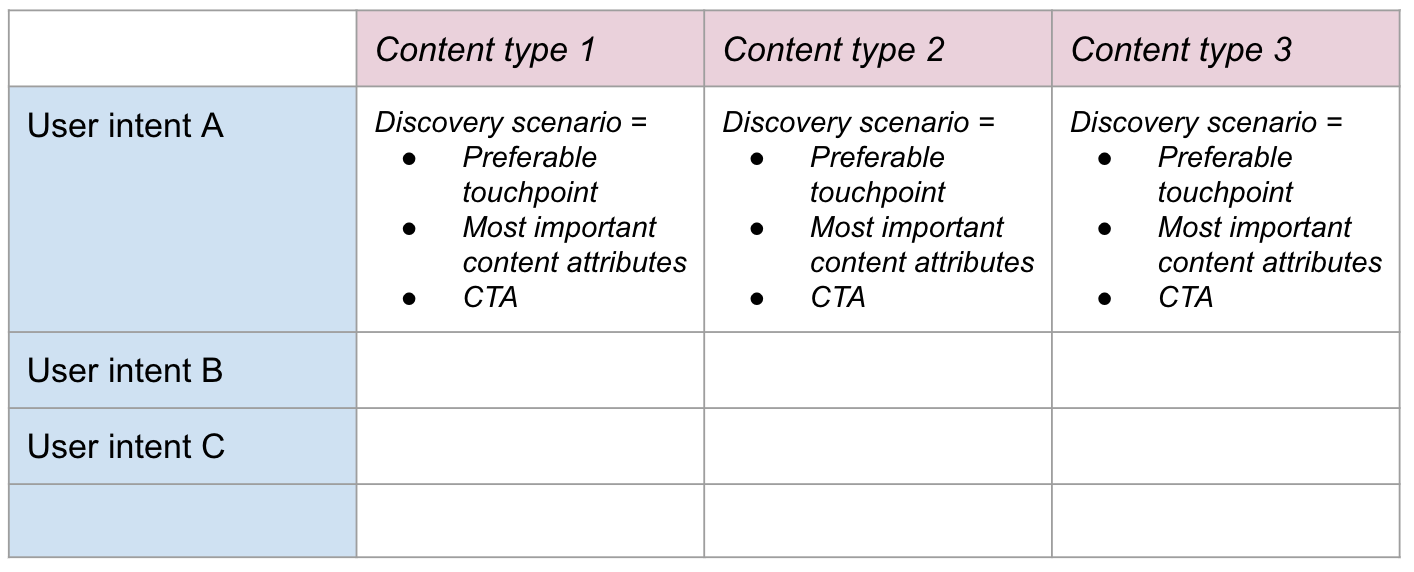
After identifying your goals and core metrics, you should then build a discovery map that reflects your objectives and specific needs. Here is a template and example to use.
On the X axis: describe your different content types: Fresh news and short reads, Reports and long-form, archives, niche content, etc.
On the Y axis : your various user’s or persona’s intents
In each content type box of this matrix, you then describe a “Discovery scenario”. For example, what is the preferable touchpoint (e.g “Search box” or “Discovery tab” or “Home Page”), or what is the most important ranking criteria for your content (e.g. “date of publication” and “topic”), and/or what is the CTA that compliments your North Star metric (e.g “read another article” or “sign in”)
Tip 5 : Evaluate your existing search and discovery
Next, audit your existing setup. Starting by evaluating your various discovery scenarios and note their pros and cons.
Below are examples of other items to evaluate throughout your audit. How do you manage:
typos? Ex: “I want to watch lalalnd”
broad queries? Ex: “I want to watch romantic comedies”?
natural language queries? Ex: “I want to watch Rom Coms”?
There are many more. Remember: The better you analyze your existing search & discovery shortcomings and opportunities, the better you can move faster on optimizing them.
Tip 6 : Find the right balance between AI-led and human-led curation
Curation strategies vary a lot across the media industry. While publishers often rely heavily on editorial teams, video platforms are often algorithmically curated. There is no right or wrong way to do this; finding your balance is key.
AI, for example, can be a way to surface what you have outlined in your content discovery map. Among the discovery scenarios that you have considered, think about how AI can help augment your team’s work. It can bridge gaps or free up editorial time. Finding this balance allows for increased efficiency and a focus on quality.
There are many different ways to leverage AI, here are a few. It can:
entirely power content blocks or rows leveraging various recommendation models
be used on top of manually curated blocks to dynamically reorder content, depending on their popularity
shorten the path to content by leveraging intent detection, and displaying personalized suggestions of content or categories
Tip 7 : Select the right solution for you
After following the tips outlined throughout this, you will be in a better position to select the right solution for your business and team. Your implementation may consist of building your own search and recommendation engine. It might consist of building from external platforms that are made for developers. Or perhaps you’ll buy off-the-shelf solutions.
In making these decisions, here are a few more considerations that are important at that stage.
Think through your unique requirements in terms of short- and long-term scalability. Not all solutions are equal in terms of a geographical footprint, expansion, and the ability to manage audience peaks, for example.
Similarly, understand your team’s unique situation when looking at how architectures and services selected will be built and maintained. If building things out in-house looks to be your best decision, consider what it takes to maintain, scale, and handle regular change requests and develop features and iterations.
Think about the future of discovery: What you have defined today in regards to your discovery map will likely evolve and change as quickly as consumer’s behaviors do. Consider a solution that will be future-proof, enabling you to consistently offer the most enjoyable and rewarding experience for your customers (and teams).
Our hope is that these tips will help you create the most optimized experiences for both your customers and your teams. Best of luck in planning, auditing, and creating your unique search and discovery experience. It’s worth it because effective search and discovery will help engage your site visitors and convert them into fans for the long-term.
Media disruption has become a fact of life in the digital age. Media disruption is a fact of life in the digital age.ons become more diverse, new channels are emerging more rapidly than most media companies can respond.
This pace places an extreme burden on media companies. They don’t want to throw money at every novel channel in our here-today, gone-tomorrow culture because they can ill afford to waste time and resources. Nor can they afford to overlook the next big trend and risk irrelevancy.
When an ad-supported model drove revenue, companies could risk complacency. With the depreciation of the cookie, there is a growing need to move fast to attract attention and leverage first-party data to drive engagement.
New channels, new strategies
Media companies and publishers have re-adjusted their revenue strategies to focus on subscriptions as per-page revenue from advertising has dropped. In a recent interview, New Yorker editor David Remnick noted that advertising sales in their print magazine largely subsidized the content in the magazine for most of its life. Now, digital and print subscriptions pay for the newest Borowitz Report.
Can a successful subscription service be enough for a media company to thrive in the years ahead? For the New Yorker and loyal reader base, the answer is likely yes. For many others, survival means embracing a truly omnichannel strategy that distributes content everywhere that content can be consumed.
The New York Times went through a tumultuous transition a decade ago as it dealt with substantial drops in print readership and revenue. Yes, they have done well with digital subscriptions. However, the Times has also developed a plethora of content products, built for the changing habits of their audience.
The Daily, a long form audio content for the passive Times’ listener, is an excellent example. It demonstrates how companies like The New York Times provide a range of content formats that meet the broad expectations of today’s audiences. Products like these also access emerging digital engagement channels, which offer new revenue streams and drive subscriptions.
New revenue: ecommerce and events
The definition of media is continually evolving. ESPN and Barstool Sports are content companies that also support new endemic opportunities such as sports-betting. Synergies like these not only create new revenue streams but drive ongoing multi-channel engagement. You don’t just read about or watch the game, you participate in the game along with your favorite content brand.
Ecommerce is also becoming a way to leverage brand recognition and build stronger relationships with consumers by supplementing information with a physical product. It may not be a surprise that HGTV sells doormats. But did you know that Barstool Sports now sells One Bite frozen pizza?
Media company events are nothing new. However, they are becoming an ever more common way to drive revenue, engagement and brand loyalty. ComplexCon, the event put on by Complex Networks, is an excellent example of meeting their Millennial and Gen Z audience how and where they want to engage. The New Yorker Festival just saw its second biggest revenue earnings ever in its new hybrid format.
True omnichannel lies ahead
What are some of the promising omnichannel opportunities going forward? As The New York Times has demonstrated, audio is proving to be quite popular. (As well as a bit of what’s old is new again). Given that audio is a fairly passive content channel, it can exist in the background without demanding focused attention from the consumer. In our multitasking culture, having the freedom to absorb ambient media while also exercising or mowing the lawn is highly valuable.
The once-taboo is now an opportunity for media companies looking to engage. As states begin to legalize online gambling and sports betting, there are opportunities to drive new branding and co-branding revenue streams, creating one of the most direct opportunities for the right media brands to surround and interact with the content. It is critical that companies keep their eye on changing trends and emerging opportunities that align with their brand and target audience.
The long game
Indeed, whatever activity a media company chooses to tap into, they must do it authentically and on-brand. The excellent podcast series on systemic racism Who We Are, created by Vox Media and Ben and Jerry’s, is an example of high-quality brand extension.
What direct revenue will these and other emerging markets create? That’s the billion dollar question. But it also misses the point. Creating a content ecosystem that authentically connects great content to your audience supports behavior that drives subscriptions and ultimately sustainable revenue. The key is being open to experimentation. And experimenting does not mean developing a TikTok strategy in 2022 to gain younger viewers.
Some (well, many) attempts will fail. However, those that succeed could become significant new revenue streams. The advent of 5G all but guarantees a turbocharged environment of innovative new channels for media companies to explore in the coming decade.
The future for media companies demands an omnichannel approach. While content is still king, customers now dictate how and where they will consume it. To win a battle fought on many fronts, media companies need to jump into the arena and embrace change. This means combining insight-driven experimentation with new emerging channels and technologies. That’s the kind of customer-centricity that will ensure content drives new revenue opportunities.
Dean Kamen, the brilliant engineer who invented both the Segway and iBOT once said that every innovation eventually becomes a double-edged sword. Initial positive outcomes will inevitably need to be weighed against future negative unintended consequences… the internal combustion engine, social media, Open RTB – for starters.
Our industry continues to pivot away from vendors who have contributed to unintended consequences (fraud, loss of publisher control, etc.). However there is an enormous risk to unilaterally severing ties with all your 3rd parties in a mad rush toward SPO nirvana. The culling of the herd needs to be done. However, it must be carried out with precision lest we cut off our noses to spite our faces.
Len Ostroff, SVP at Critero, had this to say about the programmatic supply chain in a recent article in AdMonsters:
Publishers are working with far more SSPs than they were in the past and we have seen a rise in duplicate bid requests, leading to an increase in infrastructure costs and multiple bids for a single impression. While there is typically value in seeing a few bid requests per impression, there is a point of diminishing returns which can cause a degradation in value and a drop in yield while also increasing fees and costs.
So, what are you going to do about it?
This legitimate observation about our ad industry’s Achilles heel has led to calls for Supply Path Optimization (SPO). Let’s face it: There are obviously too many cooks in the kitchen. Reduce or eliminate 3rd party vendors, say some industry leaders. Moreover, publishers don’t want to see nearly 50% of each programmatic advertising dollar slip through the cracks into the hands of redundant intermediaries. Nor should they allow themselves to be victimized by fraudulent activity.
Don’t throw every baby out with the bathwater
The fact is that SPO is not a zero-sum game. Certainly, there are bad actors whose main goal is to siphon off another point or two from your bottom line without adding value. However, there are also great 3rd parties whose entire focus is to increase income, and improve reader engagement, ad viewability, and UX for their partners.
Most of us remember when Marc Pritchard of P&G famously called for “the death of the crappy media supply chain,” at the 2017 IAB ALM. However, I don’t believe that his intention was for anyone to amputate value-added partners to eradicate the cancer that had developed in the ecosystem of our industry.
Rushing to judgement leads to errors that can be avoided with deeper due diligence. Ask your 3rd parties to articulate specifically what they contribute to your business goals, and most importantly to your income. Require that they provide you with data that supports their contribution. Consult with industry experts and ask your peers about their experiences working with partners and vendors. Look to industry award nominees from the various highly valued trade publishers whose evaluations are objective and authoritative.
It is incumbent upon all of us in the industry to seek higher ground and work with the best. With apologies to our friend Terry Kawaja, the LUMAScape does give some insight into the problem we have created for ourselves. Too much is just too much…and not of a good thing:
I’ve written about the “tyranny of choice” here before. There are simply too many players in the ad tech ecosystem. That’s part of the problem publishers face. My suggestion is to K.I.S.S. Identify those vendors who are not adding tangible value, then say bye, bye. Your ad ops and dev teams will thank you. So will your CFO, shareholders, and maybe even Dean Kamen himself.
The Internet is renowned for bringing out our worst instincts. When anonymous strangers with differing views converge in online community forums, the result is often heated arguments that can quickly descend into insults, threats, and abuse.
Once upon a time, that tendency to “pile on” seemed like a good thing for publishers. If strong emotions drive engagement, and engagement means more page views and ultimately more revenue, then stirring up angry debate must be good for business, right?
The risks of allowing online toxicity to flourish
Is it actually effective to sow controversy in an article, then sit back and let commenters fight it out below the fold? Based upon what we’ve seen over the past few years, not very.
For one thing, social platforms and publishers have had to contend with advertiser boycotts, as brands rush to distance themselves from hate speech and misinformation. Publishers like The Atlantic and Vice, meanwhile, have felt they had no choice but to shutter comments sections completely, cutting themselves off from their readership in the process.
There’s another, much more appealing option: building a safe and healthy online community of engaged commenters. Our research shows that quality conversations and respectful debate actively attract engaged users–and engaged users typically view 4.6x more pages, spend 3.6x longer on-site, and drive 3.2x more revenue than non-engaged users.
What drives incivility in online community forums?
So how can publishers turn heated arguments into quality discussions? First, it’s useful to understand what drives online incivility. Then these underlying drivers can be taken into account in audience engagement strategies. Here are three for starters:
People behave in a less inhibited way when they interact online with people they don’t know and are never likely to meet, in an environment where they can be anonymous and where there are few or no repercussions for behaving aggressively.
People get addicted to being right. Winning an argument can produce a flood of feel-good hormones, similar to winning a bet. As with gambling, that feeling can become all-consuming, leading to a greater focus on “winning” than on debating respectfully.
Comments without context get misinterpreted. While it may not be 100% true that 93% of communication is non-verbal, a comment can seem hostile when elements like body language and tone of voice are missing. And that, in turn, can promote an aggressive response.
How to shift heated arguments to meaningful discussions
There are several options open to publishers who want to elevate the quality of debate in the communities they host. Here are four approaches that we believe in at OpenWeb:
Encourage visitors to become registered users
When people feel they belong to a community, and get to know their fellow community members, the online disinhibition effect starts to fade. Interactions between community members become more civil as a result. But that’s not the only benefit. Registered users are also more likely to return more often, spend more time on-site, and deliver more revenue than non-registered users.
Have editorial teams join the conversation
Editorial engagement is a powerful way to increase the quality of online debate. Editorial teams set the conversational tone and guide discussion by responding to the highest-quality contributions. We’ve found that editorial involvement of this kind typically leads to a 17% decrease in toxic comments.
Define and reward civility
Most people don’t come to an online community forum looking for a fight: often, it’s the atmosphere they find on the site that tips them into incivility. Sophisticated moderation technology can help publishers cultivate a civil atmosphere. For example, you can:
Make it clear what kinds of language and behavior are encouraged, and what won’t be tolerated. For example, our OpenWeb Clarity Mode puts community guidelines front and center, ensuring everyone knows what’s expected of them.
Invite users to rethink their comment before posting, if it looks like it may breach the community guidelines. This draws on the “nudge” theory of behavioral economics, which holds that positive reinforcement at the right moment can spur more considered decisions. When we experimented with such prompts across some of our top publishers, we saw a 12.5% lift in civil and thoughtful comments being posted.
Use multi-layered AI and ML-based moderation to analyze, sort and highlight comments based on their quality rather than their propensity to incite hostility. That way, community members who post high-quality, thoughtful and expert content will be rewarded by seeing their comments highlighted and featured on the site.
Analyze and filter incivility
If rewarding quality conversations is the carrot, then filtering out incivility is the stick. For the most efficient moderation results, a hybrid approach using category-leading AI and ML moderation (combined with a healthy dose of intuitive, manual moderation) can reliably filter out a large proportion of toxic language–and analyze users to understand who are most likely to post toxic comments in the future.
Today, publishers no longer have to make a Hobson’s choice between enabling comments (and seeing them degenerate into petty arguments) and turning them off completely. With positive reinforcement, editorial engagement and multi-layered moderation, overheated arguments can become meaningful discussions–bringing healthier online communities, and higher reader loyalty, to publishers.
About the author
Andrew Sullivan is the Chief Product Officer at OpenWeb.
There are telltale signs that digital publishers haven’t embraced a user-first approach to monetization. Frequently, these unwelcome surprises come in the form of bad ads. There’s a subtle, yet crucial safety issue at play – that of the end user, and to publishers.
Bad ads have become more tangible in recent years. They range from offensive and unpleasant imagery to off-brand messaging. Unfortunately, they have a raft of negative effects. These include user churn, widespread user complaints, and a serious dent in monetization.
In 2021, 76% of publishers reported ad quality challenges affected user experience. Sixty-six percent of publishers reported that ad quality issues impacted their revenue, underscoring how vital it is to adopt a user-first approach.
User experience expectations are changing, and working practices must keep up. Considering fundamental recent shifts in user sensitivity and expectations, we can’t expect outdated approaches to remain effective.
The brand suitability question
With 35% of publishers experiencing worsening ad quality challenges, the pressure is on for publishers to consistently deliver on-brand experiences. In the last 12 months, the definition of brand safety has evolved. These days, the focus is on the distinction between brand safety and brand suitability. It’s no longer enough for publishers to wonder, “Is this creative acceptable for a premium publisher?” The question now must be, “Is this acceptable for my audience, my message, and the content on this page?” That is the philosophy behind a user-first approach.
Poor ad quality threatens the publisher-audience relationship. However, nearly half of all publishers say they lack the tools to control the ads that appear across their digital properties. Misleading links in ads are the primary type of low-quality ad publishers are seeing – 48% of publishers say they’ve seen such ads. Almost as many (44%) of publishers report witnessing fake news in ad content, 28% reporting links to sites with security threats (malvertising), 31% reporting violent content, and 27% reporting explicit or offensive content.
Publishers are brands too
To cultivate strong relationships with their audiences, publishers must deliver engaging, relevant advertising that works for their brand. And every ad counts towards retaining user loyalty, engagement, and ultimately, monetization.
Publishers require custom controls to maintain their standards and values because there is no universal guide for what counts as a “good” or “bad” ad. In fact, publishers are demanding customization, with 47% reporting they need “more control and transparency” from their ad quality tools.
Real-time protection against off-brand ads is essential to maintaining a positive user experience. Realtime ad quality protection enables publishers to avoid advertising that is inappropriate for their brand’s unique sensitivities and values but may be fully appropriate for another brand. Today, advertising must be alignedwith a publisher’s brand based on its sentiment, tone, and messaging.
A dynamic need
It is nearly impossible for a publisher to regain a user’s trust once the user has seen an ad that contradicts the publisher’s tone or looks suspicious, or especially if the user clicks through to a deceptive ad and lands on a scam website. In the world of brand suitability, it’s often “one strike and you’re out.”
While an overall approach to brand suitability, trending topics, and news or event cycles is a must, continual diligence is needed. A user-first approach requires that publishers roll up their sleeves and assess suitability on the ground to ensure their audience’s experience remains on-brand. In short, brand suitability is not static.
Publishers don’t have to start from scratch. Real-time ad quality tools that provide granularity exist to eliminate the heavy lifting. Setting content parameters and reviewing ads on a site is not merely a maintenance task for ad ops. It’s a vital component of a publisher’s business strategy.
The way forward
Publishers have devoted time and resources to assure brand-safe environments for advertisers. Now, publishers must remember to devote the same attention to brand suitability for their own brand and users. Going forward, a user-first approach requires publishers to align page content and ad content, and consider them holistically. That control requires full visibility into all ad content on each page, as well as granular customization for their unique audiences.
Boosting ad quality translates into revenue upside and enables a brand to stand out. When a user-first approach informs ad quality decisions, the benefits are felt by publishers and users alike.
Professionals in all industries have become obsessed by data over the last decade. It is true that having a firm understanding of your data sets is key to growing a successful business. However, data for its own sake is never the answer.
The whole point of collecting data is to achieve something, such as optimizing subscription experiences to improve your conversion rate. Doing so leads to better value alignment, longer lasting customers and, ultimately, higher revenue.
But data that isn’t understood and actionable is a waste of an organization’s time. And the concept that data is gold dust has led many publishers to chase vanity metrics.
How to approach data
We advocate for a new outlook on the types of data that digital publishers have at their disposal. Working backwards from the outcome, rather than forwards from the granular metric, data can be prioritized into three buckets:
Performance data
The most important data is performance data. These are the metrics that tell you whether things are, generally speaking, getting better or worse. In turn, this is the data that you should call on when deciding to explore a new initiative.
If you don’t have performance data, then filling this gap should be an urgent business objective. Doing so allows you to report on the overall health of your business. For example, if your organization’s churn rate has gone up, you know you need to fix it. Similarly, if acquisition rates have tanked, you know the conversion journeys aren’t working. These insights are the very least you should be getting from your datasets.
Actionable data
The next metrics to turn your attention to are actionable insights. This data points you towards improvements you can act on immediately. These are high priority as they are the clearest and least risky levers you can pull to affect your performance stats.
For example, if no readers are reaching the end of a paywall meter, you know you’ve set the limit too high. The data is the average number of pages a visitor consumes against a meter; the action is to reduce the meter size.
Everything else
There is a plethora of datasets available. However, if the metrics don’t give you an overview of your performance, or provide you with an actionable route to improvement, they shouldn’t be prioritized.
You could call this bucket of data “vanity metrics,” or data that have diminishing returns. By this we mean data that might appear interesting in theory, but in practice needs so much contextual explanation that it becomes more time consuming than it is valuable.
Let me give you an example. Imagine a publisher that uses a metered paywall, allowing five free views per week. This publisher tracks their average number of free pages before subscribing, which is 30. What are the actions that the data points can trigger?
On its own, it’s just not enough data. The metric doesn’t distinguish between visitors who viewed all five free pages, six weeks in a row, from those who dabbled with the odd article here and there over the course of a year. To derive an action would require a lot more analysis, probably with data scientists. A different metric, average meter consumption, would be far quicker and cheaper to action. This data could immediately point to a misconfiguration in the meter.
How to approach data tools
There are a myriad of tools out there to enable news and media companies to collect, clean, manage and store their data.
Data solution red flags
There are two extreme ends of the same spectrum that digital publishers should avoid at all costs.
One of these is a black box. Solutions in this camp do not expose any data or allow you to export it to other systems. In other words, these tools may do the job, but exactly how they get to the output is unclear. Digital publishers need access to their data to take action on it. Ideally, the data is embedded at the point where decisions are made.
The other red flag is a company that offers a specific solution but is proposing to solve every pain point you have. We often see solutions that provide a rich dashboard that looks great. However, it may rarely be in practice because the data is either non-actionable or not holistic.
Does the perfect tool exist?
You would be hard stretched to find a holistic, actionable solution that covers all ground. In an ideal world you could build a data warehouse that combines business intelligence and actionable functionality, although this could be expensive.
In reality, best-of-breed solutions should expose performance data for their own domain. And – crucially – they should integrate actionable data into their UI at the point of action. The important thing is that this will guide users toward an informed decision.
Modern businesses need to experiment, iterate and A/B test in real time, without calling upon a team of engineers to implement changes. All readers that interact with your content should be tracked in a comprehensive and meaningful way, by a platform that then allows commercial decision makers to test and learn from different conversion strategies.
In short, a full-scale subscription experience platform should not only show you what your data looks like, but also how you can use it to improve the customer experience. Publishers that match deep industry knowledge with powerful technology solutions will take market share from those still relying on “one-size-fits-all” customer journeys.
Data provides the key to profitability, when done correctly
You need to have quick and effective reactions to underperforming aspects of your business. This means having holistic and actionable data locally situated to make changes effectively.
Those who approach the data conundrum with a creative, long-term mindset, and avoid being dazzled by vanity data and impractical tools have the best chance of success.
The problem of data leakage is one often not well known or understood by publishers. Therefore, addressing data leakage is rarely prioritized. This particularly true if the pressure to monetize their inventory is high and resource is limited. But what does data leakage mean? And are there ways publishers can protect their data from leaking? It’s crucial that publishers learn more about this problem and about the solutions available that help prevent it.
Data leakage typically occurs when a brand, agency, or ad tech company collects data about a website’s audience and subsequently uses that data without the initial publisher’s permission. The core concern with data leakage is that it causes a publisher’s ad inventory to depreciate in value. If bad actors collect data about a publisher’s users, they can use this information to target these users elsewhere — potentially on cheaper inventory. In other words, programmatic spend is diverted from the original publisher. This results in a reduction in demand and, therefore, a lower yield.
Data leakage can happen transparently with the publisher’s knowledge or consent. For example, a company might request that a publisher install code on their page that allows data to be gathered about their users in exchange for something else such as a minimum spend commitment. In some cases, this might be considered a commercially worthwhile proposition providing the appropriate regulations are complied with.
More frequently, however, data leakage does not happen transparently. In the context of programmatic, this usually occurs when publishers choose to work with numerous technology partners in an effort to maximize revenue and yield. There frequently a correlation between the number of partners a publisher chooses to work with and the risk of data leakage.
How data leakage happens
There are a few ways data leakage can happen:
Open RTB bid requests
Data leakage can occur when Supply Side Platforms send bid requests to Demand Side Platforms via using the OpenRTB protocol. This contains a wealth of information about the user, the content they are consuming, the device they are using, their cookie id, where they are located to mention a few. (See the Site, App, User, Publisher, Content Objects). Much of this is information integral to the programmatic auction process. However, it could be used to profile users and target them elsewhere. How much this actually happens is unclear. It may even occur unintentionally by machine learning, bidding algorithms.
Cookie syncing or tracking pixels
Data leakage can also happen when a third party gets access to a publisher’s page either via cookie syncing or a tracking pixel. A pixel is an invisible piece of code that marketers or ad tech platforms use to track users, apply campaign strategies such as frequency capping and monitor performance. Pixels can also collect information about a publisher’s audience. Unfortunately, that can be used to enable the targeting of those users elsewhere.
Today, the vast majority of players in the programmatic digital supply chain are reliant on third-party cookies for user identification and for campaign targeting, optimization, measurement, and attribution. Cookie synchronization is a process that is required to communicate user identity between platforms.
The problem of data leakage arises when platforms that publishers work with give other platforms that have no direct relationship with the publisher access to the page to cookie their users. That platform is then able to build user profiles, which allows them to reach that audience elsewhere without having to buy any media on the original publisher.
How to ensure your data is protected
One way to prevent data leakage is for advertisers, agencies, ad tech companies and publishers to have legal contracts that stipulate who owns what data and how other parties can use it. You might be protected contractually. But how do you monitor and enforce these contractual obligations in practice?
Publishers can also leverage tools that track which platforms are dropping unnecessary pixels or bringing unwanted data collectors. These tools can be used to undertake periodic audits to identify where data leakage is happening. Alongside, publishers should implement policies and practices to qualify, monitor and deal with bad actors.
How to balance the risk and rewards
It is important that publishers find the balance between a closed, safe environment and a risky but sustainable monetization strategy.
With the impending “cookie apocalypse,” publishers are already opting to work with identity providers that are not reliant on third-party cookies to ensure they maintain a healthy programmatic revenue stream and protect themselves from data leakage. Next-generation identity solutions provide a foundation for user identification, which is fundamental to campaign targeting, optimization, measurement and attribution. They also offer new safer mechanisms and tools that limit the amount of data leakage.
When choosing a provider, check that they have built mechanisms that will only assign your users an identifier if they have consent to do so and only share those identifiers with the platforms you have authorized. Finding the right identity provider today can help you prevent data leakage, respect consumer preferences and local privacy regulations while facilitating sustainable monetization.