2022 already has been a dramatic year for streaming. Even if you’re not trying to keep up with day-to-day industry developments, you’re probably aware that CNN+ launched and died, Netflix announced plans to launch an ad-supported tier, and IMDb TV was renamed “Freevee.” These rapid developments may seem daunting for many potential streaming players, considering that the ground will shift again soon.
But here’s the good news about these rapid changes: While the “Streaming Wars” narrative — referring primarily to competition among media giants’ SVOD strategies — remains the focus of many in the business and trade press, the reality is that there are wide-open opportunities for a variety of players. Whether it’s a paid app, a YouTube channel, or a free channel on a FAST service, streaming is definitely not confined to the players locked in the so-called streaming wars. Streaming is for everyone.
We’re just getting started
SVOD, AVOD, FAST, OTT, and CTV are not only competing, overlapping, and complementary acronyms — they represent multiple potential business models as well as multiple avenues to reach audiences looking for entertainment, news, and sports. Across devices, services, and platforms, there are more opportunities than ever before to develop content, products and business models contributing to the next evolution of the streaming industry.
Media players and startups — large and small — can compete and win the loyalty and trust of consumers. By the end of 2022, we will see new players on the streaming scene — growing, thriving, and innovating to capture audience attention and significant revenue opportunities.
Find your place in streaming
The fact is, it remains early days for streaming viewership, and we need bold players to bring expertise and creativity to the space. So let’s set aside the winners-take-most Streaming Wars narrative and consider these factors:
1. Focus on the right video strategy for your audience.
In the streaming space, many strategies and tactics are still in an experimental stage, so don’t assume that your traditional competitor’s widely-publicized strategy is going to work. And definitely do not copy their strategy without significant research and diligence, because you may find that your competitor doesn’t have a clue — and won’t provide significant competition at all in the streaming space. For instance, it may be that launching a solid AVOD or FAST strategy will give you much of the data you need to make a decision about an SVOD strategy.
2. It’s easier and less expensive than you think to get started.
There are new technologies and new tech companies that can support a variety of streaming strategies. Generally speaking, these options are less expensive, more standardized and faster to implement than many broadcast technologies. Additionally, trusted brands will be in a good place to negotiate with these vendors.
3. Creativity and innovation are badly needed in the streaming space.
Think about how hard it is — still — to navigate streaming interfaces. This space needs to improve the consumer experience, ASAP. With so many major media brands in flux, those who are focused on making streaming a great consumer experience have an incredible chance to jump in and create a successful strategy.
Focus on the consumer to improve what’s ahead
The complexity of the streaming landscape is enough to confound savvy media veterans and newcomers alike. But this complexity should not prevent most media players from crafting or revamping their streaming strategy – now. It’s a wide-open field for trusted brands and innovators, especially those who create content, products and services with viewers at the center. We all have a lot to learn from rapidly shifting consumer habits and preferences, and the timing has never been better to start learning.
About the author
Christy Tanner, President of Tanner Media LLC, is former EVP & GM of CBS Interactive, where she built CBS News Digital/CBSN into the #1 streaming news service, with more than 1 billion streams in 2020 and 2021.
Nominated by President Biden, and recently confirmed by the Senate, Alvaro Bedoya was sworn in as the 5th Commissioner of the Federal Trade Commission (FTC) this month. As a result, Chair Lina Khan now has a majority of Democratic-nominee votes with which she intends to move quickly to implement a promised progressive agenda. Let’s dig deeper into what issues Chair Khan and the FTC are likely to move forward and how this might play out.
Privacy rulemaking
In February, the FTC gave the required advance notice to the relevant Congressional committees that it intended move forward with a rulemaking “to curb lax security practices, limit privacy abuses, and ensure that algorithmic decision-making does not result in unlawful discrimination.”
Now that Commissioner Bedoya is confirmed, it is widely expected that the FTC will move forward in the very near future. Historically, an FTC rulemaking of this kind can take years to process. However, in 2021, the FTC streamlined the process including by removing the requirement for a staff report and analysis. So, while it is not clear exactly how long it will take, the intent is to move quickly.
One of the wild cards in this process is a petition filed last year by Accountable Tech, which urged the FTC to ban “surveillance advertising” under its authority to prosecute “unfair or deceptive” acts. The petition suggested the FTC could act in one of two ways:
Prohibit platforms from using personal data for targeting ads, or;
Prohibit businesses from “sharing user data, for the purposes of advertising, to any business line, website, advertising technology, or tracker other than the business or service with which a user intentionally interacts” AND prohibit platforms over a certain threshold from using consumer data to target ads.
As hinted at in the second option, Accountable Tech’s petition notes that “any rule should make clear that it does not ban all advertising or even all targeting of advertising.” Indeed, they specifically call out search, contextual, and first-party targeted advertising as acceptable practices in line with consumer expectations. All that said, it is unclear whether and how much the FTC will follow the suggestions of the petition.
Ramping up COPPA enforcement
In 2019, the FTC initiated a mandatory review of their regulations concerning the Children’s Online Privacy Protection Act (COPPA), but we have heard very little since. Consumer groups have been calling on the FTC to modernize the COPPA rules, which have not been updated since 2013. Now that Chair Khan has a majority, we are likely to see revised draft regulations sometime before the end of this year.
In the meantime, on May 19, the FTC issued a policy statement indicating that they intend to closely examine whether ed tech providers are fully complying with COPPA. Specifically, they will focus on whether these companies have sufficient “limitations on collection, use, and retention, along with security.” Enforcement action in the ed tech space could provide clues as to how the FTC wants to update the COPPA rules.
Merger reviews
The Biden Administration has publicly announced that it will closely scrutinize any and all acquisitions by big tech companies. To that end, the Department of Justice and FTC are working on updating the merger guidelines.
As part of a series of “listening forums” to gather feedback, Chair Khan voiced concerns about mergers in the media sector, noting that there were $200 billion worth of mergers in 2021. She disclosed that “we are working to ensure that our analytical methods are keeping up with new market realities.” Specifically, she wants to avoid consolidation that leads to firms having “outsized power over how information is distributed.” At the same forum, DOJ Assistant Attorney General Jonathan Kanter expressed concerns that consolidation in the media sector has led to a decrease in the amount and diversity of content.
From my perspective, there are two big takeaways from this listening forum. First: The Administration is doubling down on its efforts to stop big tech platforms from developing (via acquisition) a dominant position in the content industry. To that end, they are looking for new ways to identify and quantify harms to content creators and the market in general. And Second: While we can expect the Administration to remain hyper-focused on big tech mergers and acquisitions, publishers should also understand that the FTC and DOJ will be closely scrutinizing deals between publishers.
Dark patterns
Last year, the FTC issued a policy statement to curb the use of “dark patterns” to trap consumers in subscriptions. Since then, the FTC has followed up with enforcement action against various companies and we expect that action to continue going forward. Many have observed that Amazon may be in the Commission’s sights. While that may be true, the FTC’s enforcement record indicates it is looking at the industry more broadly.
A bold era begins
Lina Khan has been heralded as a bold thinker, ready to lead the FTC into a new, modern era. Yet, for most of her tenure, she has been hampered by the lack of a working majority. With that constraint removed, we can expect more and aggressive action from the FTC on privacy and competition. Indeed, the era of Lina Khan is about to begin in earnest.
In the 18 months since social audio spaces were introduced the media landscape, digital content companies have experimented to uncover their purpose and how they can best serve audiences. For The Washington Post, the answer was revealed amid the discussion of a massive leak of offshore data, which exposed the secrets, deals, and assets of the world’s rich and powerful.
The Pandora Papers investigation was not The Post’s first use of social audio. They’d experimented with Clubhouse in mid-May 2021 and held their first Twitter Spaces event June 10, 2021.
It was, however, one of their most ambitious experiments as it involved other global news organizations simultaneously joining the Twitter Spaces event. The Pandora Papers investigation spanned five continents and involved 600 journalists in 117 countries.
“The Pandora Papers was the largest reporting consortium in journalism history. We’re talking about [journalists examining] 11.9 million documents and financial records,” said Michelle Jaconi, head of news talent strategy and development at The Washington Post.
That’s a wealth of information – but a challenge to present given its scope and depth. “The amount of nuance that you can go into in a platform in audio where you don’t have the set limitations of an article is wonderful.”
“Twitter Spaces has been an incredible playground for creativity and exploring ways where we could stretch that platform,” Jaconi said. “That one was one of the biggest and most ambitious spaces we’ve done, because we did it across different newsrooms. It was an incredibly fascinating test and stretch, and incredibly well received.”
Space(s) for transparency and engagement
Social audio allows The Post to share the teamwork and collaboration that takes place in their newsroom, Jaconi explained. The work that goes into a large scale, investigative report is largely invisible to readers. However, the audio format allows the journalists to communicate the process and passion that goes into a project like this one. As Jaconi points out, “The voices humanize the work, effort, the passion and the care that goes into every piece of journalism at The Post.”
One thing the team at The Post has learned through its use of social audio is that the audience is incredibly curious and wants to learn more about the journalistic process.
“We learned, wow, there is an audience for this, and [social audio] is incredibly good for things that are so complex that you need extra time and nuance and care to explain,” Jaconi said. “And, especially with Pandora Papers, we were testing the platform and how much we could stretch the production capabilities of an audio event that was truly global. We had some issues. But I think Twitter’s even gotten better since then at the product and the production aspect of doing massive events.”
Attracting and engaging audiences
Like all publications, Jaconi says The Washington Post not only wants to increase the size of its audience, but also engage younger, next generation, diverse and global audiences. For the use of Twitter Spaces grew the following of @washingtonpost on Twitter, as well as the following of their reporters.
“I think one of the things that social audio is incredible for is that social platforms convene audiences of curious people – or sometimes just bored people who become curious when they see a trending hashtag,” Jaconi said. “Every time we do one of these spaces, our reporters get new followers. That shows that we’re building audience.”
Social audio spaces create an intimate connection between The Post and their audience, on a device that many use to interact with their family and friends. “That is a wonderful way for us to not tell our expertise, but instead to show it. We do it in a way that provides intimate connection between our reporters and their audience,” Jaconi said.
For reporters who often work in text-based mediums, one of the things that makes social audio fun is that they get to know their audiences more personally and engage directly.
“While you’re talking, you can actually see avatars and photos of people joining in that conversation right there with you. And that is something that I love for reporters to know,” Jaconi said. “Who doesn’t like telling a story and looking at the avatar of someone and saying, ‘oh, thank you for listening. That’s so interesting that you’re popping into this conversation and listening to me.’ That has been really rewarding for everyone who’s participating.”
And, as it continues to improve the functionality of Spaces, Twitter is now surfacing live audio to users when they first log in and providing beacons to audiences indiscriminately. This adds value for digital content companies because previously, Twitter had only surfaced Spaces to an organization’s existing audience.
“Social audio is one of the most exciting playgrounds right now to gather new audiences because the product keeps getting better,” Jaconi said.
Adoption, addiction, affection
In helping Post reporters reach new audiences, Jaconi looks for a funnel of adoption, addiction, and affection. With The Post’s recent reporting on the war in Ukraine, Jaconi said they are seeing an uptick in followers, but also affection. Social audio plays into this by increasing the personal engagement between audience and reporters.
In particular, The Post has sees a trend of audience members sending deeply moving messages. “People have been following reporters for the first time and posting comments like: ‘I am praying for your safety. I hope you’re okay. Please be all right.’ That is affection and concern for our journalists,” Jaconi said, noting that she’s never seen this kind of thing take place at this scale before.
“To have that be the overwhelming chat response to an audio space from our reporters covering the war, boy, is that a different experience for our journalists and reporters,” Jaconi said. “It means that we we’ve done a really good job and reaching people who are interested in information and are interested in building that relationship with us and our reporters.”
Lessons learned
Jaconi explained that there are a few best practices in the social audio space that digital content companies ought to think about.
First, update your Twitter app. Jaconi explained that Twitter often updates Twitter Spaces and improves and fine tunes its functionality. (We covered some of those in our last social audio piece.)
Second, remember that audience members can join Twitter Spaces mid-stream. It’s possible those audience members have never met you before. Hosts should make a habit of re-introducing themselves during the course of an event. This should include addressing new people joining the Space and telling them what they’re speaking about, their name, background, expertise, and the topic of discussion.
“It doesn’t have to be boiler plate. It can be done in a casual way. But also, because there’s audiences that are listening while they’re multitasking, I really urge people to introduce themselves again,” Jaconi said.
Thirdly, Jaconi suggested that digital content companies who engage in social audio spaces ought to “feed their audience.” This means give your social audio space a thread of everything you covered in that space. If you’re using social audio to discuss investigations, mention the methodology of your investigation, the complexity of doing the investigation, biographies of speakers or guests and the like, in a thread. This assures that the listening experience isn’t just a one-off that happened in the Twitterverse, and instead is and can be connected to other content, events, or used in the future.
“It is so rare, and so exceptionally powerful, to be in the same place as your audience at the same time, with everybody convened,” Jaconi said. “You’re convening the curious at something that you’re an expert in. So feed them when they’re there, because it might be a while before you convene them again.”
Anita Zielina founded the Executive Program in News Innovation and Leadership at CUNY in 2019. Since that time, she has shaped the leadership skills of executives from local media, start-ups and major outlets such as The New York Times, Reuters, Bloomberg, and ProPublica.
“I just built the program that I wish I had a bit earlier in my career,” explains Zielina. Like so many in our industry, she says “I started out as a journalist and I never had the management training, the product training,” she says. “I never learned how to speak the language of the business and strategy side of things.”
An Executive MBA at INSEAD, addressed some of those needs, but “there was not one other person from media in my class,” Zielina observes. In a cohort of 120 people, all of her peers were from consumer brands, oil and gas consultancies, banks, and the like. Nonetheless, she says, “I loved the experience.” But she could see that there was a need for such a program tailored to the media industry.
Zielina has set out to fill this need at CUNY. She built a program offering elements of a traditional MBA – with classes on strategy and organizational change – alongside a “comprehensive leadership growth development program,” and a focus on media best practices.
Anita Zielina
In a wide-ranging interview, Zielina – who is returning to Austria to launch her own consultancy focused on digital and leadership transformation – shared her views on the key challenges facing the news and media industries.
Here are five of the core elements that emerged from our conversation, with a focus on supporting future leaders – and the challenges facing them – in the media industry:
1. Training the next generation of leaders
Zielina has extensive leadership experience in media including stints as Chief Product Officer & Editor-in-Chief Digital at the Swiss-based NZZ, Digital Editor and Deputy Editor-In-Chief at Stern the German current affairs magazine, and as an Editor at the Austrian newspaper Der Standard. Looking back at previous roles she says, “I think I did a decent job. But I had to teach myself a lot of the skills you need as a leader.”
Those skills include an ability to navigate the intersections of business product, audience, editorial, technology and innovation. They are not necessarily acquired in the newsroom, she suggests, and the media context is often missing from traditional business programs.
“Our industry has a tradition of people rising to leadership roles,” she says. “They were great journalists. Then suddenly they become managers, and they do not get the support that they need.”
The need for this type of support is clear when looking at the graduates from CUNY’s executive programs. “Half of the people in that cohort that just graduated have taken on a larger role throughout the year or immediately after the program,” Zielina told us, “either in their own organization or in a different organization.” The training CUNY provided has been crucial to enabling them to effectively step into these leadership roles.
2. Strategic vision and execution
“There are some similarities in organizations whether they are large or small,” Zielina says when asked to share the biggest challenges for participants in the CUNY’s Executive Program in News Innovation and Leadership. “Number one is strategy.”
Shortcomings in communication, as well as the need for strategy to continually evolve and be updated, are key factors. Even when strategy exists, she says “it’s not clearly communicated. In other cases, the strategy “is old, it’s faulty, it needs to be adapted to new challenges.”
To address this, Zielina encourages leaders to think about whether their organization is prepared for transformation. They must focus on which audiences they want or need to reach, and how to ensure that appropriate resources are prioritized. Integral to this is a “talent pipeline” as well as clarity about the type of work culture you want to instill.
“The difference between an organization that successfully manages transformation, and an organization that doesn’t, is not necessarily that one has a strategy paper or slide deck while the other does not.”
At the heart of this are leader who can turn strategy “into products, into audience work, into services, into organizational structures, and the daily execution routine.”
3. Detoxifying the workplace
Implementation is about more than just the products you build, and the platforms you use, Zielina reminds us. People, ethics, and culture must not be overlooked.
The workplace is an area in which she believes change is long overdue. If not, then talented people will leave. For good. In fact, Zielina says, many are already gone.
She notes a generational shift whereby Millennials and Gen Z “are not willing to put up with the not-so-great culture and ethics anymore.” “They are opting out,” she says. Unfortunately, “these people are never going to come back if we lose them now.”
According to Zielina, the size of this issue is one that too few industry leaders grasp, although she believes the trend is “becoming more obvious.”
“Younger colleagues in this industry, are waking up to the fact that they don’t have to stay in places that are toxic. They don’t have to stay in places that don’t let them have impact.”
“I think it’s the big the big issue that we’ll have to tackle the next few years,” she says.
4. Making DEI commitments a reality
“A lot of tensions obviously revolve around women, people of color, [and people] from different socio-economic backgrounds, finally saying, ‘I want a seat at the table. And if I don’t get a seat at the table, I’m going to leave.’ So really prioritizing DEI is so crucial.”
Zielina feels that “there was a certain reckoning after the murder of George Floyd and we see movement there.” However, many organizations are failing to deliver on their DEI promises.
Too often, she says, we hear companies say “yes, we are prioritizing, but it was so hard to find a woman and it was so hard to find that person of color. So we took another white man, but next time, we’re definitely gonna do it.”
“If we don’t tackle the big underlying cultural issues of this industry, if we don’t make this industry more attractive, if we don’t make this industry more equitable, if we don’t make this industry a healthier, better and more supportive space, we are going to lose all those people,” she adds.
5. Updating outdated modes of human capital
Making the industry more attractive, Zielina suggests, includes learning from the creator economy and the great resignation.
“More folks are realizing maybe I don’t want [to work for] an employer, maybe I want to do my own thing. But I don’t want it to be a kind of hockey stick startup with venture capital, I just wanted to work for me. I want to tell my stories. I want to serve my audience, who I care about.”
“We are going to see more of that,” she says, which means rethinking collaboration and working with creative/journalistic talent. She also believes we will see increased emphasis on impact, flexibility, and hybrid work – issues that matter to growing numbers of the workforce.
“There is a huge disconnect between the corporate world, and specifically corporate HR and applicants and employees,” she cautions. “And this disconnect is getting bigger.”
“You can start that tomorrow,” she says, urging organizations to ask “whether our incentive systems, our HR processes, our way of work is still adequate for this day and age.”
Future plans
After she leaves CUNY, Zielina plans to continue to focus on ensuring organizations have the structures, skills and talents they need, “in the space of digital leadership and product.”
Zielina sees signs that a famously myopic industry is starting to look beyond national markets for solutions. “It makes me optimistic that it seems that we are getting a bit more global and a bit more international as an industry,” she says.
“Those best practices are really starting to be shared across borders, and that that I think is an a fantastic development. We need more of that,” Zielina adds, “and I hope to play a part in that in at least bridging that gap between the U.S. and Western Europe.”
Netflix’s earnings report last week sent a chill across nearly every company with a business model tied to a direct-to-consumer relationship. There are real concerns about the global economy and speculation about whether the massive increase in streaming viewing habits seen during the pandemic will prove to be enduring. However, I wonder whether the insights gleaned from the Netflix situation are unique to Netflix and not a strong indicator for other media companies, most of which are just starting their streaming ventures.
First, let’s acknowledge the macroeconomy. Inflation registering over 8% will impact nearly every consumer market; this is especially true if inflation leads to higher interest rates and the dreaded “R” word. Unfortunately, this will be an ever-intensifying concern.
There has been a great awakening around the globe after two years of Covid, during which we had requirements and excuses to stay home and avoid socializing. There were countless stories in the trade and mainstream press as we witnessed streaming viewership’s outsized growth about isolation’s impact on our insatiable appetite for entertainment – escape. And binge-watching – which was already a trend after Netflix tossed a hand grenade into the linear schedule – only escalated during this period.
Certainly, Netflix finds itself with real competition for digital share of wallet for the first time in its history. Storied media companies have rolled out exclusive offerings that feature everything from hit television programs to blockbuster movie franchises: Batman, Star Trek, Yellowstone, Avengers from HBO Max, Paramount+, Peacock, Disney+, respectively. Many have regained rights to classic television hits that are endlessly bingeworthy. Meanwhile, Netflix has increased its price, nearly doubling its monthly cost ($15.49 from $7.99 when it first launched) while cracking down on password-sharing as it, impressively, has saturated the market.
But while Netflix may have led the way in streaming, it may not be the best proxy for the subscription market opportunity. The company faces its own issues with stagnating growth and should not be mistaken for marketplace indicators.
What is really happening
DCN’s 2021 research into the value of direct, trusted consumer relationships, brands as proxies for this trust, the needs and behaviors of Gen Z vs Gen Y, and the subscription market point to this lesson: Ignore Netflix and stay the course.
Most important are the lessons coming from studying the “next” generation. Consumer behavior is radically different in a world where payment and immediate gratification are merely a double tap of the thumb and face scan away on a mobile device. Paying for access to your favorite news or entertainment product, whether podcast, app or website, is no longer a foreign concept after hitting a “paywall.” Rather, it is little more than a friendly nudge along the way associating value with the products you love.
The number of people willing to pay for access to news and entertainment is increasing. In fact, Netflix’s greatest legacy for the market as a whole may have been leading the horse to the water. Netflix also worked with premium providers and helped build an appetite for great content and normalized paying for it.
What publishers seek
Now, distribution platforms from Apple to Google to Facebook are being pushed to finally act as true partners in driving subscription revenues and monetization for premium publishers. At times this nudge has had to come from regulatory threats in an effort to create more balanced bargaining power.
But what are publishers seeking? Publishers expect traffic to their owned and operated platforms and true ownership over the customer journey including the underlying transaction and customer data.
Publishers also want to take back control over the pricing, bundling, and messaging for their services from the distribution platforms. This allows a trusted publisher to extract and retain more subscription revenues by controlling their highly-valued brands and, importantly, the customer data from before, during, and after their subscription relationship.
Putting things in perspective
For decades, the vast majority of digital content was available for free.
Meanwhile, Netflix built its business on spending (many would say excessively) on licensing and creating content. It helped rebuild the consumer appetite for quality content and experiences worth paying for. However, when we consider the implications of the company’s recent subscriber losses, we should not be so quick to predict a ripple effect across subscription-based businesses as a whole.
While a couple of news publishers, and a handful of other streamers count their subscribers in the tens of millions, the reality is that most publishers count theirs in the tens or hundreds of thousands. Thus, the basis for comparison with Netflix’s 220 million subscribers is specious at best. That’s like comparing a slowdown in Coca-Cola’s beverage sales to my kids’ driveway lemonade stand.
And the behavior of younger consumers points to a healthy appetite for great content and a willingness to pay for it. Now is not the time to panic, pivot, or radically shift your subscription strategy in Netflix’s wake. Instead, trust in the value of quality content well-delivered in trustworthy settings and know that audiences will be right there with you.
Bugs Bunny and Michael Jordan co-starred in Space Jam. Bill Cinton was re-elected to serve a second term as President of the United States. Tiger Woods became a professional golfer. The Summer Olympics were hosted in Atlanta. And washingtonpost.com went live. What do all of these events have in common? They all took place in 1996.
It has been 25 years since those first readers could get their news from The Washington Post online. Back then, Post articles couldn’t be “googled,” since Google — as a company — would be founded two years later. And sharing a news article with friends couldn’t involve Facebook or Twitter, as these networks wouldn’t come to market for eight and 10 more years, respectively… TikTok was only the sound an analog clock made and early-social media adopters were closer to Tom being their first friend on MySpace than influencers going viral and becoming millionaires from creating content on Instagram, Snapchat and/or YouTube.
News consumption was a one-size fits all paradigm: heard or seen via broadcast news on TV or radio, read from printed ink on paper, and skimmed from websites that were effectively static brochureware representations of their print big brothers (with some supplemental content online). There was no personalization. The model was one-to-many: here are the top things reader X, Y and Z need to know to stay informed. That model is changing and has changed. And The Post has shown success in personalizing the news to readers’ interests through My Post, newsletter subscriptions and much much more.
Stay tuned, Washington Post readers are about to see more personalization in 2022!
Creating and distributing the news: then vs. now
An “Apple-to-Apple” Comparison of Reading The Washington Post on December 20 in 1996 and 2021 through then-Modern Apple Technology:
The December 20, 1996, homepage of washingtonpost.com on an Apple Macintosh
Rhe December 20, 2021, home screen of the WashPost iOS app on an Apple iPhone
Change is good. But change needs to be managed. A lot has changed in this last quarter century at the intersection of media and technology. The Post has responded to change by building new systems that manage how content is created, distributed and amplified. But one thing has remained constant — great reporters and editors create great journalism.
Another constant is that quality journalism will be seen or heard by consumers looking to stay informed. And it can shine through the cloudy haze of mis-and-disinformation maliciously shared online.
Although these constants of good journalism from trusted institutional brands and other media players communicating the news remains, how consumers get their news has certainly changed with the times. In today’s digital new media landscape, according to The Pew Research Center, “more than eight-in-ten U.S. adults (86%) say they get news from a smartphone, computer, or tablet ‘often’ or ‘sometimes.’”
As a media AND technology company, The Washington Post has not just followed consumers to their preferred destinations, it has been a leader in creating content and bringing it to readers — readers who may have an interest in politics can get their Daily 202 newsletter emailed to them; food enthusiasts can cook with confidence with Voraciously recipes and guides; podcast listeners can subscribe to Post Reports, Please Go On, Can He Do That, and other audio format news; and over 1.2 million fans of @washingtonpost on TikTok can be informed and entertained by short, witty, videos by a creative team of content creators.
All of this work needs to live somewhere. Platforms, tools and services power this news before it reaches readers’ smartphones, computers, or tablets. The Washington Post has had to understand not just the scalable infrastructure needs of today to deliver this news where and how readers want it, but technology leadership has also had to set the organization up to be successful in the future with new and expanding infrastructure and Infrastructure-as-a-Service (IaaS) resources. It’s like the old sports adage — Wayne Gretzky wasn’t the fastest skater on the ice in the NHL and he wasn’t the biggest professional hockey player. He was the greatest because he played not to where the puck currently is, but where the puck was going.
The Post’s aspiration and northstar is to not just continue to deliver excellence in journalism, but also to equally deliver excellence in engineering and innovation. The Post is playing to where the innovation puck is going by as, Deloitte Insights suggests, “designing systems in which humans and machines work together to improve the speed and quality of decision-making.” The Post is doing this to improve the reader experience through personalization and to allow company leaders to turn more data into actionable intelligence at scale.
“I’ve always understood and appreciated the work that The Post contributes to the journalistic space, but interviewing [for my role at The Post] quickly made me realize the sophistication behind the engineering effort supporting that mission.”
— Washington Post Data Engineer Jack Miller, who joined The Post in 2021.
Data, data, everywhere. Data, data, time to share.
Moore’s Law highlights the correlation of computing power essentially doubling every two years. That’s become more of a rule than a law over-time. Another rule that has held steady is the total amount of data created or copied doubles roughly every two years — therefore, The Post has seen a whole lot of redoubling of total data since 1996 and Post engineering leadership expects that trend continue in the coming years.
Inside-and-outside of the newsroom, The Post — as a business — relies heavily on data-informed decision making at strategic and operational levels. Over the years, in addition to the increased need to approach data management in a holistic way, The Post has experienced a significant increase in subscriptions and traffic across various platforms and channels. This increased data volume and velocity coupled with new sources and complexities has created new challenges (and opportunities) to turn raw, siloed and unstructured data into business intelligence.
To address these challenges/opportunities and gain maximum journalistic and business benefits from reader interests, The Post began to develop a more integrated approach to data management in 2021 under the leadership of Beth Diaz (Vice President of Audience Development & Analytics), Venkatesh Varalu (Head of Data and Analytics), and in collaboration with leaders across Subscriptions, Advertising, Newsroom, Marketing, Finance, Product and Engineering.
This data was available and accessible prior to 2021, but The Post began to manage it in a more innovative, agile and programmatic way. Under this new approach, customer data is being positioned to power various marketing and reader personalization efforts through enhanced workflows, automations and data activations via homegrown tools or services and vendor platforms. The Post is calling this macro-initiative WaPo 360.
“I’ve always been a huge fan of data. Working as a newsletter analyst, I got the opportunity to explore The Post’s various data sets to answer interesting questions about how our readers behave, and to find evidence of what works best for keeping them engaged,” said WaPo 360 Senior Data Engineer Patrick Haney. “It was a fantastic experience. However, while working with these data sets, it became almost immediately clear that they weren’t arranged in an optimal format for analysis. Answering simple business questions could take hours instead of minutes due to the siloed nature of each data set, along with the business logic that needed to be applied in a consistent fashion and often it required reaching out to a subject matter expert for validation.”
“I was ecstatic when I learned about this new data integration initiative because it would solve all these aforementioned issues and enable analysts and non-analysts to quickly and efficiently use our data to answer vital business questions,” said Haney regarding his choice to transfer from one Post team onto another.
According to a recent Deloitte study, “most executives do not believe their companies are insight-driven. Fewer than four in 10 (37 percent) place their companies in the top two categories of the Insight-Driven Organization (IDO) Maturity Scale, and of those, only 10 percent fall into the highest category. The remaining 63 percent are aware of analytics but lack infrastructure, are still working in silos, or are expanding ad hoc analytics capabilities beyond silos.”
WaPo 360 will improve the turn-around time for The Post to turn data and signals into insight-driven business decisions.
WaPo 360 and the engineering experience
When he applied to work at The Post, Jack Miller said his “interviewers stressed the importance of the WaPo 360 project across many different verticals within the organization. Being able to join a growing team supporting that project was a huge reason why I decided to pursue the position and so far it has been a great experience.”
Fellow team Data Engineer Zach Lynn agrees, saying, “the WaPo 360 project struck me as an excellent opportunity to learn and also support The Washington Post’s core mission.” Lynn’s interest included working in several business areas and collaborating with other software teams.
The first step of WaPo 360 has been focused on stitching data signals from various data sources together. Data that previously was unstructured and accessible only to data analysts is becoming democratized for Washington Post engineers and technical business users. This first pillar of work is essentially warming up the oven and organizing all of the ingredients to make it easier for business stakeholders, in different departments, to bake their own pies. Data from site and app traffic, newsletter engagements, ads, subscriptions, and other sources are becoming more structured in WaPo 360 through Customer 360 — our first pillar of the initiative.
A Washington Post data analyst recently presented how his work has been impacted by WaPo 360. In his presentation, he outlined how he experienced a nearly 96% improvement in a SQL query run time by switching data sources from the siloed unprocessed data that he was looking for to the same data signals that were structured and pre-processed in WaPo 360. As noted earlier, different data sets have been accessible before 2021, but with WaPo 360, The Post is turning data into intelligence and making it easier for staff to do their jobs. WaPo 360 is essentially replacing their hand tools with power tools.
WaPo 360 and the business-user experience
The data that is becoming structured and pre-processed in Customer 360 isn’t just going to live on an island to be visited by data analysts and data engineers. The second pillar of WaPo 360 is to make that data accessible to those with a business need to access it, in anonymized ways, through improved self-service tools.
Joshua Zieve, Senior Data Analyst, joined the WaPo 360 team, to “help catalyze The Washington Post’s data sources to better understand and serve our current and prospective readership.” Zieve has been active in coordinating with business and technical users on many fronts. “Working across the Analytics & Engineering teams, I’m grateful for the opportunity to develop systems that facilitate, deepen and expedite analytics for use-cases throughout the organization,” Zieve said.
Good data is the foundation for WaPo 360 and that leads to personalization benefits. Following the team’s work in delivering structured data in Customer 360, WaPo 360 sends relevant data to power the business use-cases that Zieve references into a new Customer Data Platform (CDP). The CDP then works as an engine to allow business-users to perform exploratory data analysis, build audience segments, create marketing and reader engagement campaigns, analyze their success, then deliver an improved personalized experience to readers through integrations with Washington Post-built tools and popular offsite services that The Post utilizes to reach potential readers.
“[I’m] most excited about the self-service potential for The Post’s newsroom and business teams … with data in one place, which is aggregated and ready to be queried, users can get their data without waiting for The Post’s Analytics team to prepare the data. For the Analytics team, this will also reduce time spent for serving ad hoc requests from the newsroom/business side.”
— Sam Han, Director of Zeus Technology and Artificial Intelligence (AI) / Machine Learning at The Washington Post
WaPo 360 and the reader experience
The Post will be doubling down on personalization in 2022 — directly and adjacent to the work being conducted by the WaPo 360 team.
Early work is underway to improve the onboarding experience for new subscribers. And the team plans to unlock significant opportunities to retool, rethink and reshape how articles are suggested to readers — such as through improved content insights and an updated Content Taxonomy System with new article subjects/topics metadata powering future innovation.
Members of the WaPo 360 team recently presented the team’s work at a company-wide virtual forum. Washington Post Organizational Development Consultant Cameron Booher said, “Planning for any What’s Next event involves talking with many project teams about their ongoing and upcoming initiatives. And the usual format of What’s Next is to highlight three projects from different areas of the business. But it very quickly became evident through conversations just how significant of an undertaking WaPo 360 is. It’s extremely collaborative, and has been built upon expertise from almost every department at The Post. It will be rolled out in various phases, which speaks to the iterative process of develop-test-improve.”
“Some of the insights we’ll gain will help us improve reader and user experiences in spades,” Booher said.
This article originally appeared on Washington Post Engineering and is re-published with permission.
True digital natives, Gen Z grew up with smartphones, social media, and video on demand. “Understanding Gen Z’s media experiences and entertainment preferences is a priority for publishers,” Michelle Manafy, DCN’s Editorial Director, observed, “ because they provide a proxy for the future of digital media.”
Not to be confused with millennials, Gen Z’s outlook and media habits are very much their own. A powerful demographic — and audience — in its own right, Insider Intelligence noted Gen Z is expected to constitute more than one in five (20.2%) of the U.S. population in 2022. With nearly 70 million tweens, teens, and young adults falling into this category, “Gen Z is the most racially, ethnically, and sexually diverse generation in history.”
So, what do we know about this demographic, and how can publishers best reach and engage with them?
1. Understand their social media habits
Given that this group was “born digital” it is no surprise they are active users of social media. One key segment of this demographic, teens, spends around four hours a day on social media new research from Piper Sandler shows. This latest semi-annual Taking Stock With Teens survey also revealed TikTok is teens’ favorite social media platform (33%) surpassing Snapchat for the first time (31%). Instagram ranks third (22%). YPulse’s social media monitor reports that, although Gen Z’s use of platforms such as Facebook, Instagram, and Snapchat increased slightly last year, “no platform has seen growth comparable to TikTok’s in 2021.”
Gaming platforms and emerging social spaces also present some intriguing possibilities. For example, YPulse found Gen Z is more than twice as likely as Millennials to use platforms such as Discord (34% vs. 15%) and Fornite (25% vs. 10%). They are also less inclined to use products like Facebook (42% vs. 75%) and Facebook Messenger (42% vs. 62%) although that may change as they get older.
With roots in gaming culture, but not exclusive to gamers, Wilson argued, “digital campfires have become a force defining not only how Gen Z audiences connect, but also how they experience and shape the culture at large.”
“For that reason, marketers can no longer afford to ignore them,” she said. The same argument can be made for publishers and other content creators too. Twitter Spaces, live streams, and AMAs are just the mainstream tip of this intimacy iceberg. Other platforms like Roblox, Geneva, and Discord should also be on your Gen Z radar.
That means “you must earn their trust, as they need to believe in your product as well as your purpose,” according to Erik Huberman, the Founder & CEO of Hawke Media, a full-service, award-winning marketing consultancy headquartered in L.A.
For media players, that may mean everything from providing more behind the scenes stories on Instagram Stories, as well as having a more defined voice on issues that matter to Gen Z. Those subjects include climate change, social justice and the wider uncertainties faced by this generation; uncertainties impacting Gen Z’s economic prospects and their mental health.
Having a voice on such matters may challenge traditional journalistic concepts of neutrality and objectivity, but can be clearly seen in outlets such as VICE, Complex, and The Recount. These are publishers I find many of my Gen Z students naturally gravitate towards because of this.
4. Lean into theircontent preferences
Video, mobility, and short-form content all matter to this cohort. DCN’s research established the primacy of video. Gen Z values video over other media platforms by a margin of around 2-to-1.
More than half of their daily video viewing is on Netflix and YouTube (both 30%) Piper Sandler showed.The research also found 87% of teens own an iPhone; with 87% expecting an iPhone will be their next phone too.
“Gen Z typically have an attention span of just 8 seconds,” the IAB reported, “a few seconds shorter than millennials, who come in at approximately 12 seconds.” From Under The Desk News on TikTok, to Axios’ penchant for bullet points (a format they’ve trademarked as Smart Brevity®) and the emergence of audio “microcasts,” no medium is immune to this short-form trend. Given that it’s not just Gen Z with infinite sources of distraction and entertainment available to them in the palm of their hand, short-form’s prevalence is only likely to grow.
5. Find fresh ways to make it pay
“The number of those [Gen Z] investing in cryptocurrency in the US increased by a whopping 200% since Q2 2020,” GWI highlighted last month. This presents intriguing possibilities for outlets seeking new content verticals, as well as new ways to secure reader revenue.
As I demonstrated in a list of 231 Ways To Make Media Pay, publishers such as the Chicago Sun-Times, Time, and The Marginalian (formerly Brain Pickings) have already been experimenting with cryptocurrency payments. More widely, Gen Z’s propensity to consume media on platforms like Netflix, Hulu, and Spotify may mean they’re more in the habit of paying for premium content.
Examples of tipping on social media, via The Information
In a similar vein, the tipping culture manifest in parts of the creator economy also offers some fascinating possibilities. Publishers may want to tap into Gen Z’s relationship with influencers and above-average propensity to use platforms like Discord and Twitch where this type of functionality is baked in.
Lastly, as more and more publishers seek to add e-commerce into their revenue mix, the emergence of social commerce — and Gen Z’s growing habit of not only drawing inspiration from social networks but then purchasing products and services directly through them — is another area publishers must pay heed to.
Implications for publishers
For content creators chasing after Gen Z consumers, the data suggests it is important to be active on newer, more visual, video-led social networks like Instagram and TikTok. At the same time, YouTube remains the most popular social media channel used by Gen Z and the rest of us, a traditional platform many publishers do not make the most of.
And it’s not just social video attracting Gen Z. Spotify’s data shows that Gen Z (and millennials) actively use audio to access diverse viewpoints and to find out about social issues, potentially creating a space to dig deeper and offer more long-form content.
Embracing these platforms, certain characteristics of the gaming ecosystem, as well as the style and tone of voice Gen Z expects from much of the media they consume, is essential if publishers are to develop long-term relationships with Gen Z. Given their size and purchasing power, Gen Z is a group no publisher can afford to ignore.
As the subscriptions race has intensified, media companies are turning their attention to the substantial segments of their audience who aren’t willing — or financially able — to pay for a full subscription. Some are returning to the tried and true tactic of lower-cost ad-supported offerings, while others have doubled down on putting the plus in premium.
News brands have always run the gamut from super-premium to completely ad supported. And some have speculated that the trend of premium digital news offerings – with the notable success of The Washington Post, The New York Times, and Financial Times – bodes poorly for readers in search of quality and value. And the proliferation of low cost or free offerings can often overwhelm, and even under-inform when consumers actually avoid the news.
It’s possible that a new approach is emerging which may address these issues – and offers premium brands a way to expose a broader range of consumers to their content.
A financial case
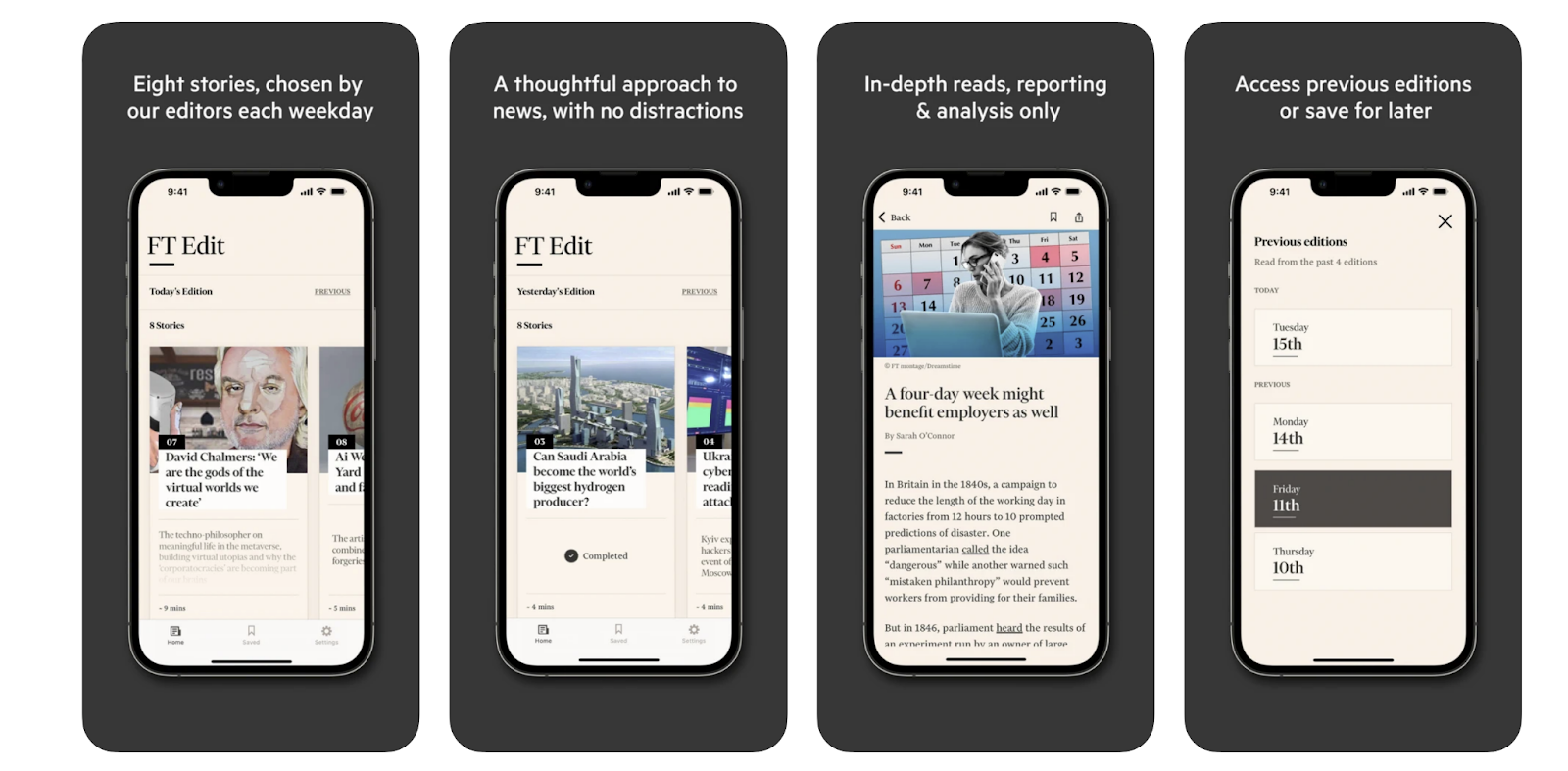
Last month, Financial Times launched a new lightweight offering called FT Edit. The app offers readers eight hand-picked stories every weekday for just £0.99 per month.
Though it has amassed 1.2 million subscribers to date, FT has traditionally attracted a certain kind of subscriber due to the high-end financial news it covers. A typical subscriber is of a higher income, with an interest in or working for the financial sector. Its most affordable digital package, which ranges from $40-$69 a month (£35-£55) would be a stretch for those who don’t need specialist financial coverage. If a consumer is after more general news, plenty of other organizations have more affordable subscriptions.
But increasingly, FT is gaining a following outside of its financial journalism. Part of that appears to be the result of making certain facets of its broader scope publicly available. Its coronavirus coverage was the first to be made freely available in March 2020. It currently has a page dedicated to free-to-read coverage of the Ukraine war “to keep everyone informed as events unfold”.
“We are known for financial news, and we’re incredibly strong at our core product. But we produce a wide breadth of news that matters, and I don’t think people really know that about the FT,” Assistant Editor Janine Gibson explained. “We weren’t really sure whether people wanted to read our free stuff more than anyone else’s, but it was very, very, very successful.”
Creating a more affordable product
The team began to see that there was a much wider appetite for their journalism. The conversations started to turn towards what a much lower-cost product would look like for the publisher. Their research about what people wanted came back with a core message: a simple product with a start and end point. Something more reflective, analytical, and deeply reported – but also expertly curated.
“There’s a different thing happening in the world of quality journalism. People understand that paying for quality journalism is vital, but they don’t necessarily have the resources or the appetite for the full, unexpurgated experience,” Gibson said.
Within a matter of months, FT Edit was conceived. Not only is the price point low, the limited offering provides a concise and digestible solution to too much news. The company says “the purpose of FT Edit is to provide an alternative to endless scrolling, allowing readers time to digest eight important stories selected for them each day. It will launch with the strapline: time well read.”
An audience-centric approach
The concern for many publishers considering this option is cannibalization of the existing subscriber audience. But Gibson sees the audience for FT Edit as adjacent to their core subscribers, not competing.
“This app isn’t here to solve a problem for a news organization,” she explained. “So many digital product launches over the last decade have come from a position of weakness, like ‘We need to replace this revenue gap’. This is, is there a wider audience out there at a lower price point for the FT? But we don’t need to offset the cost of what we already do.”
“The price point really reflects the commitment from the board and the chief executive to genuinely saying, ‘I would like to expose a much wider audience of people to some FT journalism.’”
Now, the app will go through some tweaks to find out how many stories each day works best. It is early days, but should the app get a good response in the UK, Gibson said a dedicated US version with content curated for a US audience would follow.
A bracing shot of news
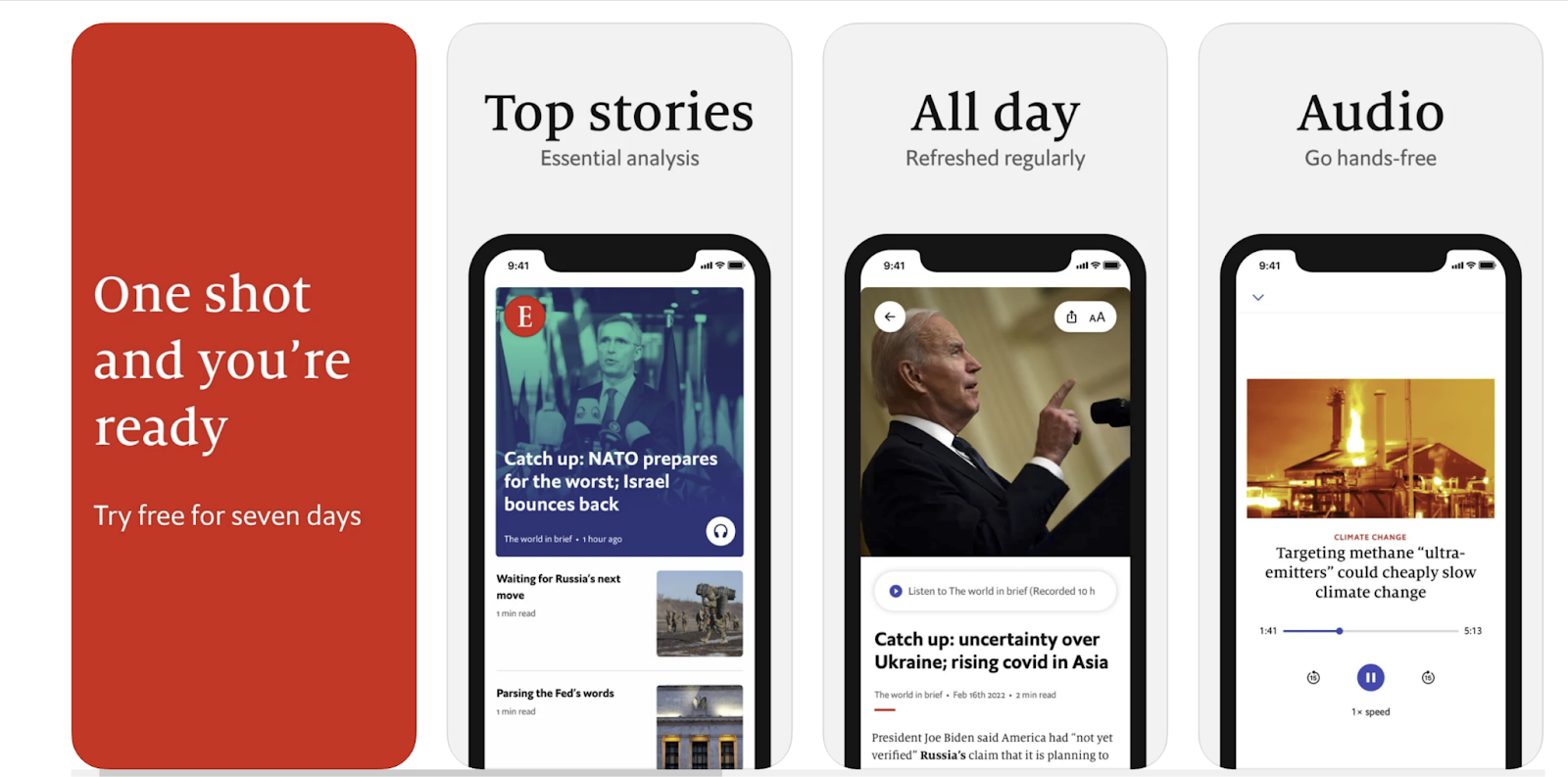
FT is not the first publisher to experiment like this. The Economist’s Espresso app is the most well-known example of a separate, lower cost, lower quantity subscription offering. The recently updated app, launched eight years ago, was introduced as a daily digital briefing to complement the core magazine, with short pieces of news and analysis. It was marketed as a quick ‘shot’ of news to get readers ready for the day.
Espresso is included as part of The Economist’s full digital subscription. It is offered as a standalone app for $7.99 (£7.99) in the UK after a seven day free trial. Those who don’t choose to subscribe can still read one article a day.
The publisher has been working on an upgrade of the app over the past few months. The new version delivers Espresso stories in both written and audio form, alongside charts, facts and quotes each day. It also includes a ‘For You’ tab that lets the user sample four stories a week from the main Economist site, based on their interests.
“The new Espresso is aimed at readers who may not have the time or inclination for the more in-depth Economist experience,” a spokesperson told us. “We see it as introducing a new generation of readers to the Economist brand.”
“We imagine that, over time, some will migrate to an Economist subscription as they come to appreciate the role that our full journalism offerings can play in their lives.”
Is an app the perfect outreach product?
The question of affordable quality journalism is likely to become ever-more pressing as more publishers turn to reader revenue. From the Washington Post to Bloomberg – and even The Smith’s yet unlaunched Semafor – the market is saturated with publications targeting the global elite who barely blink at paying hundreds of dollars a year for news access.
The challenge for publishers looking to attract a wider audience to quality journalism is pricing for access. This is where paid products like apps or even newsletters can be a good way of building a relationship with readers without asking them to pay premium prices.
The longevity of Espresso and the initial success of FT Edit also demonstrate that audiences respond well to content with a start and a finish point. Aside from the obvious parallels to print newspapers, a carefully curated, high-quality set of stories is now seen as a refreshing antidote to the endless scrolling, misinformation, and frantic news cycle. In other words, for a tiny fraction of the cost, you get a tiny fraction of the news: just what you need to know, concisely offered and expertly crafted and delivered.
Now, limited is in demand. A small bundle of stories well-packaged for mobile could be the key for other publishers to unlocking their vast untapped audiences who haven’t yet opened their wallets.
Measuring viewing habits is nothing new in the media industry. However, the shift from traditional TV to streaming has sent the U.S. industry into a tail spin, with 86% of buyers demanding cross-platform measurement. The only thing that everyone can agree on, it seems, is that everyone is confused.
According to Innovid CEO Tal Chalozin, “the biggest frustration in cross-platform measurement is that it’s so hard to understand.” This, from the man who whose company was the first to receive Media Rating Council (MRC) accreditation for its OTT ad impression tracking in 2018.
The problem is that there are multiple new currencies and measurement tools emerging, as the TV industry attempts to blend media platforms and devices, and provide a comprehensive and deduplicated view of media consumption.
Jon Watts, managing director of the Coalition for Innovative Media Measurement (CIMM), describes the industry’s current situation as “messy, but exciting”.
”The biggest change in measurement is that we no longer just use panel data as currency,” explains Watts. “Most TV is consumed in a connected environment and those devices create data about viewing habits, which compliment what panels do. Setting up a currency based on a representative panel is complex enough. But it has got more complex due to the increasingly fragmented audience.”
A storm is brewing
The shift from traditional TV to streaming was accelerated by Covid-19. OTT media revenue is expected to reach over $210bn by 2026, more than double the $106bn generated in 2020. As a result, ad spend on CTV in also on the rise and predicted to hit $19.10 bn in 2022, accounting for 5.6% of total media ad spend.
With the growth of streaming came the inevitable rise in providers. These days, 49% of US households subscribe to at least three streaming services.
“This fragmentation of audiences combined with big data and changing market dynamics has created the perfect storm of craziness,” says Nathalie Bordes, EVP Measurement for Marketers at Association of National Advertisers (ANA). “Traditional measurements are being challenged, so there is room for innovations and new approaches.”
These innovations come amidst criticism of Nielsen (rececntly acquired for $16bn) over its inability to adapt to consumers’ shift to streaming.
“Some would argue it’s a lazy monopolist, who has not done enough to evolve their measurement services,” states Watts. “For at least 15 years the industry has been trying to encourage competition and dislodge Nielsen from the market.”
However, complaints about Nielsen’s measurements aren’t limited to streaming. Confidence in its legacy TV measurements has also been shaken due to accusations of undercounted audiences during the pandemic. As a result, the MRC pulled its accreditation of Nielsen’s national and local TV ratings, which has opened the door for new solutions:
“Nipping at their heals are a new breed of providers, which are slowly gaining traction with alternative approaches to measurements based on TV data,” says Watts.
Measurement independence
Nielson’s counterattack is Nielson One, which is due to launch December 2022. Meanwhile, NBCU has taken a clear stance against Nielsen’s ratings monopoly and has been working with the industry in a bid to create “measurement independence.”
NBCU selected iSpot as its partner in January and they teamed up for a test run at the 2022 Olympic Winter Games and Super Bowl LVI. In addition, the media giant has struck up a number of partnerships with the likes of Comscore, DoubleVerify, and Innovid. NBCU also plans to use iSpot’s data as its national currency for ad buys at this year’s upfronts.
“We must move away from how things have historically been and move towards a future of optionality and interoperability,” Kelly Abcarian, NBCU executive vice president of measurement and impact, told Ad Exchanger.
iSpot claims it can measure audiences for streaming and linear on a second-by-second basis and in real-time. Measurements include ad impressions, incremental reach/frequency and deduplication. Abcarian, who joined NBCU in 2021 after nearly 16 years at Nielsen, says these new metrics will give advertisers more accurate and effective data about their campaigns.
Greater transparency
Deduplication is another challenge of cross-platform measurement as big data provides information on what was watched, but not by who. Simulmedia’s CEO Dave Morgan alleges that 90% of what is claimed in the market about deduplicating audiences isn’t true. However, Morgan cites NBCU as one of the companies “doing really well,” alongside ViacomCBS and Disney. He also has high hopes for Nielsen One and Comscore.
One of the key problems is that media measurement continues to be siloed by different platforms and metrics. A more transparent system is needed, where advertisers can see where their dollars are being spent – and where they can be saved. According to research by TVSquared, more than 90% of U.S. buyers said transparency of metrics across linear and streaming channels was critical in order to devote ad spend to converged TV.
“We need an apples to apples comparison, so we can compare the same person watching on one platform or another,” says Chalozin.
This is what the entrepreneur is hoping to achieve following Innovid’s acquisition of TVSquared. The Scottish company tracks more than 100 million households around the world and more than 75 CTV platforms. Chalozin says TVSquared adds linear TV capabilities to their arsenal, which will provide a complete view of consumer viewing habits, with a currency-grade measurement.
Aside from technological issues, a cultural shift needs to happen in which broadcasters, platforms and marketers work together. This seems to be what NBCU is trying encourage by working with the industry to create a measurement framework for all.
NBCU is not the only major media brand creating collaborations. Disney has been testing new measurement solutions with nearly 100 vendors, and recently named Samba TV as its first official measurement partner. WarnerMedia is also testing with iSpot.tv, Comscore, and VideoAmp.
No single currency
Nielsen has been the industry standard for decades, allowing networks to see how they stacked up against one another. Without a single agreed-upon currency, it is more difficult for advertisers to decide where to allocate their budgets, and for networks to prove their worth.
CIMM is doing their bit to help the industry navigate their way through these turbulent times. The coalition is conducting a deep dive study into the different methodologies of currency-grade provider to find the most effective solutions.
Bordes believes multiple currencies can work, as long as they are fully transparent and the measurement solutions are accredited. “Measurement systems needs to be reformed and there needs to be innovation,” he says. “But the processes must be validated in order to create transparency. We want measurements that go beyond the silo.”
Accreditation throws up yet another challenge in the industry. In 2019, the MRC produced cross-platform measurement standards, but three years later no providers have been accredited using the guidelines. There are companies in the audit process, including Videoamp and ComScore, but as Chalozin states, “people need to believe that you do what you say you do”.
Test and learn
According to Chalozin, another essential cog in the wheel of cross-platform measurement is the buyer. The industry needs their approval – and money.
“Solutions are coming in, but we can’t yet define success,” he says. “In order to say a measurement works we need our customers to agree on a chosen currency and trust how it’s measured. We need to have money flowing on both sides.”
“NBCU put their money where their mouth is by creating a new framework. But the Olympics was a test event, and not as large scale as full blown TV. We have yet to see a solution that can conduct business at a large scale.”
The pros of different currencies is that it has created a more competitive environment which stimulates innovation and drives down profit margins. The downside is, with no established truth state, the industry is in a state of flux as new providers and partnerships barter over solutions. Until cross-platform measurement is solved, the true revenue potential of today’s multiplatform viewing will not be realized. The opportunity is there, as is the level of experimentation.
“We are in test and learn stage,” says Watts. “Come back in five years’ time, when things have settled down. I believe there will be small number of large providers, offering slightly different, but effective, cross-platform measurements.”
For the last two years, social audio platforms have provided space hang out and chat. Businesses, brands, and groups have found that social audio fills a gap they were missing during the pandemic. Media companies have enthusiastically jumped into this format as a way to extend their brand and increase audience engagement and interaction. It’s also been a space for digital content companies like Axios to build their reporters’ on air experience and boost their profiles.
Neal Rothschild, director of Audience & Growth at Axios, says that they primarily use social audio for major news discussions, product launches, or new initiatives within the company. “We’re like, how can we add a little extra boom on top of it? And so we’ll do a Twitter Space for it.”
As Axios is still figuring out how to maximize potential of social audio, they are cautious about topic selection. “What we think is most impactful is you really need to make it about the topic that people care about, not just about Axios,” Rothschild explained.
For example, Axios hosted a Twitter Space in April 2021 about Biden’s first 100 days with reporters Alayna Treene, Hans Nichols, Stef Kight, and Sara Fischer. A few months later, Axios hosted a Twitter Space around the launch of their What’s Next daily newsletter with reporters Sam Ro, Joann Muller, and Erica Pandey.
Audience building
As is the case with the media’s exploration of many social channels, the hope is that the investment pays off in exposure to new audiences.
Reporters and journalists already live on Twitter, Rothschild explained. Thus, they have built-in audiences that carry over to their use of Twitter Spaces. However, those included in the Space – experts or guests – may also be popular on Twitter, which can be beneficial to increase reach and visibility.
“Using Twitter Spaces seems like a good bet for a media company, given the existing audiences and the ability to reach new audiences. If you’re doing a Twitter Spaces and you want to bring someone on as a guest and they have a huge following, you can have some cross-pollination and introduce your following to theirs. The potential is certainly there.”
The sound of success
However, beyond engaging in topical discussions and extending audience reach, Axios has found another interesting use for Twitter Spaces: providing its journalists with exposure and experience in the audio format.
“Some reporters are the type to go on MSNBC, CNN. Others are doing radio hits.” However, Rothschild points out that social audio is “definitely a nice option for kind reporters that don’t have as big of a public profile to have the opportunity to do live, on air experience.”
Digital content companies that want to build a brand for their reporters – many of whom are great, charismatic speakers – can use social audio as a way to introduce those personalities to the world, at a low cost.
“I think it’s important to many journalists — not all — to develop on-air skills. You never know when you might be invited onto a podcast or a radio hit or a TV hit, so getting reps in is valuable,” he said. “From a glory standpoint, it’s also a cool thing to show your friends, family and professional network. There’s a little more shine to being seen or heard than just having a byline on articles.”
Social audio hosting
But there a formula for social audio hosting. Like podcasts, hearing the “voice” of a host – both figuratively and literally – is an important component in social audio spaces. However, effective social audio hosts require a careful balance. While radio and television broadcasters deliver information in a natural voice with well-paced delivery and controlled breathing, this type of performance may sound too rehearsed on social audio platforms. On the other end of the performance spectrum, people who are less charismatic or animated will sound boring. Social audio hosts also run the risk of talking too much and overwhelming guests or the audience.
“I really think that the value of these products is that it sounds like an authentic conversation, and like you’re chatting in the living room among people. There’s cutting in and interrupting, with some give and take,” Rothschild says, “And its not just, here’s me doing my rehearsed two-minute sound bite like they might be used to on TV or radio.”
Many journalists studied writing and never planned for on air-careers. For media brands, it is always a plus to have their most popular writers extend their expertise into formats beyond text[jessica p1] . For them, social audio has the benefit of being audio-only. Hosts (and listeners) don’t have to worry about their appearance. Rothschild says that this comes through on the audio as sounding more relaxed and conversational – unlike Zoom events. “After two to three years of Zoom, I’m done. I’m so done,” he says. (And he’s not the only one.)
Spaces have potential
For digital content companies that need to see more data before jumping into social audio-based spaces, there are some interesting developments in the works. For example, Twitter has added replay stats for recorded events, so digital content companies can see how their audiences are tuning in after the fact, which could affect strategy and broadcast times. Twitter also offers Spaces analytics, which gives hosts access to data on replays for recorded Spaces, how many listeners tuned in, and how many replays the session had. Twitter also reports that it is testing other analytics tools for Spaces including total speakers in a session, duration, and monetization tracking for ticketed Spaces.
Social audio is still in its early stages so monetization and other concrete benefits have not yet crystalized. However, early forays into the format have offered different takeaways and reveal much potential. While Axios is still feeling its way through the new platform, they plan to continue to host spaces for the time being with the hopes that it will deliver audience reach. They also believe that social audio offers Axios’ journalists another way to raise their profile and promote their work as well as audio experience to broaden their skill set for the converged era of journalism we find ourselves in.
To paraphrase L.L. Cool J, “Don’t call it a comeback. Contextual advertising has been here for years.” However, more recently behavioral targeting has been hogging the spotlight because it allowed marketers to hyperfocus their targeting and track individual users across the web — no matter where they went.
As the industry now swings toward a privacy-centric model, publishers have a chance to double down on the value they bring to contextual advertising. Of course, this isn’t news to publishers. But what may be surprising is that, for the foreseeable future, the real goldmine is in contextual ads on mobile and in video.
Contextual advertising: Why now?
Google has been heralding the end of cookies for years, while putting off the actual implementation — which is currently slated for the second half of 2023. More recently, though, Google announced that it is expanding its Privacy Sandbox to Android. While this implementation is years away, Apple has been taking more decisive steps to protect user privacy. Not only did it deprecate IDFA in 2021 — changing the way mobile marketers track attribution and optimize campaigns on iOS — but it also allows users to turn private browsing on in Safari on all devices.
Apple’s shift to a more privacy-centric model has already led mobile marketers to shift spend to Android. But we can expect to see spending shift on Google’s platforms as well.
Mobile marketers — and digital marketers in general — will need to reckon with the changing industry. Publishers have a chance to step in and remind marketers that contextual advertising is a great way to reach potential customers. They also need to let them know that advertisers who have already shifted away from mobile ad spending on iOS have an opportunity to contextually target iOS users in publisher apps.
Publishers and advertisers prepare for the contextual revival
“Publishers are expecting a year of rising demand — and advertiser spend — in the area of contextual targeting,” says the report. “Among our respondents, 84% expect advertiser spend to sustain current levels or grow — and on the growth front, 61% expect to see an increase in buy-side budgeting for contextual-based campaigns.”
This isn’t just wishful thinking on publishers’ parts. The report also surveyed marketers at brands and agencies, finding that 96% of respondents said they would spend as much or more on contextual advertising that year. And 65% of advertisers will be adding to their contextual-based budgets.
So how do publishers win those contextual ad dollars?
The mobile opportunity
Much of the conversation about the resurgence of contextual advertising revolves around cookie deprecation. While we continue to wait for that to go into full effect, there is a hole that needs to be filled for mobile advertisers who still want to reach the estimated 1 billion people who use iPhones around the globe.
The rich data available to apps — especially those with a subscription model — presents marketers with a special opportunity. Forget basic, third-party demographic information, apps that require people to enter actual location data or other granular first-party data give marketers the ability to market to users based on real-time context, like weather conditions, or personally supplied information about their interests.
Publishers who can capitalize on this mobile opportunity now have the ability to build trust and solve problems for mobile advertisers who still need to reach iOS users. For instance, Sheri Bachstein, CEO of The Weather Company and GM of IBM Watson Advertising, says, “By helping mobile marketers drive forward their audience engagement efforts with addressable, performant data sources, we’re confident that this powerful data signal can be a solution for brands trying to solve the identity crisis and ensure consumers derive a more relevant experience across the mobile web and app ecosystem.”
Contextual video is on the rise
When we talk about ad trends, video seems to be a perennial list-topper. And it’s no different when it comes to contextual advertising. Digiday reported that “A number of publishers, ranging from Tastemade and Crackle, have added contextual targeting capabilities for their OTT and CTV inventory.”
Additionally, Xandr — a data-enabled technology platform powering a global marketplace for premium advertising — “launched a contextual targeting capability for CTV inventory, as part of a bid to maintain the momentum behind the video side of its business, which now represents 35% of the spend on Xandr’s DSP.” And at the time of the reporting, Iris.tv, which provides a contextual targeting marketplace, “has been growing 25% per month since the start of 2021 and now handles 28 billion ad requests per month, according to a spokesperson.”
Contextual and connected
CTV — and online video content in general — presents many opportunities for publishers, and, ironically, harkens back to the glory days of television advertising when soap companies advertised on daytime TV giving rise to soap operas. The ability to pinpoint this kind of targeting has only increased with CTV, and opens up opportunities for more interactive experiences that also allow for better tracking.
“I think one of the really powerful arenas, where contextual data will be pivotal, is CTV and more and more people are shifting to an addressable approach with their linear television as well,” Katie Price, programmatic media lead at the agency PMG, said in the Digiday Connatix report. “As contextual data gets more powerful from a digital buying perspective, we will be able to mesh together the efficiencies of programmatic buying and digital buying with that contextual relevance that has been such an advantage for TV advertisers and linear advertising in general.”
The report found that 44% of publishers were already using context-based video ad tools or were working with a third-party partner on a solution. Nearly a quarter of respondents were planning to work with contextual video in the year ahead.
That’s an opportunity The Weather Company is poised to capitalize on. According to Bachstein, “The advanced TV market is a huge growth area for us in 2022, and we’re excited to push deeper into this space. After hearing directly from our brand customers, we know that the market craves solutions that deliver personalization and drive action in this rapidly scaling medium. We’re continuing to improve our offerings to remain flexible across a multitude of platforms.”
Integral Ad Science (IAS) has already recognized and invested in the opportunities for CTV and contextual advertising. As AdExchanger reports, “Most of IAS’s growth currently lies in programmatic, and its biggest driver of that revenue line is a product it calls Context Control, which helps shift ad dollars into brand safe environments.” Through strategic acquisitions, IAS can now analyze video in addition to text. IAS creates contextual segments based on video analysis — detecting everything from language to emotions.
That’s a lot of context!
Mobile video: The perfect storm
If mobile and video present opportunities, then it only stands to reason that mobile video is a perfect storm of opportunity for publishers — and the numbers back it up. Google says three out of four adults report watching YouTube at home on their mobile devices. TikTok is predicted to have 1 billion users by January of 2022 built squarely on the popularity of mobile video.
Platforms that combine the convenience of mobile with the engaging nature of video are rewarded with vast audiences. However, marketers looking for controlled, brand-safe environments may be more likely to turn to trusted media outlets. Publishers who can capitalize on the power of mobile video and combine it with contextual ads will stand out from competitors.
The added benefits of contextual targeting
Consumers have, frankly, had it up to here with intrusive ad experiences — and that includes ads that follow them around the web. Audiences are primed for a contextually relevant, yet unobtrusive experience that provides them more control while still delivering a level of personalization. Publishers can seize that opportunity by embracing, and perfecting, the art of contextual advertising.
Contextual is not new. But these days, there are many good reasons to give it another look. Of course these include increased consumer concerns around tracking, privacy regulation, and big tech’s response.
However there’s more to it: contextual ads are smarter than ever. Natural language processing (NLP) allows marketers a deeper understanding of not only the context but the sentiment of each page, and increasingly, video on the web. With the help of machine learning, advertisers and publishers can go beyond keywords and whitelists to find the most relevant content possible.
Nobody doubts the power of television. It retains huge audiences, commands enormous ad spends, and influences discourse at all levels of society. Those strengths largely remain despite the ongoing issues of the retirement of linear TV, the great unbundling, and new entrants into the space cutting into existing revenue strategies among incumbents. What advertisers and brands doubt is the stability of the modern TV landscape — particularly given the rise of television sets connected to the internet.
The advent of connected TVs (CTVs) was supposed to herald a new era of better measurements, more accurate audience demographics, and better return on investment for advertisers. Some of that has come to pass. Other developments have meant that the CTV landscape is not yet delivering upon its full potential, and that it could destabilize TV advertising more generally.
Options abound
According to industry organization Thinkbox 80% of households in the UK have at least one television that is connected to the internet, either directly or through a third-party device like a gaming console. In the U.S., research from The Diffusion Group has found that the share of U.S. broadband households with CTVs has grown by just a single percentage point from last year, and currently stands at 86%.
That plateauing of growth coincides with a growing number of players within the space. Streaming services and digital video platforms jostle for position on CTVs with channels and broadcasters that are more associated with the medium. The number of CTV apps available on the Roku channel store, Apple TV, and Amazon Fire TV increased by over 38% year-over-year in 2020 according to research from 42matters.
It is a collision of different forms of video that mean advertisers have more choice — but also that there is a lot of confusion when it comes to measuring the success of advertising across CTV.
YouTube, for instance, is betting upon that plurality of choice to grow its own advertising business. Philip Miles, country sales director for YouTube and Display, UK & Ireland, told me after the latest YouTube Festival, “Historically, there tended to be a versus conversation — so YouTube versus television… pitted against each other. [But] our key thing that we were trying to land with Festival is YouTube is effectively part of the UK TV industry now, and increasingly advertisers are recognizing that it’s not an either/or conversation.”
But that entrant of new players, combined with resurgent spend after the pandemic, has led to inflation in TV ad prices. It is a volatile market — and exacerbated by issues around measurements. Nielsen is widely seen as not having adapted quickly enough to audience consumption habits, and its UK equivalent, BARB, only announced an upgrade to measure across subscription video on-demand (SVOD) in late 2021. At the time BARB’s chief executive Justin Sampson said, “It’s great news for the television and advertising industry that we’re upgrading our always-on measurement service to include SVOD and video-sharing platforms. For the first time there is audience measurement for these services that bears all the hallmarks of a joint-industry currency: independence, objectivity and transparency.”
Doomed to repeat digital history
Yet media buyer reticence around CTV suggests that the market is unsure about the extent to which it can reliably deliver upon its promise. And the reasons for that reticence will be uncomfortably familiar to anyone who has kept abreast of issues surrounding digital advertising more widely.
For starters, creating that joint-industry approach to marketing is easier said than done. There isn’t yet true consensus on what metrics should be captured, by whom, and which bodies should oversee the data. In the meantime, the lack of any one default measurement body is leading to non accredited bodies offering services that claim to offer a true yardstick for pricing of ads across CTV.
The European Connected TV Initiative says that, just as with digital advertising, opacity of the supply chains is paramount to making the most of the CTV opportunity. Its second most-important priority is the development of a more transparent and integrated CTV advertising supply chain. The goal, it says, is “to give advertisers and agencies the confidence to know what they are buying and where their ads will run – be it premium TV inventory, secondary TV content or social video.”
It all speaks to confusion around the different forms of video available on CTVs. With linear TV, satellite or cable, there was at least the perception of uniformity in form and quality. With the vast number of services available across CTV, that is no longer the case. Although YouTube might like to claim the quality of its content is on par with that across other CTV apps, is it really?
The problem is extremely similar to that of digital advertising, which also has the unfortunate issue of being undifferentiated. Just as projects like overtone.ai seek to provide a quality score for digital advertising — based on a number of criteria that demonstrate the veracity and safety of sites — there is a need among CTV advertisers to separate the wheat from the chaff.
Data and other dilemmas
Some marketers and buyers believe that, as with first-party data provided by digital publishers, there is an opportunity individual apps and CTV services can provide. Tal Chalozin, chief tech officer and co-founder at Innovid, told The Drum: “More data can be generated and a lot more endpoints can be connected together. Marketers would like to see other forms of measurement, more than just panels, more like a census into website traffic or app downloads.”
And probably most similarly to digital advertising, the potential for bad actors to enter the space is a growing concern. Omnicom has cited a lack of linear TV-level transparency as a major flaw in any attempt to sell CTV advertising, even among the bigger players. The company says “an inability to understand audiences at the household level across partners; and a measurability gap that translates to an open invitation to cyber criminals who are generating millions in ad fraud” is the big problem to be solved.
CTV is an enormous opportunity for advertisers. As different forms of video content collide on connected devices, the line between what is and is not TV content is eroding. With that erosion, however, comes the potential for context collapse around TV advertising and a revision of TV advertising’s effectiveness. And despite many of the challenges being familiar, there is no clear path to ensuring the industry doesn’t replicate the mistakes it made in creating digital advertising.