Digital media continues to transform the way people consume news and information. Native digital news organizations have become a vital source of information for many people around the world. With fierce competition and the role of social platforms as intermediaries, how can digital native media businesses grow, develop, and publish information with greater independence and sustainability? New research, Project Oasis, from Sembra Media, examines the trends, impact, and sustainability of independent digitally-native news organizations.
To help support the growth and sustainability of independent digital native news organizations, the report includes a searchable media directory. This database includes 530 digital native news organizations in more than 40 countries across Europe. It contains information on the types of stories each organization covers, their funding sources, and their audience reach ‒ showcasing the need for diverse voices and perspectives.
The directory is a valuable resource for journalists, editors, and publishers looking to connect with other independent digital native news organizations. It provides a way to easily find and share important stories and sources that offer diverse perspectives, which are essential to accurately informing audiences.
Challenges
Project Oasis highlights some of the many challenges facing native digital news organizations. One of the biggest is the struggle to achieve financial sustainability. Many of these organizations rely heavily on one or two funding sources, such as donations, subscriptions, and advertising. However, the report found that these sources of funding can be unpredictable and unstable, which can makes it difficult for organizations to plan their future. The research identifies the need for two to six revenue sources as optimal for native digital news organizations to be sustainable and remain independent.
Another challenge facing independent digital native news organizations is the need to build trust with their audience. Many people are skeptical of the news they see on social media and other online platforms. As a result, there is a greater need for independent digital native news organizations to establish their credibility and build trust with their audience.
Optimism
Despite these and other challenges, the report finds reasons to be optimistic about the future of independent digital native news organizations in Europe. These include several key trends that are shaping the future of the industry, including the growing importance of mobile and social media, the rise of video journalism, and the increasing use of data and analytics to inform reporting.
The research also focuses on identifying profitable business models for independent digital native news organizations. These models include advertising, subscriptions, memberships, events, grants, and partnerships.
An advertising-based model is the most traditional revenue source for digital news organizations. Competition from big tech platforms like Google and Facebook presents a difficult ad sales marketplace for smaller players. However, advertising is still a viable revenue source for digital news organizations. Digital news organizations should differentiate themselves by focusing on building high-quality content, engaging audiences, and offering first-party targeted advertising solutions to advertisers.
Subscription models require high-quality content that engages the reader and convinces them to pay for the content. There are also membershipmodels, which offer a more community-focused approach to revenue generation. Memberships typically offer readers access to exclusive content, events, and other perks, in exchange for a regular fee. The report notes that membership models can be particularly effective for organizations with a strong and loyal following.
Events-based revenue models involve hosting conferences and workshops to generate revenue. The report notes that events can be an effective way to build relationships with readers and generate revenue. However, they require significant resources to organize and execute successfully.
Grants and philanthropy in funding independent digital news organizations are also available. The report notes that grants and philanthropic funding can be an effective way to support journalism that is not commercially viable. Organizations must carefully maintain their editorial independence and avoid conflicts of interest. The report also notes that there may be viable partnershipsand collaborations between digital news organizations and other media outlets, as well as non-media organizations. Partnerships can offer benefits such as shared resources and expertise, as well as access to new audiences and revenue streams.
Future focus
As the digital marketplace continues to evolve, independent digital native news organizations will play an important role in shaping the future of journalism, filling news gaps, covering underserved communities, and combating mistrust and disengagement.
The Project Oasis report and its searchable media directory offer important resources to support the future of independent digital native news organizations. The research provides a comprehensive look at the challenges and identifies opportunities for sustainable growth. The directory also provides a valuable resource to help protect democracy by sharing resources, collaborating on projects, and amplifying each other’s voices.
Every once in a while, a trend rippling through the digital media industry that springs up from the trade publications and into general-interest media. The launch of ChatGPT has been one of those times. AI content generation feels like more than ones and zeroes to media consumers at large. It feels tangible, even visceral, because it has direct ramifications on the production of content itself. Clearly media leaders need to make their voices heard in order to help guide the conversation for users as well as AI developers.
It would appear every Big Tech business wants in on AI chat to power search. But like identity and privacy, media companies are not about to sit back and watch which of the tech giants “wins” generative AI. They need to understand how AI will change content consumption, how they can use it to their advantage, and how to keep walled gardens from absorbing more of their revenue.
A new era for the search business
We’re seeing real and atypical disruption today in AI chat’s applications for search. Bing’s ChatGPT search function removes the onus of poring over multiple search results, and simply generates what feels like a coherent response upfront – be it right or wrong, strong or flimsy, fair, or biased. And history shows that human nature tends to prefer convenience over perfection. Search providers are already investigating how AI search may be monetized, to avoid losing out on the serious revenue search advertising traditionally has delivered (58% of Alphabet’s total revenue last year, for those keeping score).
That brings us to media companies’ reliance on search traffic to monetize their own sites and content. The prospect of users being disincentivized from visiting publisher sites to verify and provide context for information looks ominous to publishers. Today, 26% of all publisher traffic comes from search, in an environment where open web publishers are already competing against walled gardens for traffic and advertisers are reducing their budgets. And as it stands, not all AI search tools link back to their sources, and marketers are still trying to understand how the AI search ad experience should appear. And while search bots already crawl publisher pages, AI chatbots present a less balanced exchange between publisher and search engine.
Publishers that control their data have an advantage
Let’s avoid tunnel vision here, though. Publishers’ imperative to soften any blow to revenue from search traffic overlaps with their existing efforts to reduce reliance on revenue from the programmatic open market. Those efforts involve building loyalty among users and advertisers alike. For users, publishers are offering subscription packages, exclusive newsletter content, and the like. For advertisers, they’re offering private marketplaces and direct deals. Publishers can better navigate AI disruption by continuing and evolving those business strategies. They need to position themselves as sources of trustworthy, high-quality content worthy of the lifetime audience loyalty that can grow CPMs and incentivize deeper advertiser relationships. And AI has real benefits for those strategies.
If and when search becomes a less reliable source of traffic for media companies, they’ll need to ramp up efforts in driving traffic from channels such as social and video. In finding the best channels and business partners, they can turn to AI to analyze large volumes of first- and second-party data, and to do lookalike modelling. Leading publishers have already been doing this as part of their data strategy for withstanding third-party cookie deprecation. Advertisers are taking bold data strategy steps, too, and have the resources to be very advanced here. Publishers should compare notes with their brand partners to learn how to best leverage AI and machine learning for predictive audience creation, modelling, data cleaning and processing, and probabilistic matching.
We’re also seeing publishers take interest in generative AI’s capacity to accelerate and personalize content production, with human staff overseeing and completing the job. AI can do some of the lifting on lower-level SEO writing, bolster production of sponsored content, and source background from the publisher’s content archives. With ad revenues dipping on account of economic pressure, publishers are actively seeking new workflow efficiencies and content initiatives simultaneously without cutting headcount.
IP law will establish new limits for AI crawling
While we’ve all heard chatter about AI displacing human creative talent, media companies have more leverage than they might appear from a slight distance. That human-created input that drives AI output is guarded by intellectual property law. Rights holders are pushing back, and we can expect to see more robust IP regulation, and even technology that protects content from being scraped by AI tools, coming into play in the near future.
But publishers shouldn’t simply wait for regulators to clear up these issues. That’s a path with unpredictable length and outcomes. At the top of publishers’ to-do lists should be bracing for shortfalls in search traffic, powering their data resources, and finding applications for AI to embolden content production. And Big Tech businesses should be forewarned: AI can’t be a higher priority than the sustainability of the digital publishing business that generative AI models depend on. An input of quality content makes the difference between useful output and unappealing nonsense.
In an increasingly crowded and competitive landscape, media companies are constantly seeking new strategies to increase revenue and customer loyalty. Bundling can play an integral part in achieving these goals. By combining multiple products or services into a compelling package, bundling can unlock new subscribers and revenue streams, as well as help reduce churn.
According to Meredith Kopit Levien, Chief Executive Officer of The New York Times Company, bundle subscribers pay more over time and are less likely to cancel. As a result, bundling can support strategies for customer acquisition and retention. Subsequently, it’s currently an area of growing strategic focus for many media companies.
Here are seven features that can strengthen your bundling strategy:
1. Make it financially compelling
You may not realize it, but you’re probably already bundling.Many publishers offer products, such as combined print/digital subscriptions, at a discounted price. These are often attractive to audiences due to minimal price differentiation, and dual access can improve their experience of your product(s).
For publishers, this also opens opportunities to sell advertising across both mediums. This can be especially valuable given the importance of print advertising, and the premium it can demand compared to digital.
The Seattle Times demonstrates this principle by offering a Digital +SundayDelivery subscription for the same price ($4.99 a month) as their digital-only package. Bundling in the Sunday print edition, complete with home delivery at no extra cost, is potentially very persuasive for readers.
Alongside appealing pricing, a further tactic media companies can deploy involves highlighting the benefits each subscription tier – or bundle – offers you.
In doing this, publishers typically point to subscriber-only content such as articles, newsletters, podcasts and events, or access to their archives. In many cases, this content is not available outside the requisite subscription bundle. And that’s a benefit that publishers are keen to emphasize.
Interestingly, the New York Times also utilizes a different approach, by stressing what you don’t have access to. This is most explicit for those accessing their news-only package (see below). The FOMO here is potentially very real, making an upgrade to “All Access” seem like good value.
It’s hard to say exactly what role this tactic plays in their continued subscriber growth. However, the company added one million new subscribers in 2022. Commenting on this, CEO Meredith Kopit Levien observes that “with each passing quarter, we saw more proof that there is strong demand for a bundle of our news and lifestyle products, hitting records on both total bundle volume and the share of new subscribers choosing the bundle.”
3. Prioritize building your stack
The cost of living crisis means that many people have less money in their pockets. To offset this, households are looking carefully at their expenditure and cutting back where they can. CNBC reports that Americans are more likely to cut back on groceries and gas than subscriptions. But this headline overlooks how low down the subscription food chain non-streaming content is.
Given publishers’ emphasis on reader revenue and subscriptions, this belt-tightening brings with it a certain vulnerability. To offset this, it is incumbent on media players to ensure that their offering is one consumers feel they cannot afford to cancel.
To help them do this, Greg Piechota, Researcher-in-Residence at INMA, suggests three ways media companies can add value to their bundle: build, buy or borrow.
Using The New York Times as a case study, he charts how the Gray Lady built Games and Cooking; bought The Athletic in 2022 (it costs $7.99 a month to subscribe to independently) and borrowed products in the form of a 2017 link-up with Spotify whereby new All Access subscribers also got Spotify Premium for a year. Bundling in Spotify for free (mirroring a similar initiative by The Times of London in 2014) arguably made their core subscription offerings more attractive to younger audiences. That means it may attract a new demographic of paying subscribers.
4. Flaunt your assets
Alongside the approaches outlined by Piechota, we should also add peacocking. Media companies with deep portfolios can prominently display this to potential suitors (i.e. subscribers) by creating bundles that tap into the sheer breadth of content at their disposal.
We have already seen this in the form of the Disney Bundle, which includes Disney+, Hulu, and ESPN+. These three content-rich services are considerably cheaper when purchased collectively. The “trio” bundle also comes with ad and ad-free versions too, another model that more publishers can emulate. (NB: ESPN+ comes with ads regardless of the package.)
In Europe, Scandinavian media giant Schibstedhas also put this notion into practice. They launched “Full Tilgang” in Fall 2022, a bundle of their Norwegian titles including national, regional and finance news, alongside magazines and their podcast platform PodMe.
For national subscribers, this regional and local content is a potentially useful value-add that they might not otherwise have consumed. It’s a model other companies might look to replicate. twipe reports that Schibsted is rolling out a similar model in Sweden.
Of course, not every outlet has the deep pockets – or the smorgasbord of content – enjoyed by The New York Times, Disney or Schibsted. Nevertheless, many outlets can deepen their bundles via partnerships.
These can come in a myriad of different forms. Digiday has outlined how partnerships with non-publisher brands – such as financial and educational institutions – are being employed by The Wall Street Journal and The Washington Post. Business Insider has also followed suit. In 2020 they offered holders of certain American Express cards a free 12-month subscription.
Tie-ins with other business and tech providers can also be seen. Major League Baseball has a long-standing partnership with T-Mobile, providing free subscriptions to MLB.TV (worth $149.99 a year) to T-Mobile subscribers. And in 2014, The Sun, a British tabloid, struck a deal with the UK mobile operator O2 to offer 02’s 4G customers content from soccer’s Premier League that gives them a glimpse of The Sun’s content which, in turn, might encourage some users to become subscribers.
It’s common for publishers to offer bundles with other titles in their stable. The Wall Street Journal offers a package featuring its Dow Jones stablemates Barron’s and MarketWatch. More interesting perhaps are partnerships with other content providers.
In the past, I’ve seen smaller outlets – like my local NPR affiliate KLCC –offer a free subscription to larger publications (like NYT and WaPo) as part of their membership model. For smaller players, this association may bring some extra cachet, or provide an additional incentive to nudge people over the line by taking out a membership or donating.
Even bigger players can successfully adopt this approach. The Weather Channel is a seldom talked about subscription behemoth, with over 1 million subscribers. It recently partnered with several organizations to offer bundles providing “companion subscriptions.” This trend may only become more prominent.
Looking ahead – where bundling might go from here?
And what of that future? Given the need for media companies to attract new audiences, as well as retain subscribers and maximize income from them, bundling will remain integral to reader revenue strategies. Here are two further ideas worth considering.
1. Explore different pricing models
In 2019, the advent of dynamic paywalls prompted Piano CEO Trevor Kaufman to ask, “Has AI brought an end to the metered paywall?”. New York Media and Neue Zürcher Zeitung (NZZ, Switzerland) are some of the outlets that have used this model, harnessing variables – such as your location, device type and browsing history – to determine when users hit the paywall.
Taking this to the next level, The Atlantic recently started using this technology to shape the price of their bundles. Dynamic pricing can be used when signing people up and for retention. For the latter, prices for renewal are determined based on the probability of a subscriber’s subscription lapsing.
“It is a concept worth exploring,” suggests Subscription Insider, although they stress the “biggest risk is how consumers will feel if or when they find out about it.” How will consumers feel if they get different prices to sign-up (or stay), each time they click on the site?
At present, audiences are at the mercy of bundles offered to them by publishers. But what if it were possible to build your own bundle?
Let’s say I just want the newsletters and audio provided by The Economist? Or I want to bundle The New York Times’ Cooking and Games subscriptions, getting them for less than two individual subscriptions?
Similarly, if I have a $25 a year standalone subscription to Politics with Charles P. Pierce on Esquire, what If I could cherry-pick additional elements to bolt onto my politics subscription?
I cannot do that at present, and this type of choose-your-own-adventure model might be technically tricky. However, personalization could enable me to subscribe to content by topic, writer, location, beat, or sports team that matters to me.
Of course, it may risk cannibalizing the take-up of other more expensive bundles. However, it might also hold strong consumer appeal, especially those for whom existing packaged offers are not compelling enough.
Moving forward, bundling is here to stay, supporting subscription strategies by playing a role in consumer attraction and retention.
Fundamental to this is making your bundle attractive and distinctive from your competitors. Subsequently, adding value to the bundle may well shape acquisition strategies, be that for talent (and the newsletters and podcasts they may front) as well as other properties.
At the same time, consumers need to be attracted by price and value proposition, this includes access to content and services they may not currently consume, but might if it’s bundled in.
The use of free trials, as well as partnerships with other media companies and brands, can be a way to get a customer’s foot in the door. Meanwhile, dynamic pricing and opportunities for personalization could become key tools to keep them there.
By bundling multiple products or services together, publishers and media companies can offer greater value to customers and increase subscriptions. There’s no hard and fast way to do this, but these seven steps demonstrate how all publishers can potentially use bundling to drive revenues and improve customer loyalty.
Consumer trust in news is a complex and dynamic relationship that varies across countries, platforms, and audiences. Different audiences have different reasons to trust or distrust news organizations. However, misrepresentation and underrepresentation are two common drivers of distrust in news reporting.
Black and mixed-race audiences (people who identified as either preto or pardo) in Brazil
Marginalized castes or tribes and Muslim audiences in India
Working-class audiences in the U.K.
Black and rural audiences in the U.S.
The findings show that many respondents have doubts about the motives of news organizations. Many attribute their distrust to what they see as chronic bias in reporting: coverage that reinforces stereotypes and sensationalized news items.
Detailed findings
Respondents feel that the news media does not reflect their realities or interests but serves the agendas of those in power. The research finds that most participants see the news media as biased and depressing. They feel the news media often treats them unfairly, perpetuates stereotypes, fails to cover them, or promotes divisiveness among groups.
Respondents have different expectations and requirements from news media depending on their backgrounds and experiences. They cite examples of the news media’s misrepresentation in story selection and story framing.
– Emphasizing negative news
– Unfairly treating groups
– Perpetuating stereotypes
– Failing to cover them altogether
– Promoting divisiveness between groups
As one respondent states, “Black and brown people are not just the focus of tragedies; there are successful people among us.”
Many Black participants in the U.S. and Brazil note that most news coverage about Black people only emphasizes negative dimensions such as poverty, crimes, and violence. Further, respondents state that news coverage about high-profile cases of police brutality adds to the complexities and experiences of racism and discrimination in their day-to-day lives. One respondent comments:
“We always knew this was happening throughout history to the lynchings and the Civil Rights era. These things were always known, but seeing it broadcast every day, week after week, month after month, year after year, it’s mentally and emotionally exhausting, and I just couldn’t keep up with it.”
Action items
Research participants want news coverage inclusive of more positive and constructive news stories. They request that news stories be diverse and offer representation, transparency, and accountability. They would also like coverage to offer personal and social relevance.
The report suggests that the news media must address these concerns to rebuild trust and engagement with disadvantaged communities. Recommendations for news media professionals:
Invest in more diverse and inclusive newsrooms and sources
Provide more contextual and explanatory journalism
Avoid sensationalism and negativity bias
Seek feedback and dialogue with audiences
Collaborate with community media and civil society organizations
Reuters Institute acknowledges the challenges and trade-offs the news media faces in serving different public segments. It argues that there is no single trust problem or solution but rather a need for more nuanced and tailored approaches that recognize the diversity and complexity of audiences.
Streaming video has seen explosive growth and isn’t yet showing any signs of slowing down. As audience habits change and evolve, are advertisers and media platforms prepared to take full advantage of the new paradigm? Whether it’s the shift from third to first-party data or ad formats designed uniquely for the streaming experience, there are plenty of cutting-edge trends and technologies that advertisers would do well to understand – and embrace.
Streaming audiences are booming
One of the biggest trends in streaming video is the rise of streaming-first networks. These networks, such as Netflix, Hulu, and Amazon Prime, often produce their own content and offer it exclusively on their streaming platforms. This model has proven to be successful, with many streaming-first networks producing critically acclaimed shows and movies that have gained a loyal following.
According to recent data, at least 85% of US households are subscribed to at least one video streaming service. The popularity of streaming-first networks has disrupted the traditional TV model, which relies on ad-supported cable and satellite networks. As more people switch to streaming platforms, advertisers are having to adapt to the new landscape and find ways to reach their audiences through these platforms.
Netflix, the world’s leading streaming service, for a long time publicly opposed advertising and relied on a subscription-only model. However, in 2022, CEO Reed Hastings announced that the company was opening the door to advertising, signaling a sea change. Hastings cited the success of Hulu and others in monetizing their streaming platforms through advertising. And, to back this up, a survey by MAGNA found that in 2021, U.S, linear TV ad spend is projected to decrease by 7.5%, while connected TV ad spend is projected to increase by 36.5%.
Self-serve advertising: targeted and brand-safe
Many streaming platforms, including Roku and Hulu, offer self-serve advertising options that allow brands to create and target their own ad campaigns. This gives advertisers more control over their campaigns and allows them to reach specific audiences in a brand-safe way. Self-serve is considered an effective compromise between the requirements of brand safety and scale; a system that is both automated and tightly controlled by the publisher.
Through self-serve advertising, brands can choose the ad format, ad placement, and target audience based on first-party data. Advertisers can also set their own budget and optimize their campaigns based on real-time performance data. Self-serve advertising platforms are built on the availability of first-party audience data.
First-party data: the key to targeting and personalization
Another trend in streaming video is the use of first-party data. Streaming platforms collect data on their users – including what they watch, when they watch it, and on what device. This data can be used to create more targeted and personalized ad campaigns. For example, if a streaming platform knows that a particular user is a fan of action movies, it can serve them ads for action movies or related products.
First-party data can also help advertisers understand their target audience better. By analyzing user behavior and preferences, advertisers can gain insights into what types of ads are most effective and adjust their campaigns accordingly. For example, if data shows that users are more likely to engage with ads that feature humor, advertisers can create ads that use humor to capture the viewer’s attention.
Trust builds strong relationships
In addition to self-serve advertising and first-party data, it’s important for advertisers to consider the relationship between viewers, streaming brands, and trusted advertisers. As streaming platforms have become more popular, they have also become an important source of trust for many viewers. This means that advertisers who partner with trusted streaming brands and create ads that align with their values and aesthetics are more likely to be successful.
Brands that are perceived as intrusive or irrelevant can quickly lose viewers’ trust and negatively impact the reputation of the streaming platform. To build and maintain trust with viewers, advertisers must focus on creating compelling, authentic, and relevant ad content that resonates with their audience.
One way to achieve this is through sponsored content. Streaming platforms increasingly offer sponsored content as a way for brands to reach audiences in a non-intrusive way. Sponsored content can take the form of branded entertainment, product placement, or native advertising. By partnering with streaming platforms and creating sponsored content that aligns with the platform’s values and aesthetics, advertisers can reach audiences in a more organic and engaging way.
Another important factor in building trust is transparency. Advertisers must be transparent about how they collect and use data, as well as how they target and deliver ads. By being transparent, advertisers can build trust with viewers and create a more positive advertising experience.
Connecting the dots with CTV
In addition to these trends, another important factor for advertisers to consider is the growing importance of connected TV (CTV). CTV refers to televisions that are connected to the internet, allowing viewers to access streaming content directly on their TVs. Already, a full 80% of U.S. households have access to a connected TV. With CTV viewership on the rise, advertisers have the opportunity to reach audiences on a larger screen and create more immersive and engaging ad experiences. Advertisers can also use CTV to target specific households and individuals, based on first-party data and other targeting methods.
As the streaming video and CTV landscape continues to evolve, advertisers must navigate new challenges, such as ad fraud. Ad fraud refers to the practice of generating false ad impressions or clicks to defraud advertisers. Advertisers can work with media platforms and ad tech partners to implement fraud prevention measures and ensure their ad spend is used effectively.
Closing thoughts
One simple saying appropriately describes the advertising impact of streaming video: the medium is the message. Streaming video isn’t just linear in a new, on-demand format. It’s a fundamental shift in the way that viewers experience media, create relationships with brands, and ultimately make decisions as consumers. There are a host of new challenges and opportunities, all of which will impact advertisers now and in the future.
The best way for advertisers and publishers to adapt to streaming video is to embrace it. And it will help to seek out expert partners to help navigate these new waters. In many ways, we will need to forget what we think we know about video media and open our minds to a new and exciting reality that is more audience-focused, personalized, and fast-changing than ever before.
The latest trust-in-media research is not pretty. But it’s not hopeless, either.
It was one of those random-but-when-you-think-of-it-not-entirely-coincidental accidents of timing, ideal for an article lede. The same day that Fox News settled its defamation lawsuit with Dominion Voting Systems, the Reuters Institute for the Study of Journalism unveiled the latest installment of research from its Trust in News Project. The Fox case showed just how little Fox journalists deserve their audience’s trust. And the Reuters survey showed just how little our audiences trust the rest of us, whether we deserve it or not.
That Americans have lost trust in news media is not exactly a stop-the-presses revelation. But the new Reuters report adds an emotional overlay to this sorry but well-reported fact by elevating the attitudes of marginalized populations ignored by previous surveys. Suffice it to say that adding emotion doesn’t make the data any less grim. We are losing hearts and minds at a dizzying pace.
Still, there are hints of hope. The research makes clear that even those who mistrust us value the work we do, when we do it well. People still need journalism, and they know it. Out of that fact arise some suggestions for how we might dig our way out. And we must dig our way out.
In case you haven’t been tracking surveys about trust in media—and I don’t blame you if you have been avoiding them—the data has been steadily getting worse for decades. According to a Knight Gallup poll last year, just 16% of Americans have a lot of faith in newspapers and 11% in TV news. Both figures are down about two thirds as compared to 30 years ago.
This time, it’s personal
What does the new research say that we didn’t already know? For one thing, because the Reuters researchers conducted focus groups, rather than taking surveys, the report gathers some arresting personal expression from audiences. In addition, Reuters sought out subjects from groups we journalists don’t often hear from, so the perspectives are sometimes revealingly different (or depressingly the same). In the UK, researchers interviewed working class people in Yorkshire and greater London. In the US, they drew on two separate audiences, Black and rural Americans, both from Iowa. (The research also targeted comparable marginalized groups in Brazil and India.)
Across all these groups, panelists repeatedly said that they felt unseen and unheard by media. In a conversation we had at conversation at the Virginia Local News Summit in April (separate from the survey), Tracie Powell, founder of the Pivot Fund, which invests in BIPOC owned media, offered a poignant example of how that inattention feels. Describing what happened when the big-city press parachuted in to cover a three-fatality traffic accident in rural Georgia, she noted that local Black residents felt that the metro reporters lavished attention on the two white victims and gave short shrift to the Black one. “The Journal-Constitution’s reporting was accurate,” she said. “Accurate—but not true. And everyone in the Black community knew it.”
Professional judgement
When professional media do pay attention to marginalized populations, the focus group participants complained, we tend to highlight the negative—deprivation, crime and racism. “[W]eek after week, month after month, it’s mentally and emotionally exhausting,” said one Black participant. Others believe that we too easily resort to stereotypes. In the other Iowa focus group, for example, a participant told researchers that she felt that coverage of rural America quickly resorted to tropes of “corn fields and pig farms,” and depicting people like her as “a bunch of hicks.”
During a phone call, Benjamin Toff, a senior research fellow at the Reuters Institute and leader of the three-year-old Trust in News Project, said that this highly personal reaction to coverage was a key difference from previous Reuters trust studies. “When you see reporting on some remote issue as sensationalistic, it sparks one kind of judgment,” he told me in an interview. “When the hype involves someone you know and reinforces stereotypes that harm you and your children, the mistrust is a lot more visceral.”
What are we in the profession supposed to do about this? To some extent, we already know the solutions, even if we have not been universally successful at putting them into practice: bring more diverse representation into our newsrooms, develop more awareness of the biases that we unconsciously import when we write about groups less white or educated or liberal then the typical newsroom.
Make the connection
The report also hinted at some more hopeful paths back to trust. Audiences in marginalized groups told the Reuters researchers they want unbiased, fair and accurate coverage of matters relevant to their lives—the same desire other audiences have. Most trust surveys, including this one, show that audiences tend to be suspicious of our motives and shockingly unaware of how we operate. That suggests that we don’t need to abandon our most cherished values; we just need to get them across better.
Joy Mayer, founder of the Trusting News Project, responded to this aspect of the Reuters research in a Medium post, writing (among many other useful suggestions): “If you work hard to be fair, consider articulating what fairness looks like for your newsroom. Get on the record about it. (Take inspiration from the San Diego Union-Tribune’s fairness checklist.) Then draw attention to that commitment day to day.”
Personal connections between individual journalists and their audience can build trust in ways that aren’t necessarily available to media brands. “[The research suggested] that people are much more willing to give individual journalists leeway,” said Toff. “Many are suspicious of the commercial and political agendas they see media institutions pursuing. It’s easier for individual journalists to build trust personally.”
It’s impossible to read the Reuters’ report and not conclude that it will take anything less than a generation for media to rebuild trust, if we can rebuild it at all. But it would also be wrong to conclude that there’s nothing we can do. Even the audiences addressed by the Reuters study—who are not, generally speaking, active seekers of accountability stories—recognize the importance of our role.
To reach them, though, we need to be aware of how they see us and to be humble in our approach. Margaret Talev[1], the long-time White House correspondent and Axios political editor who recently joined Syracuse University’s Democracy, Journalism & Citizenship Institute as director. In a panel two days after the Reuters report Talev said “It’s not enough to tell people they should trust us because we’re good for them.” She said. “We need to meet people where they are and give them what they want.”
About the author
Eric Schurenberg is the founder of the Newsroom Trust Project, a research project seeking solutions to the erosion of trust in media, and the host of the podcast In Reality. Prior to that, Eric was the CEO of Mansueto Ventures, the owner of Inc. and Fast Company.
Most of today’s digital display advertising is sold programmatically. The process is automated from buying to displaying ads and determining which ads are shown to which users. Programmatic advertising uses behavioral ad targeting and relies on extensive online consumer tracking, which raises important privacy concerns.
The benefits are often the counterargument to privacy – asserting the strong economic value consumers derive from targeted ads. But is this really the case for consumers? Do the purported positives – such as oft-touted “better effectiveness” and “ad relevance” – outweigh or offset the impact on consumer welfare? Further, how is the product’s quality viewed in targeted ads compared to other vendors, and how do the prices compare?
New research, Behavioral advertising, and consumer welfare: An empirical investigation from Eduardo Abraham Schnadower Mustri, Idris Adjerid, and Alessandro Acquisti, answers these questions. The findings show little consumer benefit in seeing targeted ads. In fact, respondents are less aware of vendors displayed and perceive products of lower quality, and at a higher price.
Study details
The research encompasses two studies. Study 1 included 489 participants across two phases.Phase One asked participants to browse randomly across selected websites using a Chrome browser on their computers. If they clicked on an ad, URL of the ad was captured. The research team then used automated scripts and the Google search engine to find competitive products of the advertised brands. They collected several pieces of information for the competitive analysis; landing pages, the product image, price, description, brand, and name of the website that sells the product.
Approximately one week later, respondents return for Phase 2. The researchers show nine product photos randomly to participants.
Respondents assessed all nine products:
three products from the ads they viewed (ad condition),
three competitive products from the organic search results (search condition), and
three randomly selected products from ads served to other participants in the study (random condition).
Study 1 included objective metrics in the analysis, like price. The study also included self-reported metrics such as participants’ assessments of purchase intention, product quality, price fairness, relevance, and novelty of product type, brand, and vendor. This design captured participants’ perceptions and purchase intentions independent of their vendors’ perceptions.
The second study replicates the first. However, it includes third-party objective data vendor rankings from the Better Business Bureau and SiteJabber. The researchers share the vendor ratings with the respondents before asking about their purchase intent.
Findings
The research shows that participants’ intention to purchase products in targeted display advertisements is low but still higher than for random products. Notably, Study 2 finds that higher purchase intentions and higher relevance in the ad condition are driven by participants having previously searched for the advertised product.
The findings also state that, on average, products in targeted display advertisements are only somewhat relevant to respondents. However, while participants appear to benefit from the pricing of targeted products, search results can offer better prices and higher-rated vendors.
The researchers only find one major difference in the direction of the results between Study 1 and Study 2. Study 1, without vendor ratings, shows significantly lower purchase intention. Study 2, including vendor ratings, shows a higher purchase intention for higher-rated vendors. Therefore, vendor quality is a relevant factor in consumers’ purchase decisions.
The research results offer insight into understanding the complexities of measuring the impact of targeted ads on consumer welfare. These two studies take a new route and look beyond ad effectiveness and click-through. Using objective and self-reported metrics across three conditions – ads, search, and random, results in low awareness, low-quality, and high-priced vendors. This new empirical study further questions the benefits of behaviorally targeted advertising.
The largest TV networks and media companies are busy presenting their upcoming programming and ad inventory for the year ahead. A large portion of advertising budgets are typically allocated to TV advertising, so advertising shifts among top brands will impact the whole marketplace. In this article, we’ll explore some of the latest advertising trends and insights to keep in mind during the Upfronts, NewFronts, and beyond.
1. Digital takes the top spot
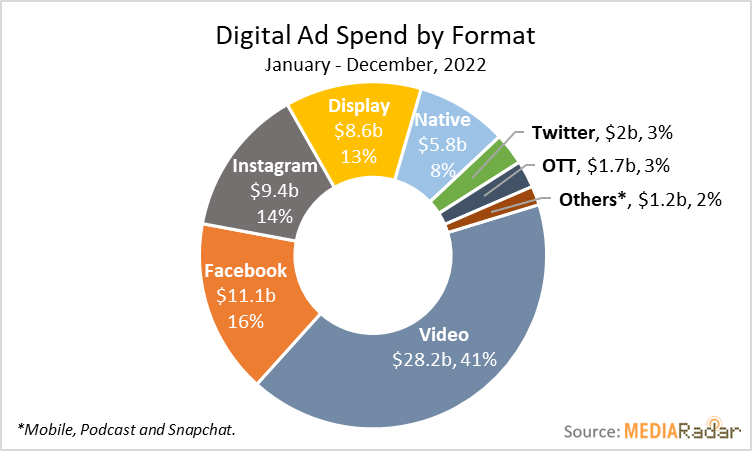
In 2022, nearly $144 billion was invested in digital, print and TV advertising. While TV still makes up 41% of total ad spend, digital was the top ranking format making up 47% of all buys. Over $68 billion was allocated to digital formats. These formats include display, online video, native, and paid social among other formats. This marks an opportunity for continued growth in digital media sales.
2. Top categories investing in TV are also top buyers of digital
Four out of the top five categories buying TV ads are top digital buyers as well. Not surprisingly big spenders from finance, media & entertainment, retail, and tech brands drive digital ad sales. TV investment for these, with the exception of media and entertainment, is down YoY.
However, each of these categories are up YoY in digital ad sales. Their combined digital investment still exceeds $36.6 billion and made up 53% of all digital spend. This represents a shift in the market towards digital advertising among top segments.
3. Few advertisers entering the market bought national TV spots
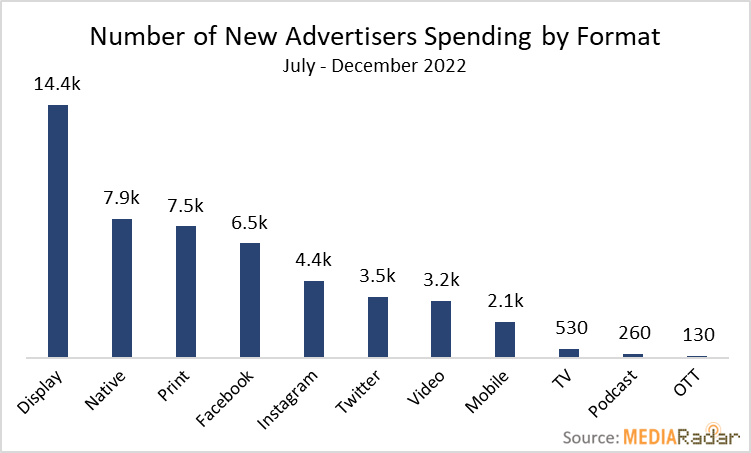
Only 1% of advertisers entering the market bought national TV spots. Despite looming recession concerns, MediaRadar observed 52k new advertisers (nearly 80k brands) entered the market in the second half of 2022. Not all of these advertisers purchased TV spots (530), but over 36k invested in digital display, video advertising and other digital formats.
4. Online video advertising is up
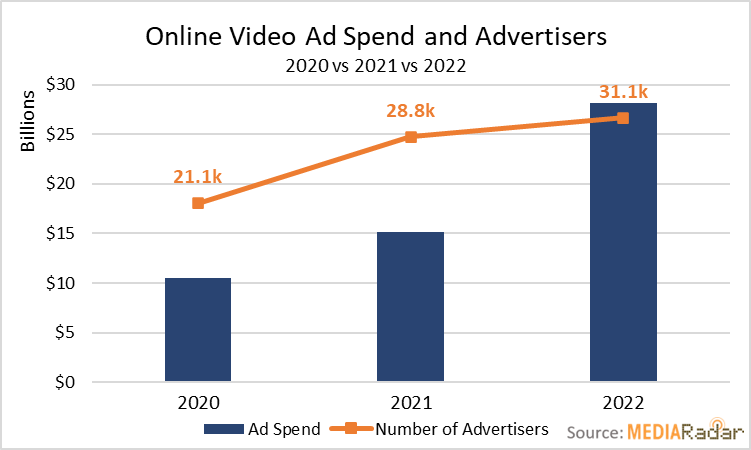
Online video advertising is increasingly more important to advertisers as it rose 86% YoY. A study by Hubspot says, “91% of marketers surveyed say they find video important to their advertising mix and 92% of them say online video produces a high ROI.” These feelings are likely contributing to the continued growth of video ad sales across media formats.
MediaRadar observed 31.1k advertisers spend an estimated $28.2b in video advertising during 2022. Top three categories advertised via online video during 2022: software ($1.9 billion), pharma ($1.4 billion), and film promotion ($1.4 billion). Combined spend nearly reached $4.8 billion, this is only 17% of total online video spend.
5. OTT investments increased despite concerns
Just a few years ago, new OTT streaming platforms were being launched regularly and consumers were anxious to embrace them. Now, platforms struggle to match growth of 2021 and prior. To overcome challenges groups, like Disney+ and Netflix, have introduced ad supported versions at a reduced cost to mixed reviews. Despite the challenges, 5.7k brands increased their investment in streaming platforms YoY. Together their buys were nearly $1.3 billion. Most notably LinkedIn, eHarmony, Kohl’s, and Febreeze contributed to this YoY increase.
While the Upfronts and Newfronts are an increasingly important time for large networks and media conglomerates, it is also an important time for all media sellers to understand the shifting marketplace and carve their niche into the new year. There is much opportunity to capitalize on the changing advertising landscape and continued digital growth.
At DCN, we’ve been diving deep into Generative AI – trying to understand what it is and what it isn’t and sort through the implications for professional content creators. We have met with hundreds of executives, tech specialists, journalists, artists, and creators who work within our member companies to create and monetize premium original content. We’ve heard first-hand what the content community is excited about and what gives them pause. Based on these conversations and our own research, we see several topics around Generative AI (GAI) that merit a closer look.
Protection for creators
Generative AI systems need to be designed in a way that respects professional content creators and the value of their IP. Perhaps the biggest concern is the loss of control over the content, in which they have heavily invested. GAI systems train by using digital content such as journalism and photos. However, they also scrape that content for reuse in a variety of ways and for a variety of purposes – some of which may undermine the business model of the content creator.
While the scraping of original content for training may seem relatively benign, Generative AI companies will clearly reap huge benefits. The use of premium trusted content helps these systems understand cultural nuances and avoid problems of misinformation and factual inaccuracies. If the old axiom of “garbage in, garbage out” applies, companies profiting from GAI should appropriately value premium trusted content.
That said, scraping of content for reuse seems highly problematic as the creator might lose the ability to distribute and monetize the content as they see fit. We’ve heard stories of Generative AI systems providing subscription content to non-subscribers and amalgamations of general news content without any attribution to the organizations which funded its creation. Stripping content creators of control over their work effectively deprives them of the ability and incentive to invest in new content. It seems like there should be a win-win here where GAI systems fairly compensate and credit professional content creators for their work.
Transparency
Companies that develop GAI systems should be transparent with the public so that we can fully assess the impacts on our society and address the consequences. If Generative AI fulfills its promise, then whole industries and sectors will be radically changed. In particular, consumer experiences with news and entertainment are likely to be upended.
With all that change, intentional and unintentional consequences are likely to occur. Generative AI systems have been shown to be flat out wrong, making up convincing sounding sources or generating “quotes” and articles to back up their responses which may be misattributed to individuals, institutions, or media brands.
There is an open question about the extent that these systems could be manipulated by bad actors looking to flood the public square with misinformation. As anyone can see, the world isn’t a perfect place. And, sadly, the internet is loaded with hateful, harmful speech. More subtly, however, there are conscious and unconscious biases baked into all kinds of reporting and opinion pieces. To the extent that Generative AI systems are training on content they scrape from the web, they may be recycling hate speech or perpetuating biases.
Therefore, allowing these systems to be developed and operate in a black box would invite all kinds of problems without an opportunity to correct mistakes before they run wild. Most of the early legislation around AI calls for transparency so that regulators and researchers can assess the potential impacts and offer solutions before actual harms are committed.
Competition
The tech industry currently has a competition problem – a lack of competition to be exact. While those dominant companies are currently under intense antitrust scrutiny, there is a concern that they may use the hype cycle of Generative AI to wrongly argue that competition exists and that regulators need to back off.
But the reality is that policymakers should be watchful to ensure that major tech companies don’t extend their dominance to the AI market. Generative AI systems are expensive to create and maintain. With such a high barrier to enter this marketplace, there is a danger that the biggest, most powerful tech companies will leverage their position and unrivaled resources to dominate the nascent GAI field.
This same playbook has been used before – Facebook leveraged its dominant position to buy out the competition. Google allocated its search dominance to acquire a monopoly position in the digital advertising infrastructure. And Amazon continues to leverage its position to drive competing ecommerce platforms into irrelevance. We should be careful to ensure that GAI systems aren’t used to maintain or increase dominance in markets and that these systems aren’t self-preferencing services from a handful of major companies to the exclusion of competitors.
TL:DR
Undoubtedly, Generative AI is an exciting new tool that offers efficiencies for artists, journalists, and other creators along with the promise of a bright new future for industries and consumers alike. And these changes are coming fast. Undoubtedly, the speed and scale of the development and deployment of GAI systems will only accelerate.
In the right hands, these new tools could revolutionize the way we interact, create, problem solve and so much more. However, bad actors also have access to these powerful tools. Therefore, problems with competition, misinformation, election meddling, and sabotage are likely to worsen.
As an industry and society, we should encourage the development of ethical guardrails to minimize the harms and maximize the potential associated with Generative AI technologies. In doing so, we can strengthen our commitment to protect consumers and incentivize new and established voices.


 / An inside look at the business of digital content
 Archive