Over the past 20-plus years, digital subscriptions have become essential to sustainable growth for media companies as part of their revenue diversification strategy. We know the pandemic created a strong consumer appetite for subscriptions. However, the digital media industry is wisely considering the future trajectory as the subscription marketplace faces heightened competition and inflation.
The research
Digital Content Next (DCN) partnered with FT Strategies to better understand the digital subscription market, explore the macroeconomic influences, and identify best practices for future growth.
The research, Navigating the Future of Digital Subscriptions, used a three-prong approach to analyze market conditions and identify business practices for subscription growth.
Qualitative interviews with a subset of senior executives from DCN member organizations to discuss business development and strategies for capturing future opportunities.
A quantitative survey among DCN member organizations on their priorities for the future as the subscription economy develops.
Review of data, analyses, and reports from the government, financial institutions, industry, trade organizations, trade publications, and consulting firms to identify and explain factors affecting the overall economic climate in the U.S. and their impact on the digital subscription economy.
Macro analysis
The Covid pandemic was a critical inflection point that significantly impacted consumer behavior and subscription offerings in the digital content market. However, as the effects of the pandemic wane, the market faces new economic pressures.
On the business side, higher interest rates could affect business investment. For consumers, increasing inflation rates, accelerating price-increases, and the reduction in consumer savings may force many to cut back on what they deem non-essential. Further, falling unemployment rates impact digital media companies in acquiring and retaining talent, which can also add costs.
Even with the economic factors plaguing the market, our analysis concludes that the digital subscription economy is expected to continue its strong growth and is somewhat insulated from adverse economic conditions. However, digital content companies must be mindful of the risks posed by the changing macroeconomic climate.
The report, which is available to members of DCN, provides details on the economic forecasts for advertising and subscription revenue, plus additional insight into the cost of doing business and the competitive marketplace. As the subscription economy continues to grow over the next three years, audiences will likely be the target of many subscription businesses from a broader set of media outlets.
Navigating the future
The research outlines four areas of focus on how best to navigate and implement new strategies for future growth in digital subscriptions.
Align the subscription mission with a highly collaborative organizational structure.
Find and leverage the right audience data to act as a common language across the organization.
Think more broadly about what innovation means to attract new audiences.
Expand content distribution to accelerate audience growth.
Digital media companies are in a stronger position now to invest and prioritize their subscription business. While overall market projections look positive, monitoring and responding to shifts in macroeconomic factors is essential to inform how best to navigate the future of the digital subscription business. The full report includes a macro analysis of current market conditions, market forecast, and steps to navigate future subscription growth.
Full research report for DCN members only. Register to download. The link will appear immediately below. If you’re already registered, the login button is on the top right of the page.
Publishers and advertisers – it’s time to unite! With collaboration, both parties can win big. Data clean rooms are a critical component in maximizing this relationship because they give digital advertisers and publishers the right tools to collaborate on their first-party data and redefine the way they target and reach audiences.
In combination with deterministic IDs, data clean rooms help to increase the addressability of existing customers. They also provide a great way to improve the targeting potential of “unknown users” and the ROI of marketing efforts. This includes generating insights and enabling personalized experiences across the web – all while complying with data protection regulations.
While data clean room technology isn’t new, the applications are not always well understood. For instance, if there’s a need for secure and privacy-compliant infrastructure to check data records for overlaps to enable downstream use cases – data clean rooms are the best fit. That’s because common variables or identifiers such as email addresses and other deterministic IDs are used.
This provides valuable insights into target groups and customers and helps develop effective marketing strategies. The key here is that the original data sets always remain separate from other parties, with no access to each other’s data (i.e., between publishers and advertisers). In this way, each party retains sovereignty over its information, works in compliance with data protection regulations, and gains new insights on mutual data overlaps to foster a variety of marketing use cases.
New targeting and reach opportunities
Advertisers who control and use their first-party data have always looked for additional external data sources to increase their advertising efforts’ efficiency. However, they have often been hampered by data security and privacy concerns. These reservations can be addressed through data clean rooms, allowing everyone to better benefit from their own and others’ data in a privacy-safe way.
Publishers and advertisers have a comprehensive knowledge of their customers who have consented to use their first-party data. Independent data clean room partners can help overcome technological, legal, and data challenges all while making the data usable for collaboration between partners. In partially automated processes, selected data from advertisers and publishers are merged and sorted in a secure way. In collaboration with their preferred publishers, advertisers can increase their existing reach.
As a controlled, virtual ecosystem, data clean rooms open and connect closed spaces for advertisers and publishers and integrate seamlessly into a client’s existing tech stack. Collaborative partners work together in a privacy-compliant manner, deciding when and how to use their own data. It starts with matching defined data sets between both parties. Where it goes from there depends on what features the data clean room solution brings to the table regarding integration, automation, and activation.
Criteria for selecting a data clean room
Advertisers and publishers considering using data clean rooms should keep the following aspects in mind when making their selection:
Data
Is there sufficient first-party data available currently or in the future, and what is the value of this data for your business?
Is there an opportunity for scaled reach and quality in terms of data & media? For example, via integrated machine learning technology?
Use cases
Which use cases are to be implemented?
Consider internal company use cases vs. external data collaboration use cases (e.g. advertiser-publisher & retail media)
Data/marketing insights
Advertising use cases (such as retargeting, prospecting, and measurement and attribution)
What is the relevance of these use cases for the business (strategic/commercial)?
Which business units implement these use cases (BI/Data Science &/or Digital marketing/media) and how easy is it to access, control and activate data in the use cases?
Integration
What security standards does the solution provide?
How intuitive is the UI/handling of the solution for the different stakeholders?
How integrated is the solution with existing ad tech?
What is the level of automation for stakeholders?
Scalability through integrated retargeting and prospecting capabilities
Matching data from both partners enables downstream processing for retargeting use cases in all data clean room solutions. In addition, some data clean rooms today use machine learning based on large data sets to create lookalike models (statistical twins) for prospecting opportunities.
If these approaches are applied on the publisher side, scalable media use cases emerge for advertisers and agencies. Beyond the targeting options, some data clean room solutions are also integrated into the tech stack on the publisher side so that the use cases can run fully automatically, and the data is also loaded directly into the activation channels.
Thus, advertisers can continue to run targeted and scalable campaigns based on their data, even without third-party cookies. Publishers using data clean rooms can, in turn, build powerful data sets from their first-party data and gain extensive reach. This makes them more attractive to advertisers and strengthens their position against walled gardens like Meta and friends. These tech giants have long been collecting consent and data on a grand scale. And because their data sets give exclusive insights into target groups, they’re irresistible to advertisers.
With data clean rooms, advertisers have a new opportunity to improve the quality of their data and increase their reach. And, by collaborating with advertisers using data clean rooms, publishers who’ve lost ground to digital heavyweights have a chance to regain lost ground and get a better return on their investment.
Although TikTok is widely considered a “Gen Z platform,” the video-sharing app also boasts an extremely high number of Millennial users. With over 100M active users in the U.S. alone, 32% of TikTok’s global users are between the ages of 25-34. With such a large and diverse audience – not to mention the recent revelation that young people are even turning to TikTok as a search engine over Google – there is a unique opportunity for digital publishers to adapt their strategies on the platform to reach critical audiences at scale effectively.
To do so, media companies must consider how best to leverage the viewing trends and the receptiveness these generations have to certain types of media. Below are key insights into how Gen Z and Millennial demographic similarities and differences fit into the larger social landscape, what influences their decision-making when it comes to attention, and ultimately what success looks like for digital publishers on the platform.
Where to find Gen Z and Millennial social media users
The rise of TikTok has significantly shifted the way people consume media. In fact, when surveyed about which sources of digital media they use the most, 37% of Gen Zers revealed TikTok takes up most of their time. While Millennials still skew a bit more towards Facebook (39%) and Instagram (19%), there is still a sizable audience of Millennials on TikTok. Nevertheless, as the preference for engaging short-form content continues to grow in popularity with Gen Z and Millennials, other social platforms are beginning to take note.
With so much buzz around TikTok’s growing user base and platform layout, it’s no surprise that Instagram introduced Reels. And, with 42% of Gen Zers sharing they also use Reels, it’s clear that this demographic jumps at the chance to create and consume short-form content no matter the platform. This insight gives publishers the perfect opportunity to maximize viewership of their short-form content. They can post virtually the same video to several platforms which means that they can cast an even wider net with little to no additional effort.
What’s influential in TikTok users’ decision-making
Though more social media platforms are mimicking TikTok’s strategies, 40% of Gen Z and 32% of Millennial users find advertisements on TikTok to be the most creative and authentic versus other social platforms. And two-thirds of users research products after seeing them on TikTok. This points to the platform’s power in helping to build brand awareness and influence purchase decisions.
This provides a unique opportunity for publishers to capitalize on especially when it comes to branded content. Last year, Buzzfeed signed a first-of-its-kind deal with TikTok, signaling the beginning of media companies leveraging the platform to create innovative deals between publishers and brands. This allows brands to capitalize on a built-in audience and allows publishers to attract new audiences – brand loyalists – to their content.
Branded hashtag challenges are one of many great tactics to attract engagement by enlisting consumers to become active participants in brand campaigns via user-generated content. So, empowering platform users to join campaigns by submitting their own content is the type of word-of-mouth marketing advertisers crave and built for the digital age. Using creative means to get information across results in a higher chance of user recollection and can help to increase follower count (for both publishers and brands), and eventually – readers.
Strategies for digital publishers to try ASAP
There are a few breakout media brands whose success on social platforms like TikTok provides insight into how digital publishers can best approach converting Gen Z and Millennial social media users into subscribers and promote consumer loyalty.
The Washington Post successfully uses TikTok to reach a younger audience and break away from its more traditional, serious tone. Morning Brew, the media company that aims to help professionals of all ages, began to use TikTok to help grow its newsletter subscriber count. The publication partnered with a creator to create authentic TikTok videos while also promoting the Morning Brew message. This enabled Morning Brew to expand its social media footprint as well as gain thousands of quality, engaged newsletter subscribers.
Digital media publishers have an opportunity to extend their reach by using social media platforms focused on short-form video content. Ultimately, TikTok truly allows for and incentivizes creativity that both Gen Zers and Millennials heavily respond to. Digital publishers can use a variety of features and trends to create effective, immersive, and interactive content to reach their target audiences with unprecedented efficiency. Authentically reaching consumers through TikTok will help media properties gather accurate data on consumer interest as well as humanize humanize the company by providing digestible content in a more relatable and accessible way.
To clarify, Nielsen’s own research put streaming services ahead of traditional cable products for the first time since it began collecting data on those practices. And, arguably, some of its data is debatable, since it rolled services like Hulu with Live TV and YouTube TV into both the “streaming” and “cable” categories (cable networks are core to both products).
Also, while Nielsen’s own data has streaming at a slight edge over cable, columnist David Bloom notes that the measurement firm doesn’t typically gather data from devices like computers or game consoles where streaming services are also offered. More importantly, as Bloom pointed out, the Nielsen report probably reflects a consumer trend that has been taking place for several years.
Still, the survey has fueled comparisons between streaming services and cable television — and not always for the better. Bloomberg media correspondent Lucas Shaw recently wrote that price hikes and advertising made it so that “the streaming business is starting to look like cable TV from 10 years ago.” The idea is that price hikes and advertising are turning the streaming industry into “Cable 2.0“.
It is difficult to argue with that logic from a price perspective: Netflix, Hulu, Amazon Prime, Disney Plus are among the streaming services that have implemented one or more price increases since their debut. (Netflix has raised subscription fees on averageat least once per 1.5 years since 2014). But to focus squarely on price misses the bigger picture: Streaming has liberated good entertainment from the wall jack and the television set. And, in doing so, has made it cheaper and more-accessible than at any point in television history.
Streaming is not too far removed from cable’s history
Accessibility has spurred technological advances throughout the history of domestic television: Broadcast TV emerged about a century ago as a way to add moving pictures to radio programs. What is commonly known as cable TV started out as community antenna television. Regions in remote parts of the United States banded together to build a giant antenna capable of receiving distant broadcast signals, then ran coaxial cable from the antenna to homes. Customers paid a few dollars to maintain the system and had access to most, if not all, of the main three networks plus a handful of independent stations.
In the mid-1970s, television mogul Ted Turner figured he could make a few dollars more from the advertising he ran on his Atlanta station, WTBS (Channel 17), if he uplinked it to satellite. From there, cable systems could receive the station and distribute it to their viewers. The idea took off, and soon stations like WGN (Channel 9, Chicago) and WOR-TV (Channel 9, New York) jockeyed for satellite space so they, too, could get national distribution on cable.
Years later, another television pioneer, John Malone, saw that cable was a much-bigger business opportunity than anyone else seemed to realize. His Tele-Communications Incorporated (TCI) grew to become one of the dominant-players in the industry between the late 1970s and the mid-1990s. Malone and TCI bankrolled some of the first cable-only networks around (including Turner’s own CNN when it faced bankruptcy). And many of those cable networks are still around. (TCI is currently owned by Comcast.)
Both phases of television limited viewers to their TV sets. It wasn’t until streaming came along that video was finally liberated from the living room cable jack.
Streaming is not an extension of cable — it’s an evolution of television
Jason Cohen spends a lot of time thinking about this 30,000-foot view of the domestic television industry. In 2019, he left his job as a media portfolio manager for a Wall Street firm to launch MyBundle.TV, an online marketplace for streaming services. He thinks people who focus on streaming services being the new cable — “Cable 2.0” — are missing the bigger picture. He believes that “TV 1.0 was broadcast, TV 2.0 was cable and TV 3.0 is streaming. It’s taking the closed, set-top box model of TV 2.0 and opening up the marketplace.”
There are still pain points for streaming services, with price being an obvious one. It’s true that over the last few years, most major media companies have raised their subscription fees as they invest billions of dollars in original content production earmarked for their own direct-to-consumer services.
And the marketplace is reacting to rate increases by diversifying their subscription tiers. For years, Hulu has offered customers the choice of buying their streaming service at a budget price if they are willing to tolerate ads. They also have the option of paying more money if they want a commercial-free experience. Since then, other streaming services like HBO Max, Discovery Plus, Comcast’s Peacock and Paramount Plus have taken the same approach. Disney and Netflix have confirmed plans to do the same in the near future.
Cohen thinks price diversification will help a streaming service appeal to a broad group of customers at any given time: “If a household wants to save money, they can watch tons of free, ad-supported streaming services. If a household has money to burn, they can spend a ton of money on ad-free tiers of streaming services and never watch another commercial again. And if it’s something in-between — which is probably most of the country — it’s subscribing to a handful of services at one point, and then switching them out during the year.”
TV 3.0 is a chaotic landscape that will stabilize with time
There is some data to suggest that consumers are growing more comfortable with the idea of switching services on a whim. According to theanalytics firm Antenna, around one in five households dropped three or more subscription services in the two years ending this June. In 2020, the number was closer to one in 20 households within the same two-year stretch.
One reason why subscribers might be switching away is the sheer volume of streaming services. Consumers are also finding their favorite TV shows and movies shuttled between them. Netflix, for instance, has lost several of its top comedy shows: “Friends” moved to HBO Max, then “The Office” moved to Peacock. Disney has slowly pulled titles from Netflix, too, as it seeks to reclaim movies for its own Disney Plus streaming service.
The revolving door of content hits on another pain point for streaming: In the TV 3.0 world, finding content can be a confusing experience. Cohen believes that platforms are starting to address this by building technology that makes it easier to find shows and movies across a number of different services and devices, and recommendation engines should become better and easier to use over time.
As Cohen describes the situation, “Where is it easiest to discover shows? It’s probably your phone. Where’s the best place to watch TV? It’s probably on the TV.”
So, how do manufacturers and platforms respond to that? By building a bridge between the two — whether that’s Vizio Account, or a Samsung app, or a Roku app, or something else. As he points out, “every TV maker and every operating system is trying to figure out the best way to help consumers find content on their platform.”
That said, Cohen acknowledges the streaming world is something of a mess right now. Mergers and acquisitions mean the owner of one streaming service (like CBS All Access or Discovery Plus) suddenly becomes the owner-operator of another (Pluto TV, HBO Max). And that, of course, means figuring out a long-term strategy for both. (If you’re Paramount Global, each streaming service lives in its own ecosystem. If you’re Warner Bros Discovery, youannounce plans to get rid of two flagship streaming services and start anew).
It is a particularly chaotic time to be a sports fan, with sports rights to popular franchises like the National Football League and Major League Baseball split between broadcast, cable and streaming. Major League Baseball games, for example, are carried on regional cable sports networks in many markets, except for a few games that are exclusive to either NBC (and Peacock) or Apple TV Plus. This means that baseball fans this season might have to subscribe to cable and make an account with Peacock and Apple just to follow their home team.
Adding to the confusion is the lack of a single sign-on feature that allows customers to have one username and password that covers every service they want access to. Some companies have experimented with offering a feature that comes close to this: Roku, Apple and Amazon have streaming marketplaces baked within their own platforms. And Vizio recently announced Vizio Account, which seeks to replicate that experience. (Google is alsoreportedly exploring this idea.)
Cohen’s own MyBundle.TV is a platform-agnostic marketplace that asks streamers about the channels and programming they want to receive, then directs them to streaming services where they can find it. Eventually, customers will be able to manage their subscriptions from within the MyBundle.TV platform. Currently, MyBundle.TV only offers this feature with Sling TV, but other partners are in the works.
Malone, the cable magnate who pioneered TV 2.0, thinks bundles will eventually be the winning ticket for TV 3.0. He also believes there will be further consolidation between media companies as their war with each other intensifies.
Cohen backs the idea of a single platform where customers can start and stop streaming services at will — he left his Wall Street job to build that kind of product. But he’s not convinced that streaming services have to appeal to everyone with everything. He thinks niche streaming services can be successful on their own merit: “Streaming services don’t need to be everything for everyone. There are options that appeal to every household.”
As content becomes more fractured, Cohen said consumers need to resist the itch to sign up for every streaming service that is out there. The idea that customers had to have access to everything hearkens back to the days of TV 1.0 and 2.0 — when popular shows were watched in real-time on just a handful of channels, whether they were on broadcast TV or cable. That experience resulted in appointment-viewing — people had to watch shows at a certain time (later, they could record them for delayed viewing) — and also helped spur water cooler conversations and pop culture moments.
The TV 3.0 landscape is different. Streaming, for the most part, doesn’t require appointment viewing, because people can — and do — watch things on their own time and at their own pace. Cohen says things like streaming watch parties are offering solutions to people who still want television viewing to be a social experience. But it appears to be a technology that few people want. What customers do want is access to everything. But those days are long gone.
Streaming still has its challenges. However, the technology will improve over time and consumers will eventually come around to the idea that the convenience and price of streaming is worth the sacrifice of not having access to everything. That, coupled with the flexibility of starting and stopping services as well as the ability to watch programming across any number of devices, means streaming should not be reduced to Cable 2.0. It is an evolutionary leap in a revolutionary entertainment experience. It’s TV 3.0.
Digital publishers work hard to create quality content that engages audiences and keeps them coming back for more. When an article or video receives a surge in views, that means mission accomplished, right? Not so fast.
Since invalid traffic (IVT) makes up for nearly 40% of all website traffic, it’s likely that some of these viewers are non-human, or “bots.” And, unfortunately, when bot traffic is included in analytics reports, it can skew data and give an inaccurate look at content performance.
Here are steps publishers can take to achieve more accurate website data, which allows them to make more informed editorial and marketing decisions.
Identify traffic sources and spikes
To understand how content and promotions are truly performing, it’s important to identify and remove invalid traffic from data reports. A first step is to determine traffic sources. If a visitor comes from an unusual website or unfamiliar referral source, it can be an indication that the traffic is not human. This includes traffic from locations beyond the typical readership area. Or it might be a slew of visitors from one city, which could be the site of a datacenter.
Another indicator could be the time of day that visitors view content. If many arrive on the site at an unusual time such as in the middle of the night, it could indicate that the traffic is robotic. Other non-human behavior such as spending zero seconds on a page or achieving a 100% bounce rate are also signs the traffic might be robotic.
Analyzing traffic spikes might also uncover increases in legitimate visitors, which offers insight into why content performed well. For example, an increase in an article’s views could indicate that it was picked up by another news source, shared on a popular website, or received a greater attention on social media. Identifying traffic sources and patterns can reveal what articles are truly performing well. And, of course, that is likely to influence future content decisions.
Filter bot traffic
Not all bot traffic is malicious. Search engines send bots to crawl websites to learn more about them, which helps inform search results. However, bots also visit websites for harmful reasons including scraping content to create fake sites, inserting malware to steal user data and injecting spam. Publishers can also unintentionally invite bots to their website by purchasing website traffic.
Many analytics platforms have built-in tools to filter bot traffic. Since these tools often must be activated by a site administrator to begin working, it’s helpful to check to make sure the filter is being applied to analytics reports.
While automatic known bot filtering tools are a great start to getting a more accurate look at website data, they might not detect all bots. Publishers should identify traffic patterns of good and bad user behavior to identify unknown robots that are not detected by the analytic partner and create custom filters based on the characteristics of those bots detected. Some of these characteristics may include the location the traffic came from, screen resolution, service provider, time on page and bounce rate.
Identifying traffic patterns and creating custom filters to remove bots from data ensures that publishers are getting the most accurate look possible at their website visitors.
Check site tags
Analytics providers require that publishers install a tag on their website to allow them to collect data. If a tag is inadvertently installed more than once, data analytics will be inflated. Or, if installed incorrectly, it might produce incomplete data. Publishers should check tag containers to ensure there is only one tag for each tracking suite so that data isn’t included twice in reports.
Get a third-party evaluation
Sometimes it helps to get input from a third party that specializes in analyzing website traffic. A digital publisher audit is great way to get an expert’s opinion about site traffic, tagging and creating custom filters. Website auditors keep up with industry trends and platform changes, which saves publishers time and the resources needed to identify new bots or create custom filters.
By taking the steps above, publishers can better identify high performing content, discovering promotions that drive real traffic, and making more informed business decisions. They can also take steps to reduce bot traffic and avoid common missteps that occur when it goes undetected.
As in many countries, TV and video viewership in the UK registered a surge during Covid. However, as consumers re-emerged from lockdowns, TV viewing time declined. Ofcom’s fifth annual Media Nations UK 2022 Report offers insight into viewership patterns in the UK and the audience shift to on-demand platforms.
On-demand takes time viewed
Total viewing time for TV and video in 2021 was 5 hours and 16 minutes per person per day, a decline of 25 minutes in 2020 but up from 2019.
Time spent on broadcasters, across live TV, recordings, and on-demand, declined by 9% compared to 2020 and 4% in 2019. As a result, broadcasters’ share of viewing continues to fall from 67% in 2019, to 61% in 2020, to 59% in 2021. Interestingly, broadcast video-on-demand (BVOD) increased by an average of three minutes per person per day compared to 2020, growing its viewership share from 6% to 8% in 2021.
Time viewing SVOD, at 58 minutes per day per person, declined by 6% from 2020. However, SVOD maintained its share of viewing, from 19% in 2020 to 18% in 2021.
SVOD market matures
Subscriptions to SVOD services (at least one service) declined slightly in the UK from 68% to 67%, or19.2 million households, compared to Q1 2022.
However, Ofcom’s analysis confirms a high concentration of multiple SVOD services among UK households. Nearly half of all UK households (46%), which is approximately 13.2 million, access two or more services in Q1 2022. Furthermore, of these households, 5.2 million—or about one in five homes—subscribe to the three most popular services: Netflix, Amazon Prime Video, and Disney+.
Netflix remains the largest SVOD provider in the UK, with 17.1 million households (60%) subscribing. It’s followed by Amazon Prime Video (46%) and Disney+ (23%).
Maintaining subscribers is crucial in a competitive SVOD market. According to Ofcom’s report, 2% of Netflix users, 4% of Amazon Prime Video users, and Disney+ users canceled their subscriptions in the past three months. Ofcom’s Public Service Media (PSM) tracker identified cost as the top reason for cancellation.
Audience attitudes
In addition to time spent, the Ofcom report provides details on viewer satisfaction and offers insight into audience engagement. Eighty-six percent of consumers who used Netflix in the past six months said they were satisfied with the service, while 81% said the same about Amazon Prime Video and Disney+, respectively.
Top Netflix attribute scores:
Provides services that are easy to find my way around (82%);
easy to find something I want to watch (80%);
Appeals to a wide range of different audiences (82%); and
has programs that are relevant to me (75%).
Top Disney+ attribute scores:
Easy to find my way around (78%);
easy to find something I want to watch (74%); and
appeals to a wide range of different audiences (73%).
SVOD market growth
Overall, the SVOD market performed strongly in 2021. It generated approximately $3.2 billion (or about £2.7 billion), an increase of 27% compared to last year. The top three services—Netflix, Amazon Prime Video, and Disney+—accounted for 89% of the market share.
Ofcom’s analysis highlights the evolving TV and video landscape and the divide between younger and older viewers. Almost nine in ten adults, 18-24, go straight to streaming, on-demand, and social video services when looking for something to watch. In contrast, 59% of adults aged 55-64, and 76% of adults who are 65+, turn to TV channels first.
The report also suggests that streaming services with hybrid business models may become more common among SVOD offerings. Introducing ad-supported tiers (e.g., Netflix and Disney+) subscription opportunities to hard-to-convert viewers may move the dial for new subscribers. As the on-demand market evolves, media companies must consider multiple access points, platforms, and price points to acquire new subscribers to grow their audience share.
Live sports have been the jewel in broadcast companies’ crowns for decades. The allure of a live and hugely engaged audience has proved to be an effective draw for brand advertisers, particularly those with high-value consumer goods to hawk. That allure hasn’t lost its luster.
Sports broadcast rights remain competitive, expensive, and increasingly fragmented. But what has changed is how audiences choose to interact with sports content. The rise of social media and streaming platforms has changed the game, as their inherent interactivity enhance the appeal of live sport.
Combine this with the investment other media companies have placed in their subscription- and advertising-based streaming platforms, and the growing cost of sports content, and you have a space ripe for disruption. And while the details of exactly how disruption is taking place varies by platform, sport and country, it ultimately has the same cause as the tumult across the media world: tech turning passive audiences into active participants.
Social sport
At Twitter’s recent Newfronts appeal to advertisers, the company announced the rolling over of the platform’s partnership with the WNBA. This marks the sixth year of the partnership which grants Twitter the broadcast license for live games. It is no coincidence this is designed to further engage a predominantly women-led audience at a time when bringing in new audiences is key. Following its 2022 regular season, the WNBA announced that the league “set records for engagement with 186 million video views (+36% vs 2021)” across its social media platforms.
Twitter’s rationale for that partnership is its ability to offer real-time reaction to every basket and foul on. The real-time interplay between tech platform and sports content is part and parcel of how many media companies are selling their sports streaming to advertisers.
Theo Luke, senior director of global content partnerships at Twitter, tells me, “A fundamental to the live sport experience is talking about it. Increasingly broadcasters are actively including social media rights in their deal renewals with leagues because they see the value of highlighting clips alongside the live streaming experience to capture larger audiences and other revenue streams.”
“For example, through our recent Twitter Amplify partnerships with ITV and Formula 1, we offer a number of real-time highlights and the opportunity to engage with the moments that matter directly on people’s timelines,” Luke continues. “From an advertiser’s perspective, this not only allows you to align with premium video content, but also position yourself at the heart of the action and fanbases. When sport happens on Twitter, you don’t have a passive viewership, but an engaged, attentive and connected audience.”
Live community interaction has also been Twitch’s core appeal from even before it was Twitch. Since its acquisition by Amazon, the livestreaming platform has been inching ever closer to a destination for premier sports content. That’s been accelerated by Amazon’s investment in the broadcast rights for sports, and the deeper integration of its advertising tech with the Twitch platform.
In 2020, only two years after Amazon acquired some of the rights for Premier League matches, it was already streaming those high-value matches for free on Twitch, as well as NBA content. At the time, Twitch’s content acquisition lead, Eric Brunner, said, “They’re very open to exploring new ways to engage their community, like co-streaming USA Basketball on Twitch.”
Effectively, then, the new streaming platforms are hoping the pre-existing live interaction that formed their core appeal will supercharge interaction around sports coverage. That creates huge opportunities for potential advertising partners, both in terms of activating those audiences in the moment and by providing analytics around the interaction.
Sports clubs reap the benefits of streaming
The transition to sports streaming on new platforms is also being driven by the sports leagues and clubs themselves. Andreas Jung, chief marketing officer for FC Bayern Munich, told me the club’s engagement windows have widened beyond match day: “This is the expectation that the fans have and they want to participate in everything. This means that they consume content everywhere and anytime… 24/7.”
Fans can pay a yearly fee to be club members, and Jung says members, “have the expectation to get more information, to get to be closer with a club and therefore we have to bring them more information, we have to bring them more services and so on and so on.” As a result, Bayern is betting on its multi-year partnership with Adobe to boost its streaming content for users – and to deliver greater advertising revenue.
Opportunities for smaller leagues and networks
And while platforms and the bigger legacy leagues take advantage of the new advertising opportunities afforded by live streaming, smaller clubs and platforms are effectively launching as alternatives. Unbound by the limited amount of airtime on linear channels, new wrestling leagues are vaulting over the lower bar to entry to replicate some of the new opportunities – albeit at a smaller scale.
Guildford Town FC is a regional soccer team in the UK, far removed from the glittering heights of the Premier League. Speaking about the club’s partnership with dedicated sports streaming platform Joymo, its manager Paul Barnes echoed the comments from larger clubs: “I believe this is where the world is going. We’ve talked about the benefits from a playing perspective and staying connected with our fans, but this is also a way for us to make revenues that can help the ongoing development of the club.”
In the U.S., too, smaller leagues are using streaming to grow audiences and revenue. Overtime, a sports media company aimed at Millennials, recently raised over $80 million in a Class C funding round. Much of the confidence around the investment is predicated on Overtime’s strong social media and streaming offering, which includes 65 million followers across all of its 80 social media channels
The strategy was pioneered by esports leagues, which grew from grassroots to huge events through judicious use of live streaming platforms like Twitch. What is especially interesting for wider media companies, though, is that even traditional broadcasters, such as BBC and BT Sport, are now adding esports coverage to their linear offerings.
New audiences, new approaches
“Twitter works alongside broadcasters and rights holders to help make live sporting events even bigger,” explains Luke. “Our platform connects people directly to what’s happening around live events and that conversation provides greater value to our partners.”
He continues, “Most recently, we saw this with the UEFA Women’s EURO 2022, which saw the number of tweets [triple] ahead of the final and nearly 900 million impressions in the UK throughout the tournament. Watching live sport in 2022 isn’t just about consumption, it’s also about engagement.”
James Hartnett, account director for sports-specialist marketing agency The Playbook, told me, “As the topics and ways they are discussed has also evolved, so too have the platforms sports fans turn to. The primary source of 39% of 18-24-year-old ‘social natives’ for sports news – including match highlights, unique moments and opinion commentary – is TikTok, Instagram and YouTube. The stats are much the same for 25-34-year-old, though they tend to prefer Facebook over TikTok.
Streaming has indelibly altered sports viewing. This creates new opportunities across the ecosystem, especially when it comes to engaging new, often younger, audiences – a challenge most publishers can relate to.
Increasingly, consumers are opting out of targeted advertising, leaving publishers searching for ways to continue serving marketers’ desire to reach relevant audiences and to optimize ads for audiences. A significant part of the answer for many will lie in publisher content, context, and the savvy application of first-party data. To do this, publishers must capture powerful insights they have available to monetize the most relevant, high-value consumers – all without compromising their privacy.
Much of the adtech ecosystem has kept their eye trained on when Google will or won’t deprecate third-party cookies. There’s also a great deal of focus on existing and pending privacy regulation. While these are valid concerns, we do need to work in the here and now: Safari and Firefox already block third-party cookies and Apple’s ATT makes opting out of tracking incredibly easy. And in Europe, consumers already have the ability to “reject all” cookies via Chrome.
The reality is consumers are already opting out of advertising more than ever. However, publishers can still make those audiences available for advertising. With their content and their unique, direct relationships with users, publishers are the keyholders in re-establishing a connection with unreachable consumers.
Advertising powered by content and first-party data
Publishers are the keepers of a crucial component of advertising: content. Visitors to publisher sites certainly continue to engage with content, even when they’re not traditionally visible or they’ve opted out of third-party cookie tracking.
Publishers have access to a wealth of traditional first-party data. Not only is this first-party data more reliable than third-party data, but it’s also more powerful. And, because the data is owned by the publisher, they can target these known audiences on behalf of advertisers. Beyond that, they also possess a great many applicable insights from page signals created by users around categories, concepts, emotions, sentiment, keywords, and entities. The power of these data points ensures that publishers can maximize both addressability and revenue.
Traditional contextual targeting is often as simple as placing sports ads on sports pages, but that’s not enough. With the right technology, publishers can build next-generation contextual targeting that not only builds bridges between their own content but provides additional value to advertisers in terms of scale and accuracy.
Beyond simple context, publishers can learn from consented users’ data and create an affinity score for each piece of content, based on page attributes. This can then be matrixed with a publisher’s cohorts to predict how likely a given cohort is to engage with a page, compared to the site average. By leveraging their own content and the rich first-party data they have access to, publishers can deliver accuracy and scale to advertisers from first page-view. And, critically, they can do all this while respecting user consent.
Direct advertiser-publisher relationships
Advertisers are preoccupied with evolving timelines for the depreciation of third-party cookies or new regulations. However, the reality is that without the right publisher partners, they already cannot reach large swaths of audiences. The California Consumer Privacy Act, Apple’s Hide My Email and App Tracking Transparency, and Safari/Firefox are all impacting consumer choice to opt-out of invasive data collection – and even advertising altogether.
Things are different when advertisers partner directly with publishers that have consented first-party data from their audience, particularly when it is paired with contextual signals. These publishers are uniquely equipped to activate users and make otherwise unreachable audiences available to advertisers – without compromising consumer privacy.
These direct relationships provide another pathway for publishers to make desired audiences available to advertisers. They also shift power away from the data-driven duopoly and place the power back in the publishers’ hands. Publishers’ position to maximize their trusted relationship with audiences provides a viable alternative to third parties that exist only to commoditize publisher content and data.
Consumers’ increasing methods of protecting their own privacy are, ultimately, a positive for the industry – especially for publishers with strong first-party data practices. But this brighter future can only be embraced if we acknowledge the need to invest in those practices and ensure consumer data is treated responsibly.
About the author
Aarti Suri is a Product Marketing Manager at Permutive. Aarti has worked in the marketing, advertising and communications space for over 10 years, this includes experience working with OOH, Media Owners, Ad-Tech and in SaaS businesses. An advocate for a more inclusive industry, Aarti is a mentor and member of Bloom.
You probably have a presence on YouTube, but do you have a specific strategy for the platform? If you don’t, then it’s time to address that.
With close to 2.5 billion monthly active users, YouTube is the second most popular social network in the world. Only Facebook, with 2.9 billion users each month, enjoys greater reach.
Despite this, many publishers’ presence on YouTube can often feel like an afterthought. The popular video-sharing network sometimes seems like an also-ran when compared with the content strategies (and resources!) being deployed across newer, shiner, networks like Instagram or TikTok.
It’s time for that to change. Here are three key reasons why.
1. YouTube is too big to ignore
Originally created way back in 2005, YouTube is not exactly a new kid on the digital block. Yet it’s also far from being an internet dinosaur.
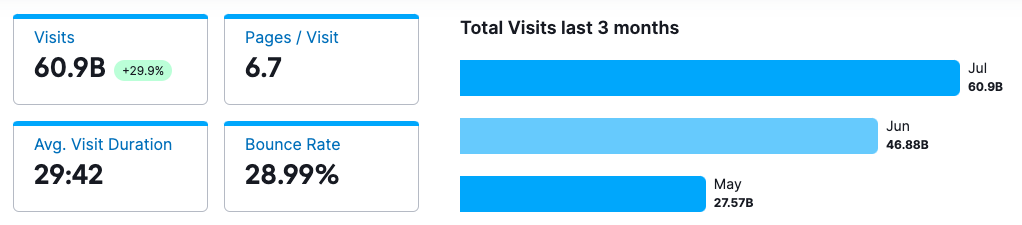
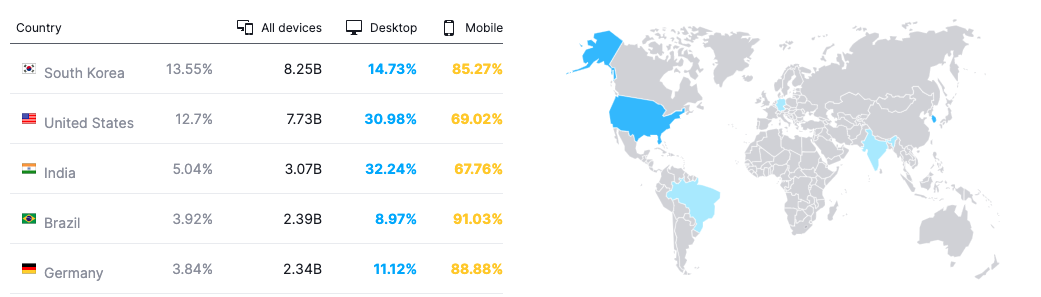
According to Semrush, a software-as-service (SaaS) platform used for keyword research and online ranking data, last month YouTube was the second most visited website in the world with 60.9 billion visits. The average session visit was a whopping 29 mins 42 seconds.
Image: Screenshot(s) via Semrush, 22 August 2022
“YouTube is a seriously undervalued part of most publishers’ audience development plans,” Nic Newman, the lead author of the annual Digital News Report, recently told me during an email conversation about their 2022 study.
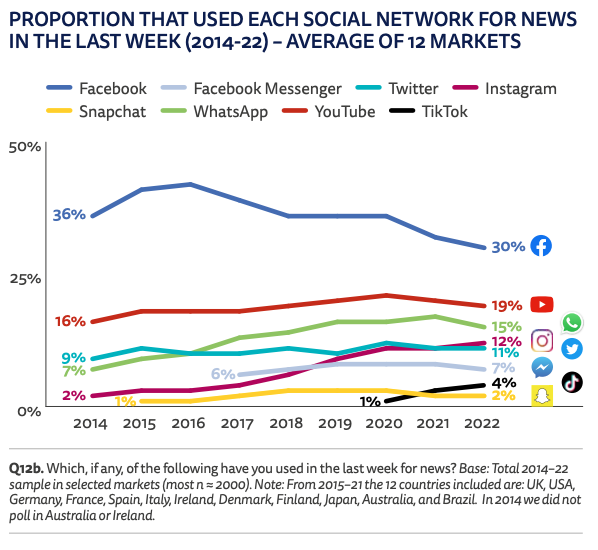
The latest findings, which were published in June by the Reuters Institute for the Study of Journalism, found that across the 46 countries covered by the report, YouTube “is the second most important network for news after Facebook,” Newman says.
Because this is a global study, there’s considerable variance on a country-by-country basis.
Nonetheless, in the United States, YouTube is the second most popular social channel for news in a typical week (19% of the sample). That puts it behind Facebook (28%) but some way ahead of Twitter (11%).
It enjoys similar popularity when figures are aggregated across 12 major markets. This reflects the universality of its appeal and begs the question of whether publishers are giving the platform the attention it deserves.
2. YouTube is a versatile platform
User habits for news and other content on YouTube might also surprise you. As Micaeli Rourke explained in a feature for Digital Content Next last December, YouTube is something of an audio powerhouse. (Disclaimer: She interviewed me for the article.)
YouTube was the leading platform for podcast consumption in the Ulast year, the 2021 Digital News Report found. They don’t provide comparative data for 2022. However, the latest study does note that YouTube is the second biggest platform for podcast consumption in Germany (19% of listeners) and the top source in Spain (30%).
Video-led podcasts are part of the reason for this popularity, as well as the opportunity to access content on multiple devices. This includes desktop and Smart TV consumption, which allows YouTube to play in the background, as well as more active “lean in” viewing.
The rise of YouTube viewing on TV sets is one reason why mobile increasingly makes up a smaller percentage of overall views in many developed markets. This presents opportunities for content creators to reach audiences in new places and spaces.
Meanwhile, the ease of publication (and lack of a requirement for a broadcast licence) has resulted in the emergence of YouTube TV-style shows and commentary alongside popular formats such as WIRED’s Autocomplete Interview (where celebrities answer the internet’s most searched questions about themselves) and Vogue’s 73 Questions video series. It also creates opportunities for historically text-centric outlets, such as Portland-based newspaper The Oregonian to go deep with long-form investigative stories. And it enables the Guardian (and others) to produce highly effective short explainer videos on issues du jour.
Looking ahead, Podnews revealed in March that YouTube is working to improve promotion, discoverability, and monetization opportunities for podcasters, including audio ads and “new metrics for audio-first creators.” Similarly, YouTube Shorts, its “TikTok clone,” is also a growing priority for the platform and another space that publishers may look to capitalize on.
Collectively, these formats, along with more traditional video content found on the site, present a variety of means for publishers’ to harness YouTube as part of their engagement and revenue strategies.
YouTube generated around $20 million in advertising revenue in 2020, CNBC reports. Arguably, that puts it in competition with publishers for ad dollars. However, creators can join the YouTube Partner Program (YPP) to earn income through mechanisms such as advertising, sponsored content, channel subscriptions and online shopping. YouTube’s revenue share model means that publishers typically take home 55% of the revenue from ads shown against their videos, Digiday stated back in 2020.
That said, some of these returns might be less than publishers hoped for. Digiday notes that “news publishers, in particular, have a harder time attracting ad dollars because advertisers remain wary of their ads appearing next to controversial topics.”
Nevertheless, when it comes to both content and opportunities for revenue, the platform’s versatility means you don’t have to deploy a cookie-cutter model to be successful on it. There’s scope for variety, experimentation and avoiding the “one size fits all” approach, which you sometimes encounter on other platforms.
3. YouTube effectively reaches younger audiences
Reaching a youth audience has long been the Holy Grail for many brands and media companies. For publishers interested in reaching Millennials, Gen Z, and even Generation Alpha (a cohort born in the past decade), YouTube should feature prominently in their plans.
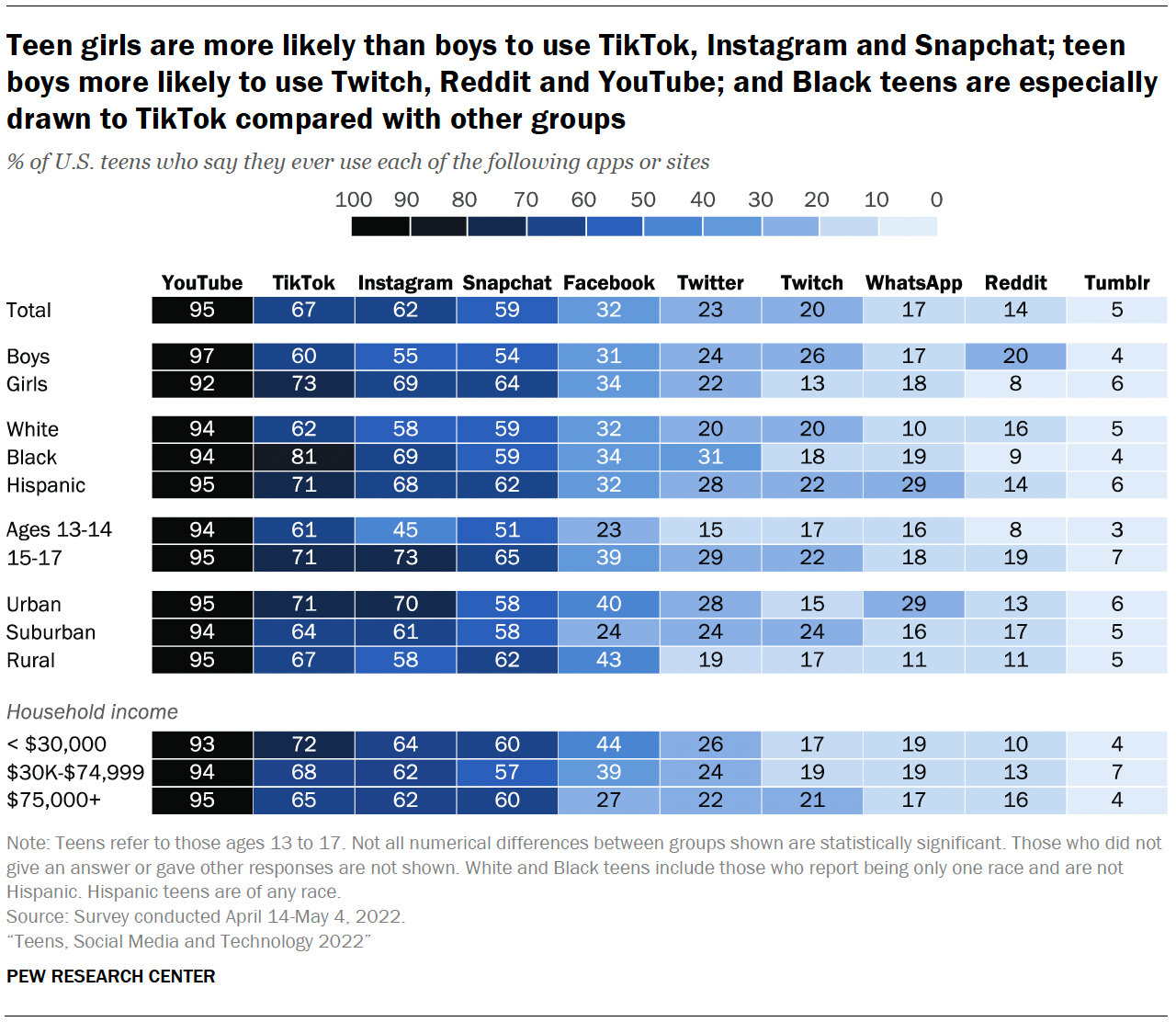
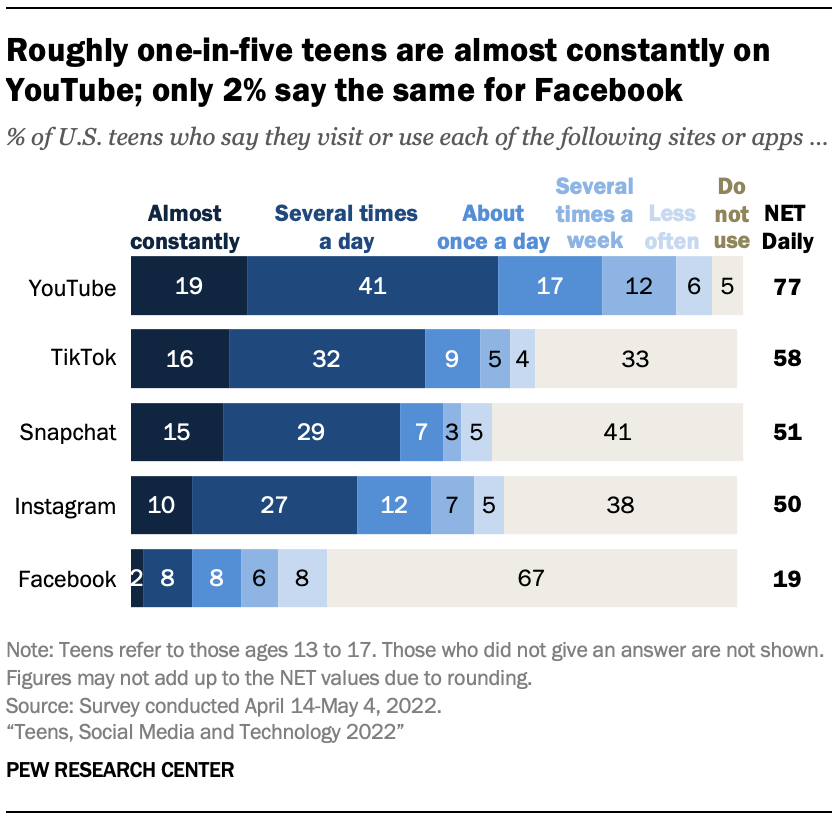
New data from the Pew Research Center demonstrates how YouTube usage is virtually ubiquitous among American teenagers. Teenage boys are more likely to say they use YouTube than teenage girls. However, in terms of those who have tried the service, there’s actually surprisingly little variance across a wide range of different indices.
Moreover, when looking at teens overall, Pew’s “Teens, Social Media and Technology 2022” report discovered that nearly one in five (19%) say they use YouTube almost constantly. That puts it ahead of both TikTok (16%) and Snapchat (15%). Collectively, around three-quarters of U.S. teens (77%) visit YouTube on a daily basis, some way in front of its rivals.
Roll credits
This isn’t a piece extolling another “pivot to video.” We’ve been there. We know how that worked out. Instead, it is a recommendation to take a look at YouTube and whether you are using it as effectively, and comprehensively, as you could.
Of course, the platform is not without its challenges. Its recommendation engine can drive viewers away from your channel to other creators. Publishers might prefer to keep traffic (and its associated ad revenue) on their own properties. And last year The Information argued that programmatic ad sales were also hurting midsize publishers. Companies like BuzzFeed and Vice receive less money via YouTube’s revenue share arrangements than if they sold the spots directly, they said. Nonetheless, despite these real considerations, YouTube’s size, versatility, and reach with younger audiences are all major plus points.
Press Gazette has outlined how the biggest publishers on YouTube—in terms of subscribers and all-time views—are typically broadcasters. Many of these providers will post copies of reports, bulletins and shows, or offer a livestream, on the platform. But that doesn’t mean non-broadcasters can’t punch through. Press Gazette’s research also shows how Vox has broken the paradigm with a distinctive approach to high-quality (and often quite evergreen) video.
Vox, along with Vice News and Insider, have also achieved success on the platform despite publishing considerably fewer videos than many of their more broadcast-led peers. This makes it clear that this isn’t just about volume of content.
In a separate discussion with video leads at UK newspapers, The Sun and The Guardian, they also posited how a clear voice, a willingness to experiment and “building trust with the casual audience,” are all potential ingredients for YouTube success.
Thus far, tapping into YouTube’s potential isn’t something that many non-broadcast publishers have done well. Yet.
But, if publishers are able to look beyond platforms like Twitter, Instagram and TikTok (channels that either fall into the media’s longstanding issue with “shiny object syndrome” or spaces that might also seem more natural hubs for their content), then that might change in the not-too-distant future.
Certainly based on its audience, reach and breadth of content you can post, there’s an argument to be made that YouTube merits more of many publishers’ time and resources than it currently enjoys. If you want to ride the next digital wave, this trusty steed may not be a bad one to back.


 / An inside look at the business of digital content
 Archive