The pandemic was a key driver of new subscriptions from news and gaming sites to entertainment streaming services. As a result, publishers registered record subscription growth. For digital media businesses, once 100% reliant on advertising revenue, the question now is how to sustain this growth over time.
Publishers naturally encourage heavy readers to convert to paying subscribers. These readers offer a high lifetime value and are an excellent market for new products, upgrades, and cross-sells. However, heavy users were not the only segment showing an increase in subscriptions during the pandemic. Casual readers also increased their subscriptions sign-ups.
Greg Piechota highlights strategies to convert and retain light readers after the pandemic in the International News Media Alliance (INMA) new report, Light Readers: Digital Subscriptions’ Next Growth Path. Publishers should think differently about light readers and develop a value proposition and marketing mix that fits this target audience.
Open a door for casual readers
Publishers grew their subscriber base last year. High-interest news events such as Black Lives Matter and the U.S. presidential elections, in addition to the pandemic, signaled light readers to learn more. As a result, casual news consumers were part of the wave of increased traffic to news sites.
Recognizing the historical events of 2020, many publishers responded with looser paywalls during Covid. They recognized the value of trading content for reader registrations. Once readers registered, it allowed publishers to track and understand their content preferences. It opened a valuable communication channel to push content to causal readers via e-mail, paid ads, etc. — hopefully leading to new subscriptions.
The standard acquisition funnel may not be the right path for casual readers; they may need more passes in the first stages of the relationship to trigger registration, engagement, and subscription.
Insert chart optimize customer journey
Developing a new habit
Onboarding new subscribers need to be centered around developing a new habit of regularly visiting publisher’s content. Piechota cites research from University College (UCL) that suggests “people are most likely to adopt new habits after 66 days of repetition.” In other words, publishers have approximately two months to engage light readers daily to become a regular habit.
Developing a new behavior is a critical step in creating a long-term subscriptions relationship with light readers. Further, trial lengths should include sufficient time to adopt this new habit-forming behavior.
Learn about the light reader
Publishers must focus on engaging light readers in both content and site design. Segment personalization in many content management systems (CMS) can offer different homepages to different reader segments. A homepage design for casual readers can include explanation sections, added news analyses, and 24-hour recaps.
Light readers, by definition, are more limited in what they read on sites than heavy users. Heavy readers often look at everything. Therefore, it’s more challenging to figure out what is truly interesting to them. Given the disparity between these two cohorts, it may be beneficial to focus on the overlap of their content interests. Finding this intersection can serve light users well while maximizing the reach of content.
Further, increasing engagement of light readers can be more critical than maximizing heavy-reader engagement. Piechota points out increasing heavy readers from 50 visits per month to 60 may not affect their engagement. However, moving a light reader from two visits a month to 10 is likely to affect their engagement significantly.
News publishers see casual readers as a valuable audience. A renewed focus on this cohort, understanding their behavior and knowing their unique characteristics offer an opportunity for growth and a gateway to engagement.
The post-cookie world is facing a measurement problem. There is plenty of talk surrounding FLoCs, Unified IDs, first-party data, contextual advertising and more. However, there is not enough conversation about how the worthiness of these solutions will be understood by buyers and sellers.
There will likely be no silver bullet replacement for third-party cookies for some time, so teams need the ability to analyze the effectiveness of new technology and data sets. This is particularly true for publishers, who will suddenly be attempting to meet new advertiser KPIs based on a much broader range of data types and technologies.
More data, more discrepancies
Publishers have typically been in a reactive position relative to advertiser expectations. But what happens when those expectations evolve due to the industry-wide push to replicate the performance of behavioral targeting through various post-cookie solutions? Complexity will increase, and with it, there is the potential for increased friction. This will inevitably impact publisher revenues.
Discrepancy management was historically limited to the differences in first-party and third-party campaign pacing. But as new data is used and advertiser KPIs change to incorporate different technologies for the same campaigns, discrepancies will become more of a three-dimensional problem.
Cookie-based targeting is an example of where this could get more complicated. Third-party cookies made it very simple for a sports brand to serve ads to an audience of soccer fans in the 18-36 age range. Without access to third-party cookies, advertisers will want a way to analyze the audience data that determined the age group and interests, or the context of the page, or a number of other potential factors in order to understand whether the ad was served to the right audience. This makes campaign analysis and compensation inevitably more complicated.
Another example can be found in the case of contextual segmentation and semantic differences in classification. An alcoholic drink recipe that one advertiser may consider as “cooking” may also be classified as “alcohol ” with a different advertiser. Since publishers work with many partners, they need the ability to recognize and normalize these nuanced differences that can have a large impact on campaign discrepancies. In short, the new world we’re entering is even more fragmented, and existing publisher workflows must adapt.
The need for measurement alignment
In a soon-to-be-released survey conducted by DoubleVerify, 47% of publishers cited measurement standards as one of the biggest challenges with relying on first-party and contextual data. The same will likely be true for advertisers, as more complex data sets will be closely tied to KPIs. This highlights the need for neutral measurement that improves collaboration and reduces friction between buyers and sellers.
Even within individual solutions such as FLoCs or Unified IDs, there have been delays and setbacks that highlight the complexity of these issues. The industry will need different types of data to fill the gap left by third-party cookies. Ensuring this data is trusted, verifiable and actionable will be a key challenge for the industry.
Ensuring post-cookie success with holistic data strategies
The looming industry changes will make it more important for publishers to address instances of data silos and manual reporting that slow down decision making and reduce transparency. This can be made possible with a holistic data strategy and tech stack that can manage the rising complexity. Publishers focusing on aggregating their data and optimizing workflows can better position themselves to be proactive and take control of how targeting and measurement impacts their business.
In this age of experimentation where new variables lead to more complicated deals, it’s even more important for publishers to invest in tools that will facilitate the ingestion of a variety of both first- and third-party metrics holistically. Successful campaigns must account for making first-party audience data actionable for advertisers while considering key media quality metrics and any third-party data that buyers rely on. Many industry stakeholders expect first-party data to be key, but this is only the case if the data is able to be used to effectively replace third-party targeting.
What you need for a holistic data strategy
Holistic data strategies will help manage complexity in discrepancy management and ad targeting, but what does this look like in practice? To help publishers get into a holistic mindset when it comes to data and workflows, they should ask themselves the following questions:
Which data sources does your organization rely on now? How is it collected and aggregated?
Which data is valued by your top advertising partners? How will this change in the future due to cookie deprecation?
Does the organization have a system to connect these resources in a meaningful way?
What teams stand to benefit from data that they don’t collect themselves?
Once publishers decide to move forward with a holistic approach, they must determine whether they will build a technology solution in-house or purchase one that can adapt as the industry evolves. One key point to consider moving forward is the potential for automated, algorithmic optimization based on the intersection of these data sets. For publishers, it’s important to think about the long-term implications of this choice, as workflows and tech stacks are often difficult to transition out of once they are established.
No one can fully predict what’s coming next for post-cookie targeting and how those results will trickle down to publishers. What publishers can prepare for is the fact that complexity will only increase from here. With that in mind, it’s vital for media companies to prepare by evaluating their tech stack and data foundation in order to aggregate and analyze more complex data sets.
Is there such a thing as a free lunch? For online audiences looking for news, metered and freemium paywalls offer a little taste of the feast that exists beyond the paywall. And if we’re honest, savvy online audiences know that there are ways and means to get at the content behind those paywalls for free, too.
But for the publications that are looking to monetize digital audiences through a paywall, how much to give away for free is an inevitable discussion. Beyond the public service implications – such as The Atlantic and The Financial Times making much of their pandemic information free-to-access – the point at which the paywall kicks in is a constant consideration for digital media companies. Consider all the attention The Economist received for reducing the number of articles readers got for free – from five to three – back in 2019. At the time its MD of global circulation Marina Haydn said the focus was on providing “value over volume.”
It’s a constantly evolving conversation. Better, more accurate modelling tools allow for flexibility of paywalls based on user habits and demographics, so even within the same publication there are different amounts of “free.” Similarly, there are many sites where the “cost’ of access isn’t monetary, but instead the time and data cost of handing over user information at the registration wall.
There are as many options as users, and often multiple in use across the same publication. But which content is always free at certain publications, and is there best practice for what should always be free in different publishing verticals? How do hard news, B2B and B2C shake out?
Always free
According to the Reuters Institute “more than two-thirds of leading newspapers (69%) across the EU and U.S. are operating some kind of online paywall.”
There is an excellent argument to be made that most news content online should be free to consume at the point of publication. In the article ‘The Truth Is Paywalled But The Lies Are Free’ Nathan J Robinson states that while news paywalls are justified, we need to reappraise that in light of the new economies of disinformation online.
Given the number of recent revelations about the role of advertising-based outlets in disseminating disinformation, it’s more important than ever that we examine how news sites can act as a bulwark against that trend.
Despite these concerns, of the largest quality news publishers online only the Guardian has a direct audience revenue model and also remains free. But there are other digital publishers that are primarily user-funded that make free news at point-of-consumption a core pillar of their offerings.
Eurogamer, the UK-based consumer news and analysis site, recently launched its own subscription or ‘supporters’ service. Notably when announcing the move its editor-in-chief Oli Welsh was clear that the content that was free-to-access would remain so; its new content would be “additive”:
“One thing we decided very early on was that we didn’t want to lock all of our work behind a paywall. We wanted to keep it freely accessible to everyone. So, inspired by the example of The Guardian (as well as of some of our competitors), we’ve created this supporter program where subscription is entirely optional, but comes with a bunch of (hopefully attractive) benefits, ad-free viewing first and foremost among them.”
That additive model is very similar to that of The Independent, which also creates subscriber-only content while allowing the majority of its content to be free-to-access. It brands the content behind the paywall as ‘Independent Premium’ – which matches Eurogamer and many other titles using the partial paywall model.
Similarly, back in 2016 the Telegraph abandoned its metered paywall in favour of its current model, which has certain types of content that are always free. It then has a premium option on top and certain perks of registration that encourage users to sign up.
Nor does the free content necessarily need to exist in the same medium as the paid-for content. Quartz, for instance, still offers its newsletters for free while gating some content on its site behind the paywall. It currently has around 27,000 subscribers.
For news publishers of any stripe, then, the option is there to have a certain amount of content that is always free. That could be, as with the Guardian, from a purely ethical perspective or, as with Eurogamer, because other revenue sources afforded by free access are still a big part of the overall mix.
Never free
This is the easy one. Many of the most well-known subscription success stories have a hard paywall at their heart. In fact, in many cases, any free content that isn’t purely promotional is anathema to their publishing strategies.
That’s especially true for B2B and business information publishers, which mostly never lost sight of the value of their own expertise. Despite that, even among news publishers the hard and fast paywall remains notably rare. Of the biggest subscription success stories, only the Financial Times, The Wall Street Journal and a handful of others really embody the hard paywall ethos.
It is, as has been pointed out, a fantastic option if you have a rich seam of proprietary information or data, or occupy such a rarefied niche that few if any competitors exist alongside you.
Free enough
Consumer-facing magazine brand Condé Nast has ultimately said that it wants all its brands to be paywalled. That’s a huge bet upon the ability of titles – mostly based around lifestyle and hobbies – to convert people to paying readers, and on the back of a metered model. But it’s not a contention without some supporting evidence.
On the back of WIRED going behind a paywall in 2019, its editor Nicholas Thompson said that: “I think it can work for every Condé Nast brand. I don’t think it can work for every brand. Think about Forbes, which has this very lucrative contributor network. No one’s going to subscribe to the contributor network, in part because there isn’t really an identity or a style or a voice – why would you subscribe to that?”
But the ability of free, premium content to act as an antennae for potential future subscribers shouldn’t be overlooked. For both the freemium and metered models – which are neck-and-neck alongside one another in terms of popularity in the EU – that free-to-access content puts readers at the beginning of the funnel to a full-blown subscription.
If you have ever hit the paywall on an article I have written (there has to be at least one of you), today is your lucky day!
That’s especially true for consumer magazines, which rarely occupy the sort of rarefied niche that would enable a hard paywall. Over the course of the pandemic research from Jellyfish found that UK tech and gaming titles saw a rapid growth in digital subscriptions (268% YOY) – of which most have a metered paywall model.
It would be foolish to say that the never-free model works best for B2B exclusively, or that a metered model is the definitive best for consumer magazines. There are exceptions to each rule, and often the individual brands themselves play around with which content is free at any time.
People working in CTV advertising often toss around phrases like “the living room of the future” and “the connected consumer.” TV technology today is pretty darn impressive and its easy to be optimistic. With content like choose-your-own adventure programming and sophisticated hardware, today’s TV tech puts the “home theaters” of even a decade ago to shame.
However, there’s also a central dilemma: The tension between wanting to innovate and wanting to play it safe in order to avoid annoying or alienating consumers. How high-tech is too high-tech for certain audiences? There are a number of emerging technologies designed to enhance the viewing experience that advertisers could leverage. However, just because they can doesn’t mean they should.
For brands, designing a campaign for unproven territory can mean designing a campaign that doesn’t work because it fails to resonate with consumers. On the other hand, if you pass up the chance to be first-to-market, someone else will get there instead. The trick is to find the just-right spot in between.
Luckily, there are some lessons to be found in some of the past few decades of innovation in the living room. As with ad overload, history can teach us a few things about marketing on CTV.
Watch for consumer adoption
First, track consumer adoption. Just because a technology exists doesn’t mean that consumers are using it. That might be because it’s too expensive, too difficult to use, or just not useful. Consumer uptake is what really matters, especially with an emerging medium. And the reality is that plenty of TV technologies promoted by mainstream consumer electronics retailers encounter lukewarm reception from buyers.
Remember curved TVs, which were hyped up back in 2013? It turns out that you can’t replicate an IMAX experience in your living room, no matter how high your ceilings are. Meanwhile, take a look at voice control, something that may have seemed like a science fiction technology not long ago. You can thank the marketing behind Amazon’s Alexa and Apple’s Siri for convincing consumers that voice control is both useful and user-friendly. As a result, we’ve found that voice-controlled ads really do engage users.
Consumers crave convenience
Second, never forget that consumers crave convenience. Integrating new tech into your advertising often isn’t worth it if it makes the brand experience more complicated for the consumer. This is particularly important when translating digital campaigns from desktop and mobile to the lean-back CTV environment.
There’s perhaps no better cautionary tale here than 3D TV. Watching some entertainment in 3D – sports, for example – seemed thrilling at first. But needing to wear specialized glasses for the experience, in addition to the added cost of 3D TVs, posed a barrier to entry that consumers weren’t willing to surmount. Then ESPN backtracked on a plan to put live sports into 3D, which eliminated the one incentive many consumers had to adopt the new tech – a more immersive sports experience.
There’s an exception to this, though. You can offset added complexity with a value exchange. If you’re going to make an ad experience more complicated, be upfront with what consumers will get in return. That might be fewer commercials for the rest of the episode they’re watching. It might be discount that they can capture with their mobile phones straight off their TV screen (or both).
Prepare to adapt to change
And finally, be ready to adapt to change. Things change fast – hardware, software and consumer habits. Five-year plans for a new medium may need to be altered in a matter of weeks.
In addition, keep an eye on market signals even if you consider them to be externalities. Some media executives and technologists were singularly focused in the mid-2000s on the HD-DVD vs. Blu-ray race to supplant the standard DVD. However, that might have distracted them from the fact that before either could “win,” streaming media became the choice of consumers worldwide. Millions of dollars were invested in technologies that were obsolete before they even hit the market.
“We’ve screwed up in the past but we won’t do it again” is a common mindset that’s been in the ad industry for decades. Typically – spoiler alert – we do screw up again. But even as we look to the future, having an eye on the past can never hurt to help avoid a few missteps.
Streaming TV may have killed cable - but where do we go from here? After the pandemic-induced streaming boom, consumers are cancelling subscriptions at record rates. As viewers grapple with rising prices and an explosion of subscription services, OTT players should embrace the potential of ad-supported streaming in order to survive an increasingly competitive market.
OTT on the up
The OTT (over-the-top delivery of TV and film via the internet) industry is booming. In 2017, approximately a third of U.S. adults cited streaming services as their main means of consuming television. Double that for people aged 18-29. During the pandemic, streaming television has continued to display incredible growth. In 2020, screen time overall was up almost a third on the previous year. Viewers watched streaming services, such as Netflix, Amazon Prime Video, and Disney+, for one hour and 11 minutes per day. Also, 12 million people joined a service they had never used previously. Three million of those viewers had never previously subscribed to any TV streaming service at all.
A changing paradigm
The mass adoption of streamed OTT services coincides with a fundamental change in the television business model. While television has traditionally been funded largely by advertising, most streaming TV platforms have instead opted for a subscription-only model. For traditional TV providers transitioning to streaming, this choice is understandable, given the abundance of legacy technologies that cannot easily be switched towards an advertising-based SVoD. New players like Netflix, by contrast, have made a strategic decision not to offer an ad-supported subscription.
OTT overload
The subscription model appears to be working well enough for Netflix, the undisputed market leader. The problem lies in the explosion of alternative streaming platforms. In 2020, the average viewer was subscribed to nearly eight streaming services, compared to six in 2019.
Netflix raised the prices of their memberships in 2020 and may well do so again. The result is that the monthly cost for consumers of streaming tv is increasing, as both the prices and number of services go up. There is an inevitable tipping point where paying multiple subscriptions becomes too expensive for the viewer and they will choose to let some go. Many have already crossed that threshold: 36% of Americans plan to cancel streaming subscription services in the next 12 months. And the most common reason – by far – is the price of service.
Ad-supported gains ground
Although subscription dominates, ad-supported streaming services have seen substantial growth during the pandemic. Research by Deloitte found price to be a key factor in consumer streaming decisions. Most consumers (65%) want cheaper ad-supported streaming options (up from 62% pre-Covid). And, of those who did, more than 50% preferred ad-only streaming. Sixty three percent of respondents in a PwC survey said they would be willing to sit through more ads if it meant cheaper subscriptions. Providers offering ad-supported streaming now include The Roku Channel, IMDb TV, Discovery plus, CBS, and Hulu, to name a few.
Sell smarter ads
Part of the appeal of the subscription-only model lies in its apparent simplicity. For established television providers, transitioning their advertising model from cable to digital presents many technical challenges. For those providers who have embraced ad-supported, a combination of white-glove and programmatic ad sales are the norm.
However, a new approach is also gaining popularity: self-serve advertising platforms. Inspired by the walled gardens of Facebook and Google, self-serve ad platforms allow OTT providers to sell their ad inventory through a branded, automated marketplace. This allows them to tap into the massive SME ad spend that currently drives digital ad growth. SMEs increasingly favour self-serve solutions, and for OTT brands with their own platforms, less value is lost in the infamously murky “black box” programmatic supply chain.
Roku, for instance, sells home screen banner ads, Roku screensaver ads, and video ads via their self-serve platform Roku Ad Manager. Ad Manager is designed to be a smarter, simpler, and more cost-effective way of managing channel promotional campaigns within the Roku ecosystem. It is just one of an increasing number of self-serve platforms popping up among OTT brands.
The other important aspect of ad-supported streaming is that it’s not simply a return to the dark days of regular, irritating ad breaks (as still found on linear TV). OTT providers that adopt ad-supported models are innovating the user ad experience to make it more effective and less obnoxious. Hulu, for instance, runs pause ads. This non-disruptive, non-intrusive user-initiated ad experience appears only when viewer presses pause when watching content. That’s a far cry from the ad breaks of old, and an indicator that ad format innovation is an essential part of the new streaming experience.
Ad-supported is inevitable
As OTT prices and the number of platforms continue to rise, consumers are increasingly looking for flexible, low-cost alternatives to meet their streaming needs. For OTT providers, offering only subscription models means that they price themselves out of the market for cost-conscious cord cutters.
We are not likely to return to the days of constant ad breaks and linear TV. Rather, the future lies in the flexible middle ground where consumers can pick and choose from a selection of price models: subscription, ad-supported, or a hybrid of both. OTT providers need to embrace ad-supported streaming - the sooner, the better.
About the author
Johan Liljelund is the Executive Vice President at DanAds based in Sweden. Johan is an entrepreneur with more than 20 years of experience in developing technology towards the media industry and a pioneer in the digital advertising industry enabling publishers to streamline and efficient their internal processes on a global market.
The media is covering news from more angles, and at more depth, than ever before. The Tokyo games generated a flurry of content that spanned fashion, mental health, gender equality, politics, and more. (And let’s not forget the athletes and actual events!)
The summer games reflect how big news events typically branch out across industries, lifestyle categories, etc. Sometimes, the link between what would be considered a critical piece of news and everything else is tenuous.
Unfortunately, in the pursuit of absolute safety and stringent brand preservation, many advertisers err on the side of caution. They employ rigid brand safety practices that lead to overblocking, which diminishes the yield publishers need to bring the important conversations to the fore. As a result, many advertisers sit on the sidelines as journalists explore the various facets of evolving news. Unfortunately, that even includes topics that could be on-brand for many advertisers.
News content holds digital advertising’s future
The advertising industry’s pullback associated with Covid-19 coverage early last year illustrates the negative impact this can have on publishers, advertising brands, and the overall consumer experience. In early 2020, traffic to major U.S. news sites jumped more than 50% compared to the same period the previous year. However, that increase in visitor time and attention did not provide a corresponding revenue increase because many advertisers were steering clear of any content referencing the virus.
The root of the problem lies in the “blocklist.” This simplistic brand safety tactic prohibits ads from being served based on keywords appearing in URLs or nearby content. According to news reports, “coronavirus” was the number-one term on industry blocklists. In fact, more than three thousand advertisers have blocked ads from appearing near it.
Despite these challenges, there is ample opportunity for publishers to move the conversation past purely transactional ad sales and take more active control of their content strategy. By offering curated inventory packages that are both contextually relevant and brand suitable, publishers are able to address advertisers’ brand safety concerns. They can provide also advertisers with greater control over the audiences they are reaching and the content they are aligned with.
Adapting advertising to the news ecosystem
Overly restrictive blocklists impact publishers and advertisers, yet the news will always have complexities and nuances. However, according to GroupM, “There are simple ways to advertise in news without compromising brand safety. But to avoid hard news, or even bad news, flies in the face of the facts.”
Adapting to fast-paced news cycles requires you do the following:
1. Gain insights and control
Evolve from the brand safety of yesterday. Focus instead on understanding the context of the content surrounding brand messaging. Contextual Intelligence tools help advertisers and publishers understand and evaluate billions of webpages and other digital content. This allows them to evaluate supply and identify brand-suitable environments for advertising based on overall page context, not a single word or meta data.
For example, many advertisers might decide they are comfortable with ad placements around current content related to topics like personal hygiene, cleaning, telework, streaming entertainment, food delivery, education, cooking, books, games, or exercise. While each marketer needs to determine its own standards for brand suitability, this type of related content may be appropriate.
In an interview, Edwin Wong, SVP of Insights & Innovation at Vox Media, noted that: “When quality content is matched with people’s passions and interests, it creates a much richer picture of who the audience is, why they are there and what motivates them. When we do this right, we no longer base contextual targeting on just the individual, an individual action, or an individual piece of content, but on what our platforms deliver for the audience holistically. It changes the retroactive perspective of targeting and makes context targeting future-facing.”
2. Provide meaningful ad measurement
Establish baseline metrics
Two primary benefits emerge from consistent monitoring and accounting for viewability, invalid traffic, and brand-safety reporting across your campaigns. First (and very importantly), you protect your advertisers’ brand dollars. Second, effective brand safety will be dynamic. Brand suitability takes page context and intent into account to address continuous content evolution.
Life beyond verification
Connect your campaign to data sets that reveal meaningful impact so that attention becomes an outcome to pursue in tandem with traditional KPIs such as viewability and verification. More broadly, marketing campaigns need an industry ready for new metrics to gauge cross-channel impact beyond just verification.
Measure across channels
Publishers and platforms will look to brands to maintain consumer loyalty and trust in their expertise. This calls for both robust content and multichannel dissemination.
Evolve KPIs to gauge true engagement and impact
Innovative marketers who experiment with formats beyond traditional social media posts and editorial-style content learn more because verification alone won’t tell you about impact post-view. As marketers seek further control over their ad spend and a better understanding of campaign efficacy, measuring advertising outcomes like consumer attention will become crucial.
When you move measurement beyond ad verification to attention, you’ll show advertisers how your inventory helps them drive success and hit their KPIs. That’s a surefire way to keep them coming back for more.
Drive more revenue through agility
Changes to ad targeting, data collection, and privacy regulations will continue to challenge the digital advertising ecosystem to evolve and bring new solutions to market that support its future. The ability to stay agile and adapt to the changing industry will be critical for publishers while increased collaboration across the ecosystem will provide not only innovation, but an increased customer experience and the need every stakeholder to rise to the occasion.
Ever opened an article and started reading, only to lose your spot because you were bumped down the page? This annoying occurrence is the result of layout shift, one of many performance issues that can crop up without consistent care and attention.
Improving the experience of our users is always a top priority at The Washington Post. With Google’s focus on user-centric performance metrics via new page experience signals called Core Web Vitals (CWV), we can better monitor and iterate on those experiences.
CWV signals are currently being rolled out globally. They consist of three new performance metrics: Largest Contentful Paint (LCP), Cumulative Layout Shift (CLS) and First Input Delay (FID). We set a target to reach the highest threshold across all three metrics by August 2021, as Google’s rollout of the new signals is set to be completed by the end of the month.
For publications like The Post, which need to balance rich advertising, rich content and page speed, CWV poses an interesting challenge: How do we ensure a performant experience on all pages across our domain in the short term? And, looking ahead, how can we bake good performance and attention to UX into our long-term processes and culture?
In August 2020, aggregate CWV scores show room for improvement (Note: This data is for our entire domain on mobile devices only.)
Last summer, the engineering team at The Washington Post began exploring just that. Since then, we’ve seen significant lifts across all three scores.
In August 2021, aggregate CWV scores show significant lifts after performance investments.
To accomplish this positive shift, we put our users at the forefront of our engineering and design practices. Here are some key takeaways.
Understand the baseline
We began by determining a baseline for our CWV scores across our site using several different monitors to understand the complete picture. Luckily, there are a lot of awesome tools to help.
Step 1: Identify Patterns with GSC
The Google Search Console dashboard for CWV provided a good first pulse. This allows us to drill down into our less-performant urls and begin to identify patterns in templates or features.
Step 2: Get more granular segments with real-user data
Next, we collaborated with our Analytics team to set up dashboards that would show us an approximate distribution of scores for real users. This gives us more granular insight to triage issues on lower connection speeds, varying devices, etc.
Step 3: Automate and monitor release impact
We highly value continuous deployments and set up synthetic monitoring using Calibre App against our common page templates, with automated alerts going to Slack when we fell below our threshold. This allows us to gauge impact of each release so we can #alwaysbeshipping.
Make it a priority and assemble the team
Communication and a shared commitment to deliver high-quality user experiences are the cornerstones of our success. From engineering to design to advertising and our newsroom, web vitals became a common language and a common goal through a series of communication and alignment methods:
Recurring (and actionable) checkpoints across departments and teams to check in on progress, flag concerns and share tips
Slack channel for sharing web vitals wins, resources and questions
Company-wide presentations on web vitals in town halls
Getting company buy-in for performance work is possible by illustrating to stakeholders how CWV will benefit customers, increase the bottom line and speed up engineering productivity to ship more features, faster! It’s a win-win-win.
Fix the things!
We took several strategic steps to improve CWV scores at The Post.
Optimize Rendering of Main Images for LCP
We reworked the way we rendered the main image in our standard article layout, and as a result, it was the biggest improvement we saw in LCP.
How it worked:
Preloaded the img element’s srcset
Used an LQIP (low-quality image placeholder) in the form of a blurred svg as the background-image of the image element until the high-res request loaded
Assigned the attribute decoding=”async” to the img element
These changes resulted in an improvement to our LCP score that was immediately noticeable.
Reserved Space for Components to Minimize CLS
Anywhere we used lazy loading, we used a placeholder element with a min-height — and potentially min-width — to reserve the space so the element would not jump in and push content elsewhere on the page. We invested in skeleton states to improve the user experience for our readers. This is one of those techniques that became a pattern for us in our quest to improve our CLS scores.
One example of this execution is with our advertisement placeholder. Previously, ads would jump into the slot and push content down the page, which could be frustrating for users, particularly on mobile devices or on smaller displays.
Improving our CLS score required close collaboration with the advertising team. To evaluate impact, we developed and ran extensive A/B tests that served different creative with predictable sizes into the slot for a split segment of users. By analyzing the CWV and broader impact, we were able to make data-driven business decisions. In most cases — and to our surprise — serving predictable creative sizes increased revenue and we were able to commit several units to a set size and eliminate CLS. By opting to serve larger ad sizes (300×600 units only instead of a combination of multiple sizes, which caused a layout jump), we saw higher CPMs. We also eliminated several ad format types that were jumpy. These were traditionally poor performers with our users. We replaced those formats with units that loaded fully in view, resulting in higher ad viewability metrics and, ultimately, higher engagement and improved ad performance.
As the page loads, min-height is reserved with a skeleton state for inline ads:
Because of this, the ad can be fully loaded in without impacting CLS:
Code-splitting for Faster FID
While we have made continuous improvements to our FID, we found opportunities to further enhance the score by utilizing code-splitting. We were able to ensure that, on any given page, unnecessary code was excluded from our JavaScript or CSS bundles, making our files lighter and our pages faster.
FID is described as a phenomenon that “happens because the browser’s main thread is busy doing something else, so it can’t (yet) respond to the user. One common reason this might happen is the browser is busy parsing and executing a large JavaScript file loaded by your app.”
By leveraging Next.js dynamic imports, we can conditionally load the JavaScript for components that are needed by each page. We took a similar approach to code-splitting CSS with updates to our webpack build:
Maintain, maintain, maintain
As with many things, improving CWV scores is not something you do once and then move on. We’re working at The Post to integrate CWV into our ongoing product, design and development processes, in addition to regular review of changes in our scores. It’s an ongoing effort.
We were able to introduce CWV as a new set of standards in cross-team collaboration — and dedicate resources to maintaining these standards. This will serve as a point of reference for other cross-team initiatives in the future. Now, we’re looking at structuring other projects the same way, for example, on web accessibility.
This article originally appeared on The Washington Post Engineering blog and is republished with permission.
Want to share CWV tips, interested in working with us, or just feel like saying hi? 👋
This project wouldn’t be made possible without the hard work of this outstanding team: Holden Foreman, Robyn Bortz, Anna Scalamogna, Taylor Scott, Christopher Kankel, Erika Johnson, Hannah Mahon, Amanda Bozzi, Arturo Silva, Dan Weaver, Joey Weed, Sarah House, Amanda Hicks, Ted Cook, Thomas Chan, Tommy Lisiak, Eric Lin, Hope Tambala, Ryan Luu, Leo Dominguez, Nathan Walker, Gregory Auld, Ryan Coughlin, Matt Callahan, Dave Merrell, Jeff Turner, Julie Bacon and Kat Styons.
The post-cookie era of digital advertising is approaching. Google may have postponed its plan to remove third-party cookies, but the result remains the same: industry players must prepare for a huge amount of industry upheaval. Most notably, there will be a significant drop in data availability.
Publishers – with direct access to audiences and first-party data – are widely acknowledged as being best-placed to survive in the ecosystem’s data-frugal future. But having valuable first-party data at their fingertips won’t be enough for them to flourish. Moving forward, publishers must discover new ways to optimize their offerings, enhance their monetization strategies, and heighten the value of the user experience.
With technology powered by artificial intelligence (AI), publishers can harness the capabilities needed to become digital advertising’s main providers of quality, first-party data. They will also be in a position to build of scalable, privacy-safe data solutions. By combining the power of AI with valuable first party data, publishers have a significant competitive advantage.
AI helps publishers leverage their pair of aces
Publishers were already holding a pretty good hand, with content and consent their figurative aces. Publishers build trust among their regular users by generating high levels of audience engagement and loyalty through the production of editorial content. This, in turn, helps them earn consent from logged-in users to gather and use their first-party data.
Publishers’ first-party data strategies, therefore, give them a solid basis to achieve reach with known audiences. However, it is broadly acknowledged that consented data has its limits. At best, only one in 10 users are willing to share personal information, such as age and gender. However, almost a quarter (23%) are reluctant to do so regardless of how it could improve their online experience.
Consequently, optimizing reach beyond known users relies on publishers taking different approaches to data, aside from adopting log-in walls. To increase the effectiveness of their strategies, data processing and enrichment solutions driven by AI and machine learning are vital. Publishers looking to preserve the availability of their online content will find these especially advantageous. But all publishers stand to gain from their benefits.
Predictive modeling is one of the most valuable capabilities made possible by machine learning. The removal of third-party cookies will make deterministic data less accessible. However, with consent, publishers can leverage their logged-in user attributes as a robust analytical base for predictive models. These models then allow publishers to extend addressable reach with accuracy. This helps them target unknown audiences that exhibit similar attributes to their logged-in users.
The quality of these predictive models is also very high. For example, Ad Alliance – Germany’s number-one advertising sales house – achieved 70% market reach in a campaign for e-commerce company, OTTO (up from 32% for standard run of network campaigns), with 92% accuracy in age segment targeting.
Contextual is the trump card
To boost reach and engagement even further, publishers can also feed real-time contextual insights into their data solutions to enable privacy-friendly targeting. Contextual analysis upholds user rights to data privacy by utilizing inferred characteristics rather than declared ones.
AI technologies accurately predict audience preferences based on the content they consume. This information can then be used to personalize targeting and the user experience. For example, French publisher, Le Figaro, utilized 1plusX’s real-time audience targeting, contextual targeting and first impression targeting solutions to strengthen relevance, maximize impact, and enhance the user experience, all while adhering to data privacy regulations.
Bringing users’ content consumption into the mix, publishers can then use advanced AI analytics to develop precise, interest-based audience segmentation. This further improves targeting capabilities, resulting in stronger alignment between ad content, editorial content, and user intent. By leveraging data enrichment and machine learning capabilities on top of its contextual targeting tool, Le Figaro was able to deliver precise targeting solutions to connect with first-time users. As a result, the publisher generated an average campaign reach increase of 38% across campaigns from all verticals.
Publishers play a key role in shaping how the ecosystem accesses and uses first-party audience data sets. But simply being the gatekeepers of user data won’t give them the competitive edge they need. AI-powered solutions allow publishers to support privacy-centric advertising and optimize their own revenue streams.
With the enhanced capabilities of predictive modeling, publishers can make the most of their consented data and expand their reach to unknown audiences with a high degree of accuracy. By combining this with contextual data, they can deepen the personalization of the user experience and maximize the effectiveness of targeting methods with heightened relevance. Thanks to AI, publishers can ensure they have the optimal solution to identity challenges in the post-cookie era.
With wide-ranging changes pushed within a very short time span, the publishing world had to rapidly transform many workflows and strategies during the pandemic. We saw trends accelerate and tried and true strategies hold strong.
Fastly’s SVP of Engineering Nick Rockwell (the former CTO at the New York Times) sat down with a group of senior technology leaders from four global digital publishers earlier this summer to reflect on this challenging period.
Panelists:
Jorge M. Ibarra, CIO/CTO, El Pais
Mariot Chauvin, Head of Engineering, The Guardian
Marco Kaiser, CTO, Zeit Online
Sacha Morard, CTO, Le Monde
Here are a few of the key takeaways from the discussion that publishers everywhere can leverage as they adapt to the new normal.
Traffic surged and content strategies shifted
Unsurprisingly the four news outlets all saw large traffic spikes at the onset of the pandemic. Traffic records were shattered. What may be a surprise, though, is that though it is tapering off, visitor numbers are higher overall to this day.
A closer look at viewer behavior confirmed that expected content cannibalization took place. Readers flocked to COVID-19 coverage and spent little or no time with other sections of the website. To address this, they decided to expand the coverage of Covid-19 with additional content such as infographics, which are still being referenced by news sources to this day. However, this audience behavior also drove the creation of a “Covid-19-free content” hub, where readers could educate themselves on other world news and topics.
El Pais saw the record traffic extend into other areas such as sports coverage, educational content, and even radio broadcasts.The Guardian observed a similar trend. The site experienced a 25-day streak with more than 20 million visitors. Traffic surpassed 366 million visitors in one month alone – up 50% from the previous record. Like the other participants, they are seeing sustained higher traffic levels with readers being particularly interested in culture, education, food, and crossword puzzles.
Subscriptions numbers are up. Ad revenue, less so
A common thread among the digital publishers on the panel was that they were quick to move Covid-19 news outside their paywalls. (Note: The Guardian does not have a paywall). Therefore, it might be surprising that a news outlet such as Le Monde saw subscriptions jump 3x.
Prior to the pandemic, Le Monde set a long-term goal of reaching one million subscribers by 2025. During the pandemic, they reached 300,000 paying subscribers and found themselves fast-tracked to reach their target.
Still, not all business metrics were positive. Several of the panelists which were already experiencing ad revenue declines saw this trend accelerated by the pandemic. El Pais converted to a subscription model in March of this year, which worked well in terms of timing. However, it’s too early for them to comment on the success of the switch.
Zeit Online also saw a 2-3x increase in online subscriptions during the past 18 months. Interestingly, the uptake extended into the paper version (Die Zeit). In particular, they experienced an increase in non-subscription papers sold at kiosks, train stations, etc.
Strategies remain and are reinforced
One might think the recent 18 months had CTOs and engineering teams rethink strategy. But that was not necessarily the case. All four panelists indicated that the pandemic confirmed some strategies that were already in place. However, it spotlighted outdated technology and workflows and sped-up previously planned changes.
The Guardian, for example, already had a cloud migration underway. So, things like running and maintaining systems remotely were already possible because of the programmable content delivery network (CDN) in use. Currently, they are focusing on three specific areas:
Improving SEO optimization to help secure ranking at news aggregators;
Building a fast and responsive website that can effectively compete; and
Continuing to implement tooling that can help collect data to constantly optimize conversion. They recognize the importance of understanding new audiences to find out what motivates and converts them.
Zeit Online also found that some strategies remained consistent, although acquiring new subscribers and converting trial subscriptions took a backseat. They are planning to catch up on this, though, as there’s obviously a strong desire to capitalize on the additional visitors.
As far as news aggregators and SEO optimizations go, Zeit Online is currently analyzing the long-term effect of stories being picked up. As Kaiser put it, “We saw the sheer power of platforms like Apple News and Google News. If you get your story listed there, you have a strong increase in traffic. That’s great but it’s fly-by traffic. People will read the article but then they are gone again. It’s hard to convert them. It made us look at what’s really a qualified visitor for us – someone we can convert into a subscriber. It’s an interesting question: How do we engage these fly-by visitors”
The changing needs of the newsroom
As with strategy, the pandemic accelerated the switch from legacy and stationary systems to those able to offer remote access. While a portion of these publishers’ workforce already worked remotely, it was the minority. And, for several panelists, the exercise to get hundreds of laptops in very little time was a daunting task. As many newsrooms are built on proprietary content management systems, they offer very few options for remote access at the scale needed, and new systems had to be put in place.
Interestingly, both Zeit Online and The Guardian have seen newsrooms adopt tools from engineering and other parts of the house to increase productivity and bring together dispersed teams. These include things like stand-ups, JIRA tickets, and other agile tools that for years have helped keep track of progress.
The panel offered a rare opportunity for a discussion between four of the largest European news organizations. In addition to the topics I’ve covered here, their discussion touched on topics such as online security, potential negative effects of the changed workflows, and more. (Feel free to check out the whole thing here.)
It’s obvious that the pandemic profoundly impacted digital publishing. However, it looks like the changes it triggered were not all bad. The switch to a cloud-based workflow has proven especially useful for this segment and the media workflow has likely been changed for good. It remains to be seen if the increase in subscribers will remain but with added visitor and subscriber insight as well as an increase in appreciation for quality content, publishers are rightly optimistic.
While the cryptocurrency market has been growing at a steady rate over the past few years, it has recently exploded – and shows no signs of slowing down. Estimates show the industry will hit $4.94 billion globally by 2030. That’s more than triple its size of $1.49 billion in 2020.
With such a large market, it’s a no-brainer for advertisers whether they be crypto platforms, providers or innovative merchants – to take advantage. There may be no bigger sign that the door is wide open than the fact that Google, just this summer, loosened restrictions on crypto ads after banning them in 2018. As money flows into the category and advertising becomes more accepted and possible,it presents a big opportunity for publishers to capitalize on a growing and lucrative ad market.
Meet the crypto advertisers
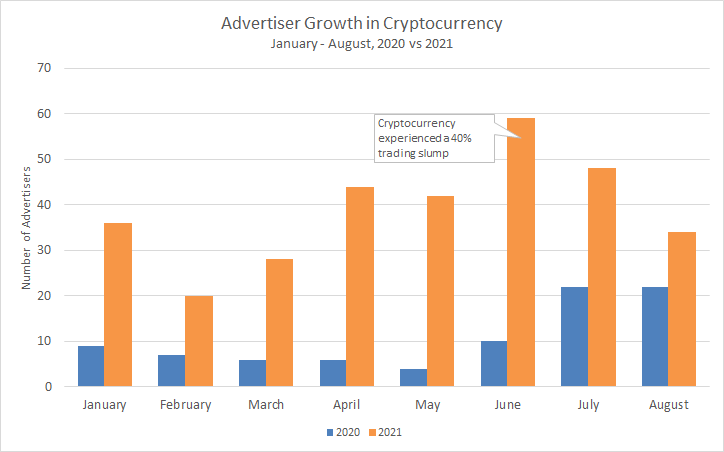
According to our own data at MediaRadar, we’re seeing that bear out. In 2020, there were just 27 digital currency companies who purchased ad digital display or print ad space. In 2021 that number increased 159%. New companies include BitYard, Anatha, BitTrust IRA, Phemex Limited, and Gemini. Existing advertisers, like Coin Mobile App, Hex.com, Bakkt Marketplace, Nexo, and Celsius Network, continue to spend. This growth will only continue and to the benefit of the overall ad ecosystem.
Source: MediaRadar
Supporting the industry is the increased credibility it has seen in recent years. We know Google has shifted its view on it, but it’s not the only major company.
Tesla invested $1.5 billion in Bitcoin back in February, and that caused the cryptocurrency market cap to surpass Google’s stock. Tesla founder Elon Musk has always been a crypto advocate – despite brief moments of doubt. In fact, his backing of certain currencies has caused them to skyrocket.
Breakthrough business
Beyond bleeding edge players like Tesla and Musk, legacy businesses like McDonald’s are now accepting crypto for payment. So, there’s a more accepting audience for crypto ads. And, with all the different cryptocurrency formats out there, it’s easy for advertisers to try and market one people haven’t tried yet. The same goes for crypto platforms.
However, in such a crowded market, how do crypto brands break through? What are advertisers doing to market crypto to the public, especially when there are plenty of people who still don’t know what crypto is or how it works? And what types of publishers are benefitting?
This year, crypto companies advertised across digital and print formats, with most spent on digital (86%). However, 14% of spend has been in print. In 2020, there was no investment in print, which marks a substantial year-to-year change.
This indicates that the industry is growing and is striving to reach a broader demographic by advertising in The Economist, Bloomberg Businessweek, Car and Driver, and The Globe and Mail. Note, of course, the audiences of these publications. They’re often more business and tech-savvy. Also, they likely follow the crypto category or are more receptive to trading crypto than the average person. Publishers that feature these audiences can win ad dollars from the growing number of crypto brands eager to invest.
Follow the money
Still, while crypto is beginning to mainstream and broaden its outreach, crypto advertisers haven’t shifted to the ultimate mass marketing channel – linear TV. There has been some experimentation, of course. However, according to our research, TV was the least popular channel for cryptocurrency companies. In comparison, the majority of advertising spend from traditional banking services in 2020 and 2021 – think Capital One, Chase Freedom, Chime Bank, and CitiBank – has been on TV ads.
Beyond the channel, the format in which crypto brands deliver their message is similarly important. One way to engage their audience effectively is with contextualized messaging. According to BuySellAds, “those in the cryptocurrency industry are more likely to engage with advertising from contextual advertising networks that display contextualized messaging and is relevant to what they’re viewing, is honest, and doesn’t utilize forms of tracking.” The best crypto ads are native and tightly aligned to the format and content. For publishers seeking to partner with cryptocurrency brands, this is critical intelligence when pitching formats and capabilities.
Moving forward, enterprising publishers can take advantage of the crypto ad explosion. With a growing number of competitors, platforms and players, there is a massive opportunity here to build business and grow revenue.


 / An inside look at the business of digital content
 Archive