The digital advertising industry is changing. Third party cookies are being rendered obsolete by recent browser updates including Safari’s ITP 2.2/2.3 and Firefox’s v69. Users are also becoming wary of how vulnerable their personal information is to misuse and mishandling following the Cambridge Analytica Scandal and Equifax Data Breach – among others.
In the face of this shift, the industry needs to behave
responsibility and be cautious, so that “data” is not called out as the
underlying issue that needs to be solved. Data is not inherently good or bad. And
when data is used responsibility, it empowers digital media and advertising.
Data can a user to discover a compelling article or product that they may have
never found on their own. It also gives tools to advertisers to be strategic about
who, when, and where their messages reach valued consumers. And data allows the
world’s leading publishers to focus on producing quality content that consumers
depend on.
As an industry, we are scrambling to find tactical
solutions to each new browser update or legal regulation that comes out. Despite
the need to address these emerging issues, we must keep our eye on the big
issues. And the proper use of data is one we must focus on.
Consumer privacy comes first
Consumers have a right to privacy. They also have a right
to know how their data is used and shared and they have a right to determine if
they are comfortable with their data being used for advertising. The industry
needs to come together to align on governing principles that, at the core, have
fundamental protections in place for user’s data across the entire ecosystem.
There needs to be a sincere consideration for the user’s
right to privacy and fundamental protections in place for their data across the
entire ecosystem. Consumers need to feel safe and protected online. And their
information is not being misused or mistreated. Additionally, we need to be
mindful with the perception of “creepy ads” in order to build the level of
trust like that of users sharing fingerprints and face recognition with phone
manufacturers.
Education
is key
The industry needs to better inform users about how their
data is being used and provide the option to opt-out. At the same time, it is
critical to teach users about the importance of advertising and how it fuels the
free content that they consume on a daily basis.
Moreover, we need to educate users on why allowing
sharing data with responsible parties can help them have a much better
experience and receive more personalized ads. With more and more
direct-to-consumer brands, consumers mostly learn about them and their products
through advertising. These companies are taking on giant competitors and need
to be very efficient with their advertising. To do so, they focus on providing
a unique and added value to consumers, particularly early adopters. The most
effective way to reach those people is by using data and customer profiles.
We also need to be open about how data driven advertising
supports journalism while making a true and honest best effort to provide value
to marketers, publishers, and users.
Let’s build
a healthy economy
In order to move forward, we need to commit to building a
healthy digital economy and evolve compliance in order to restore trust among consumers.
We need to look at ways to ease concerns among users, providing more
transparency across the web and making it easier for users to exercise their
right to privacy. We need to educate users on the value of their data and the
ways that it is being used to provide a healthy digital economy that they can
benefit from. The bottom line is a
cookie-less world means one big thing for advertisers: We need to gain back the
user’s trust in order to succeed as an industry.
Audience revenue is a growing component of the digital
business model, but it often comes at the cost of advertising inventory. News
media companies are struggling to support their newsrooms with digital
advertising revenue and subscriptions offer a stable revenue source. In fact,
media companies of all kids are seeking subscription revenue as they find
digital advertising revenue insufficient for sustaining their operations.
However, as they employ a subscription revenue strategy, publishers must consider the potential for lost advertising revenue from reduced site traffic and address it through smarter paywalls. As digital publishers limit the public’s access to their content by putting it behind a paywall, they place some advertising inventory at risk. A membership model strategy, such as that pursued by De Correspondent in the Netherlands, or a contribution revenue strategy, pursued by The Guardian in London, may alleviate some of this lost advertising revenue. But all audience-based revenue strategies will have some effect on advertising inventory.
Advertising revenue will also be at risk due to the product
changes required to make a digital product compelling to a paid audience. Improving
the user experience typically requires reducing the number of advertisements on
a site relative to a pure advertising-revenue business strategy.
Two different stories
A sample analysis of two news media company’s digital audience and advertising revenue is presented below to measure the potential return from employing an intelligent paywall in place of a standard paywall. The data has been adjusted to protect confidentiality, but the relative metrics across segments remains accurate.
Publication One is the second-largest newspaper in a large American
city with about 10 million average monthly page views and about 4.5 million
unique visitors. It is focused on long-form articles. Publication Two is a regional
publication with about 120 million average monthly page views and about 22
million unique visitors. It has infinite scroll and publishes shorter articles.
Neither publication had a pay wall at the time of the analysis of their
audience.
The current audience for each publication was segmented by
engagement. Engagement is defined using three dimensions: the volume of content
consumed, the pattern of consumption behavior, and the nature of the content
consumed. There are six metrics helpful for quantifying these three dimensions:
Article page views
Frequency (how many visits per month)
Recency (average time between visits)
Time on site
Content breadth (number of content categories
visited)
Scroll depth
These engagement metrics are used by many publishers to
segment their audience, and they are correlated with a customer’s propensity to
subscribe.
Engagement-based audience segmentation of two news media sites
In the table, we see that engagement decreases from left to
right moving from the Fanatics to the Non-engaged. Metrics for each segment are
reported for a 30-day time period. Fanatics and Enthusiasts are the customers
most likely to subscribe. Stable Users and Dabblers require more engagement
before they are viable subscription candidates. Fly-bys and non-engaged are
unlikely to be observed again beyond the one visit captured in this data. Using
these metrics, it is possible to estimate a propensity to subscribe for these
segments. We are also able to measure advertising revenue from a user in each
segment[1].
The propensity to subscribe can be estimated using several
approaches, including machine learning methods and econometric models. The
segmentation is determined by relative propensity to subscribe, and differences
in audiences can be seen in the metrics. For instance, the Fanatics in
Publication Two have more article views than the same group in Publication One.
This is in part due to the nature of the two products and the mix of mobile
browser versus desktop browser traffic. Other behavior metrics, such as time on
site and scroll depth, are affected by the nature of the site user experience
and hard to compare across sites. However, visits and unique days are helpful
for comparing the two audiences. In these two metrics, the audience for
Publication Two is found to be relatively more engaged for a comparable level
of subscription propensity.
Engage and convert
As expected, the audience segment most likely to subscribe
are the Fanatics, which average 2.5% of the site users. The Enthusiasts are the
next most likely group of subscribers, with an average of 4.5% of the users. Together,
these two customer segments represent the majority of the addressable market
for acquiring digital subscribers.
Stable users are potential subscribers. But the best tactic
for that group is to grow their engagement via registration, newsletter
promotion, and content recommendations before seeking a subscription. Publishers
that have print products and all-access subscriptions may have a significant
portion of these addressable customer segments already as digital subscribers. Some
of these customers may be economically unable to subscribe, and many digital
readers will take a long time to convert to subscribers or will not subscribe
due to the value proposition of the current digital product.
An important observation from these data is that the
customers most likely to subscribe generate a significant share of a
publication’s advertising revenue. Asking for subscriptions from this group
would appear to significantly reduce advertising revenue. However, not all of
the ad revenue from these customers is at risk from a metered or premium content
model. Pages that will not be behind the pay wall, such as the home page and
index pages, make up a large share of the ad revenue. Other types of ad revenue
not affected by a pay wall are also removed from the at-risk revenue. The chart
below shows how the at-risk advertising revenue is determined for a site.
At-risk advertising revenue from a pay wall
The target groups for subscriptions will have relative high
conversion rates, which will also mitigate the loss of advertising revenue. When
the at-risk advertising revenue is calculated for the segments and adjusted for
likely conversion rates, we find that the revenue at-risk by segment are about
equal, as is observed the following chart.
Advertising risk by engagement segment
Balancing risk and rewards
A conclusion from this
analysis is that an across-the-board pay wall will increase the advertising
revenue loss. If the pay wall limits access to only those customers likely to
subscribe, the lost advertising risk will be significantly reduced. Another
conclusion is that the across-the-board pay wall will attempt too few
subscription sales to the target audience because it is balancing the revenue
streams across all customer segments and not just the segments likely to
subscribe.
To illustrate these points,
the table below gives forecasted results for two alternatives for a site
currently using a 10-article pay wall. The first alternative reduced the number
of articles a reader will receive before reaching a pay wall modal with subscription
offers from 10 articles to 5 for all users. The second is a targeted meter of 5
articles to only those customers in the likely-to-subscribe segments and a meter
at 10 for all other readers.
Comparing a targeted pay wall strategy to the current state and across-the-board meter of five article views per month
The key findings from these
alternative pay wall scenarios is that targeting the readers most likely to
subscribe with acquisition offers increases the number of acquired subscribers
by 11% while saving about 30% of the lost advertising revenue relative to the
more aggressive across-the-board strategy and raising the net digital revenue
by 27%.
A metric for measuring the
effectiveness of a subscription acquisition strategy is the ratio of incremental
subscription revenue to lost advertising revenue. In the table above, this
metric is labeled the Dollar Tradeoff, and the use of targeted acquisition
offers yields $5.98 of subscription revenue for every dollar of advertising
revenue lost compared to $3.78 for the more aggressive across-the-board
strategy.
Devising a strategy to maximize audience revenue while minimizing lost advertising revenue is the challenge facing digital publishers. Finding the best path forward requires innovation in product design, content marketing, and subscription sales tactics. An often-overlooked aspect of a successful digital subscription model is retaining customers once you have them. Understanding the economics and engagement of the current readership is the starting point of a digital audience revenue strategy, and an intelligent paywall is an important tool for implementing that strategy.
About the author
Matt Lindsay is the Founder
and President of Mather Economics, a consulting firm that works with publishers
around the world on audience analytics and subscription revenue strategies. Its
clients include the many of the largest news media publishers in North America,
South America, Europe, Asia, and Australia/New Zealand.
[1]
This data comes from the Listener data capture tagging solution. Ad impressions are captured in the data with JavaScript tags and revenue per ad is added to the data from the advertising billing systems, advertising platforms, and other sources.
Digital advertising is growing. However, the Duopoly continues to dominate and capture the majority of the market share. While the Duopoly drives growth in terms of scale, publishers are actually seeing a decline in revenue. And, in turn, newsroom employment has declined by nearly half in the last decade as users spend more time consuming “free news content” through platforms. For quality journalism to survive, the advertising industry has a responsibility to open new revenue opportunities for publishers that can level the playing field with the Duopoly outside of traditional ad units.
Today, traditional ad servers
and SSP providers are relatively commoditized
and while they have been beneficial in driving some revenue to publishers, Google’s dominance in this area has stifled innovation.
In turn, this has provided even more leverage to
Google’s own monetization efforts instead of those of publishers. For their part, Facebook is entirely focused on its own
walled garden. Thus, it shows very little interest in helping publishers to increase their traffic or bolster monetization.
The value of premium ad experiences
The majority of ad serving and
SSP technologies in the marketplace are focused on the monetization of commoditized
ad units, whether its standard display banners or
in-stream video ads such as pre-roll. These formats
typically underperform in terms of meeting advertiser KPIs such as viewability or engagement.
And, unfortunately, only the Duopoly can extract maximum value from these formats due to their
sheer scale and unique data.
The good news is that publishers
do possess a competitive advantage over the
Duopoly. They have highly engaged audiences
that are often interested in staying within the publisher’s environment.
They also arguably have the most brand safe content
environments for advertisers. Why shouldn’t technology providers be
thinking outside the box to leverage the very environments that have proven to
be much more effective than traditional ad units?
Partially, because they don’t yet have the tools to
scale their own internal advertising businesses. It’s time that technology
platforms stop solely thinking of the bottom line and start empowering
publishers to thrive despite the giants of search and social.
Using your
competitive advantage
So, how can we think outside the box and enable publishers to compete?
1. Optimize Advertising Creatives
As everyone in the industry is well aware, the shift of content consumption is to mobile devices. On mobile, attention spans are shorter and screen real estate is limited, which poses challenges to advertising effectiveness particularly with display (enhancing banner blindness) and video where creative assets are typically designed for TV. Publishers are seeking ways to make display and video creatives engaging by adding interactive elements, and optimizing for elements such as duration and “sound on vs. sound off” are imperative to success. This is perhaps most challenging for publisher teams that don’t necessarily have the creative powerhouse resources.
2. Sell Outcomes
Another vestige of commoditized ad formats is the traditional CPM sales model, which has been further reinforced through the shift to programmatic buying where SSPs/DSPs only trade on CPM. Primarily, the marketplace focuses on trading impressions in bulk, and scale is therefore needed to ensure those impressions deliver on specific advertiser KPIs, which again shifts the balance of power to the Duopoly.
Google and Facebook have also
differentiated from publishers in that they’re heavily focused in promoting
buying models that are focused on particular outcomes such as
Cost-per-Completed View in video and Cost-per-Click in display. They have used
their scale and data to optimize towards those outcomes. Traditional SSPs have not yet provided the necessary tools
to enable those models for publishers or the data needed to guarantee those
outcomes.
Publishers should investigate new ad technology platforms that not only support outcome-based buying models but also have the prediction algorithms (aka AI) necessary to guarantee impressions that deliver those outcomes and not waste a publisher’s ad inventory.
3. Leverage Data
The combination of global scale and data has historically provided a competitive advantage to the Duopoly, as opposed to publishers that typically operate on a more local/regional or verticalized level. Publishers should not discount their own unique first-party data from subscriptions, newsletters, commerce or other sources as an alternative for advertisers to reach the right audiences.
Even without this proprietary
audience or behavioral data, publishers still have the unique advantage of
context from their editorial environments. This is becoming more critical not
only for differentiated ad targeting, but also more valuable in web
environments where cookies are becoming challenged from web browser privacy and
government regulation efforts.
We challenge
the advertising technology industry to continue to think outside the box of
traditional ad formats, and do more to empower the publishers so they aren’t beholden to solutions that diminish the value of their
premium audience and content. The Duopoly have recently pledged money
towards journalism projects and promised to update their algorithms but it’s
not enough. To save quality journalism, we need to create sustainable
monetization models for advertisers that extend beyond the current status quo.
As antitrust investigations envelope tech giants like Google and Facebook, some publishers may be lulled into thinking that their competition with Big Tech is fading. It’s certainly encouraging to see that Google may be held to account for their monopolistic practices. However, it’s unlikely to change the fundamental battle between publisher and platform. Google will continue to profit from news delivery and aggregation, and marketers will still funnel large portions of their budgets to stay at the top of search results. But to say that Big Tech is here to stay is not to admit defeat. This David and Goliath battle will surely rage on, and there are plenty of ways publishers can win along the way.
If Google escapes all 50 state attorneys general investigations unscathed, will the pressure from publishers and legislators be enough to force change? The likelihood of any specific outcome aside, this recent news has led to a fascinating game of “what-ifs.” Well beyond mere speculation, this exercise is helpful for legislators, publishers and tech giants alike.
So,what changes if Google loses?
Whether Google faces fines or recent scrutiny leads to legislative changes, most agree that Google will have to make fundamental changes in the coming years. Since News Media Alliance reported that Google made $4.7 Billion in 2018 from aggregated news content, calls for Big Tech to begin sharing a piece of that revenue pie have grown louder and more insistent.
Proposed policies like the Journalism Competition & Preservation Act would enable publishers to collectively negotiate directly with Big Tech platforms to “improve the access to and the quality of news online”. Senators John Kennedy (R-LA) and Amy Klobuchar (D-MN) introduced this legislation in June, a key tenant of which is the establishment of a 48-month “safe harbor” (a.k.a. regulation-free period for Google) for publishers to “band together to negotiate with dominant online platforms.”
One must wonder what is preventing publishers from doing this now, and what would be achieved. You’ve armed David with a slingshot, but where is the stone? For some, it is hard to believe four more regulation-free years for Google would lead them to start paying publishers for their content.
Either way, publishers must emphasize how they compete
If the changes on the table are unlikely to move the needle for publishers in a significant way, can publishers compete with Big Tech? Yes! And they should. The challenge for ad sales teams is to learn how they stand out against Big Tech digital advertising and be prepared to clearly articulate this to advertisers.
Too many local publishers are unprepared to compete with Google and Facebook, and believe their only option is to partner directly with their biggest competition. What they fail to realize is that if they could only communicate to advertisers why they should add local advertising into their marketing mix, they could tap into an important revenue source.
In the eyes of marketers, how do publishers differ from Big Tech?
Here are four difference that publishers can capitalize on:
1. Trustworthiness
DCN has long emphasized the importance of quality, trustworthy content. And this is not just for the sake of readers and the future of journalism, but also because these factors are critical for advertisers. Due to the “black box” nature of Big Tech algorithms, campaigns from trusted brands may end up in distasteful corners of the internet. This is not only embarrassing for reputable brands. It can have a detrimental impact on their bottom line.
In contrast, publishers are not only focused on the quality of their content, but they vet their advertisers as well. Marketers need not fear their ad campaign showing up next to pornography or propaganda. The trust that readers place in a quality publication is extended to the brands that advertise there. And this value is nearly impossible to replicate on Facebook or Google.
Ad sales teams must be prepared with the facts about ad fraud and why trustworthiness is critical for campaign success.
2. Audience data
Advertisers don’t want to purchase impressions or ad space – they expect access to specific audiences. Google makes this easy. Do you? Publishers have an opportunity to show advertisers that they can leverage their first-party data for a better user experience and higher-quality, audience-driven campaigns.
If your publication is behind a paywall (in full or in part), you already know the value of your first-party subscriber data. Be the opposite of Google’s algorithmic black box. The more transparent you can be, the more value marketers will see in your audience.
3. Omnichannel campaigns
Advertisers want easy to understand campaign options, a clear understanding of campaign ROI, and they want doing business with a publisher to be easy. With the right tools, publishers can deliver on all these things – but they must go one step further.
We’ve shown that publishers can compete head-to-head on trustworthiness and quality data. But what can publishers offer that Big Tech cannot? Omnichannel campaigns that cross mediums and deliver clear results. Who else can combine digital and print with OOH and events?
As publishers diversify their revenue streams, they must be careful to train sales staff to understand the uplift these additional channels can provide for advertisers.
4. Marketing expertise
More and more publishers are adding marketing services to their offerings, and it’s no wonder. Research from Borrell Associates indicates that agencies and advertisers alike look to media companies for marketing expertise. This means your sales teams need to be prepared to be that expertise. The consultative selling approach has been proven effective. However, it requires a dedication to understanding the latest trends and recognizing how your products and services can help advertisers capitalize on them.
Time will tell if Google and Facebook will be held to account for their monopolistic practices. Regardless of how policies change, publishers must recognize that they’re already able to compete with Big Tech. It is critical that ad sales teams understand what differentiates them from the Googles and Facebooks of this world. If they can, they’ll become an invaluable resource to reputable brands and local advertisers.
With such a large appetite for content in the
digital landscape, sponsored content has become a key source of revenue for the
publishing industry. But with branded content leveraging the tone and style of
a publication, should the editorial team exercise oversight, ensuring the
sponsored pieces meet their high standards? Or should they focus on continuing
to build trust with their readers in a space where paid and earned content look
increasingly similar?
As sponsored content has transitioned into a
common advertising practice, publishers can see the financial benefits of
producing branded content for their audience. The more divisive question is how
— if at all — should an editorial team be involved in its creation?
To better understand how the two sides of the
digital publishing industry — sponsored and editorial — work together,
Pressboard conducted a survey of 32 industry professionals. The results show
that the industry is divided on whether the two teams should collaborate on
sponsored content creation. More than half of the respondents reported that
their editors are not involved. On the other hand, 46% reported some degree of
editorial involvement in creating sponsored content.
Among
the respondents who indicated that their editorial teams were involved in
creating sponsored content, the level of involvement varied. Some divulged that
they were very involved, while others only somewhat. The relationship is
evidently a complicated one, especially as audiences grow more accepting of
branded content.
“The more I see branded content online and in
print the more accepting I find readers have been,” stated Joel Vosburg,
Advertising Account Manager for Gripped Publishing. “The primary concern for
their audience isn’t whether or not the content has paid sponsorship, it’s the
transparency of the advertiser’s involvement.”
Does branded content influence
editorial?
The question of whether editorial content
should be free from influence is an important one. However, those in the
industry understand that it is not always cut and dry. While 33% of respondents
shared that the brands that they partner with have some effect on editorial
content, 13% said their editorial is very affected. Publishers in the product
review space were vocal about how the editorial content they can create depends
on the brands they work with. Vosburg explained that it’s “tough to provide
editorial coverage when the brands do not work with [you]”.
However, the separation between editorial and
sponsored content teams is much more substantial when it comes to news coverage.
In fact, some publishers have strict policies in place that forbid brands from
influencing editorial content.
Striking a balance between
sponsored and editorial
As we delve further into the data, it becomes
more apparent what approach publishers are currently taking with sponsored
content, as well as how the industry may evolve going forward.
A strong majority of respondents feel that
editorial pieces should be at the forefront of a publication’s site, with only
a small number indicating that they feel their site should be evenly split
between editorial and branded content. However, respondents were somewhat less
rigid when the question involved a lifestyle site as opposed to a news site.
“You need to be keenly aware of what your
readership wants and does not want,” stated Nikki Csek, CEO at Csek Creative
(which supports NowMedia). When asked exactly how much sponsored content is
ideal for your site, Csek noted, “As much as your readership is interested in
engaging with. Sponsored content can be as interesting and sometimes more
interesting than day-to-day editorial content.”
The tone, look, and feel of your website
should be cohesive including the sponsored content it hosts. This question
garnered the strongest agreement amongst respondents, with 84% agreeing
(strongly or somewhat) that sponsored content should look and read similarly to
a site’s editorial content.
Mindy Claggett of COX Inc. said this concept
had a key role in defining her position. Though she is the Associate Editor of Branded
Content, her role reports directly to the editorial team.
“[They] decided that my role should report
through editorial primarily because I would be creating content, so they felt I
needed to be on the content team. Additionally, they wanted to ensure that even
paid content was consistent with the brand standards for our publications and
sites, and that the content would fit the brand voice.”
Half of all respondents affirmed that
audiences do care whether content has been sponsored by a brand. Readers —
especially millennials — generally don’t like ads. However, 58% of
millennials will watch ads if their favorite digital
personalities are involved. Therefore, presenting high quality information and
entertaining content is still imperative.
Maintaining trust
When a brand is connected to a publication it
benefits from the same level of trust and credibility, which is important to
readers. The relevance and pairing of the brand and the publication must be
believable for your audience to want to engage with the content produced.
Partnering with brands your audience cares about has proven successful for
several of the publishers who responded.
It is important to note that when it comes to
branded content, audiences are sympathetic to the economics of the publishing
industry. According to Vosburg, “Readers understand the troubles some
publishers find themselves in these days and know that financial support
through content is a way to help this.”
It’s clear that publishers and brands will
continue to collaborate in creating content. But for now, the question of whether
editorial teams should be involved remains unanswered. On one hand, the
emphasis placed on maintaining the impartiality of editorial content suggests
that there should be a strict divide between editorial and sponsored teams. On
the other hand, the need for sponsored content to look and feel similar to editorial
suggests that there needs to be some degree of editorial involvement. And it’s
likely this relationship will remain complicated in the near future as
sponsored content becomes an increasing source of revenue for publishers. It
appears that only one thing is certain: Sponsored content is here to stay.
As the B2B space evolves and matures,
so must its marketing. In recent years, consumer-facing brands have come to
terms with the “adapt-or-die” scenario. Now, B2B brands are following suit by
adopting people-based marketing and new levels of personalization. In response
to opportunity (as much as out of necessity), B2B advertisers are shifting
their advertising dollars towards digital advertising.
B2B focuses on digital advertising in
2019
According to a December 2018 study by eMarketer, the US digital B2B ad spend is on the rise, increasing from $2.9 billion in 2015 to $6.08 billion in 2018. The biggest jump in spend, a 24.9% increase, occurred between 2017 and 2018. The following month, January of 2019, Mark Treacy, Head of Sales – B2B at Oracle, predicted that B2B marketers would continue to invest more in data and analytics capabilities, which would increase the competitive edge within the industry.
In July 2019, my company, advertising intelligence and sales enablement platform, MediaRadar decided to take a closer look. So, we analyzed whether B2B brands had shifted to buying both print and digital ads, as a follow up to our 2018 B2B recap trend report, which had found that most B2B brands would only spend on either print or digital. In fact, according to the 2018 report, only 11% of brands bought both print and digital placements.
Our deep dive in July of 2019
revealed that, while not much has changed, there was a slight deviation toward
digital and print ad spend within B2B in the first half of 2019. The study also
found that B2B companies’ digital ad spend rose 36% year-over-year, when
comparing the first half of 2018 with the first half of 2019. This indicates a
pretty significant shift toward digital ad spend within the B2B space.
Who is taking the lead?
Industries paving the way towards increased digital advertising include both those that are spending the most on digital ads as well as those who are increasing their ad spend the most. Our study revealed that the B2B industries that spent the most on digital ads in 2019 included the Pharmaceutical, Finance, and Professional Services industries. The B2B industries that increased their ad spend the most year-over-year were Cigarettes & Tobacco, Beer, Wine & Spirits, and Beverages (Non-Alcoholic).
Looking at the top companies within
these categories, the analysis found that the digital ad leaders in the pharma
industry included Endo International, Pfizer, and GlaxoSmithKline. Pfizer, who
has partnered with multiple platforms to serve its programmatic ads, has spent
over $100 million across all media. They have placed video, direct and
programmatic ads on major domains in 2019.
Additionally, the data revealed that
TD Ameritrade, Schwab, and Vanguard lead the pack within the finance sector.
Vanguard, specifically, ran display ads on major online publications such as
U.S. News & World Report and BBC.
Within professional services, our
research saw that Informa, USPS, and Accenture spent the most on digital ads.
USPS, in particular, placed display ads everywhere from Jezebel to The
Economist.
Recently, a LinkedIn Marketing Solutions blog by Sean Callahan reported that these major companies are all part of the rapidly growing $6 billion B2B digital advertising market in the US. According to Callahan, the expansion into digital advertising has been triggered by several factors, including increased popularity of both account-based and people-based marketing within the B2B space, the advancement of programmatic platforms, and the increased power of personalized content sequencing.
What’s next?
While B2B companies are certainly making strides when it comes to following digital trends, there are still areas left to improve. Most B2B brands are still focusing their advertising spend on print. According to our July 2019 data, 56% of B2B advertisers are spending on print only, consistent between both 2018 and 2019. However, now that it is clear where the industry is headed, we can only wonder how both these brands and publications will soon adapt, and grow the share of B2B companies using both channels.
The B2B industry must take stronger
leaps in digital advertising to fully reap its benefits. However, they are
moving in the right direction and, as the space continues to transform, so will
it’s advertising tactics.
People used to be loyal to a single publisher. They paid for the content then and there (or were longstanding subscribers). And they didn’t even notice stories from other publications. It’s frustrating that online content consumption hasn’t work in the same way. But the same system that brought about the democratization of online content also broke publisher loyalty.
Suddenly, consumers had access to numerous content platforms. The barriers to entry lowered and smaller, niche publications could reach a global audience, adding multiple views to the same angles. This meant people got used to judging by the story rather than by the publication.
Paywalls should work as a logical solution to monetizing online content. And paywalls do function as a way to pay for content. However, they don’t account for the way the majority of online users actually consume content. They can be an inflexible solution in an environment that changes daily.
That’s why publishers need to consider paywalls as one element of a wider monetization strategy.
Paywalls turn away 98% of users
The formula for consuming content used to be: Seek out a source of content you trust or enjoy—such as a newspaper. Now online content producers have to find, and fight for, audiences. Through media aggregation and search platforms, news competes with other versions of the same story for reader attention. Now users don’t have to choose just one publication and stick with it. Information is everywhere. This has led to to consumers having a distributed, fragmented web of content sources.
For hard paywalls to work as a primary monetization system, publishers must possess (or build) a formidable audience based upon a strong, trusted brand. Many readers will only pay for content they know they can’t get anywhere else. Major media brands have the resources to offer this. But even then, the many readers are going to look elsewhere for content, particularly if they hit a paywall and feel they can find good enough information for free.
Speaking at a publisher conference, Marfeel CEO, Xavi Beumala described the problem of scaling a paywall model. “Even in the US market of 330 million, the total amount of business you have for a subscription model is always capped. You can’t scale it ad infinitum.”
The generations that are loyal to a single media source are dying out. Subscriptions may work for the New York Times. However, the New York Times is using the fuel of the reputation it took 100 years to build (not to mention a significant investment in its technology and delivery). Without new readers experiencing the quality of their output, some question whether this model continue to sustain the brand for another 100 years.
Other media groups, such as The Guardian, have bucked the trend with a voluntary subscription basis that doesn’t wall-in content. This model relies on readers wanting to support the business and see it continue to operate. Again, brand strength and reader trust and value are big factors here.
Netflix for news
Content aggregation platforms represent a further hurdle for publishers that want to paywall their content. Several big tech companies have announced plans to deliver news and entertainment from multiple sources in their own subscription platforms.
While publishers will be able to negotiate payment rates that allow their paywall-segregated content to appear in aggregated content platforms, these deals will always favor the major tech companies over the publisher. It’s not hard to imagine these companies also downgrading search results or newsfeed positions for any content that has a paywall—that they don’t operate. Facebook, Apple, and Google don’t want to direct users to content or a search query only to have that user bounce back from a hard paywall.
The arrival of these news platforms also offers further competition to the paywall model, one that has a real chance to further disrupt publisher loyalty. Consumers may hedge their bets, possibly choosing to pay more to see content from multiple sources than tethering themselves to a single subscription.
Easy to get into, hard to get out
Google’s latest Chrome update was an example of how the ecosystem is built around a handful of major technology providers, and small changes can cause major disruption. The update in question prevented publishers from detecting if users are browsing in incognito mode.
Intended or unintended, the consequence of closing this loophole meant that many publishers’ metered paywalls were no longer effective. When readers hit their article limit they can switch to incognito mode and instantly reset their meter of free articles.
Publishers suddenly found that their paywall solution was ineffective, in one single stroke from Google.
Distributing monetization
A lack of resources to build technology means that some publishers bet all of their chips on a single strategy. And, for some publishers, paywalls represent a functional option with a guaranteed level of revenue.
But paywalls can be a blunt and imprecise tool. They cut off the majority and work for a minority. With a paywall, you often close the doors to new readers and rely on a core of hyper-engaged users. These readers are effectively paying for the loss in traffic that the paywall creates. It also insulates content in a world where sharing and exposure are the oxygen of publications.
Using different sources of technology, publishers are now able to deliver a layered monetization strategy that meets the needs of different readers, different content, and different stages of the engagement journey. Technology that implements programmatic, direct, paywall, subscription, micropayments and more will empower readers to build tailored packages. Like GDPR, readers will be able to select their preferences based on their needs.
A small percentage of readers will want (and pay for) a dedicated, personalized, ad-free experience. For these readers, a hard paywall with a personalized experience is the perfect solution. A far larger subsection of the audience will accept advertising in return for content that is free at the point of purchase.
Broad multitudes within this grey-area will sometimes pay, sometimes won’t. They won’t accept recurring transactions or fees and will need the process to be frictionless. For the first time, mid-size publishers will be able to out-pace major media groups that are forced to develop bespoke solutions, banking on only the most profitable.
More technology and monetization platforms are being democratized and made available to mid-sized publishers. With a sliding scale of monetization options, they will finally have the ability to reflect readers’ stage in the process, capture new traffic, and give readers options that will build a longer-lasting connection with their brand.
In today’s digital economy, all businesses are software businesses – especially content-focused businesses like digital publishing. With a wide range of apps and platforms all competing for consumer loyalty, companies that would have never called themselves tech companies are now engaging with developers and innovators to maintain customer engagement. Understanding what drives successful product development is critical to achieving growth.
One of these key realities is that product management is not the same thing as project management.
Whenever 3Pillar advertises for a product manager, the majority of the resumes we receive will inevitably be from project managers. However, these are vastly different jobs. And hiring for them as if they are the same is one of the biggest mistakes a company can make.
In product development, the product manager should be responsible for the “what,” the “why” and the high-level “when.” However, the project manager should be responsible for the “who,” the “how,” and a more detailed “when.”
Building a railroad
Let’s use the analogy of a railroad: The product manager is the person responsible for deciding that a railroad is the right solution for the problem of getting people from point A to point B. The product manager also charts the course to navigate the terrain. He or she determines where the train will go and what stops it should make and the route taken including questions like whether it should go over or through the mountains.
A product manager also prioritizes the sequencing of railways between stations. Perhaps he or she determines that New York to Boston is the most critical route. Only after that’s finished and operational should the railroad build a track to San Francisco.
Project managers, on the other hand, are responsible for laying the tracks and making the trains run on time. In product development, a project manager plays this role. They are responsible for the internal operations of the train: how fast the train goes down the track, what fuel it uses and what parts need to be replaced.
Finding the best
In the big picture, product managers are responsible for maintaining the long-term product roadmap and defining the product vision, while the project manager is responsible for managing the team’s day-to-day activities.
The best product managers inherently have these four key areas of responsibility:
Product strategy: Setting the vision and determining how to get there.
Product roadmap: Managing and prioritizing the backlog of features, defining them and making associated trade-off decisions.
Product releases: Setting what features will be delivered to the customer and coordinating all aspects and interdepartmental dependencies.
Product ideation: Running the ideation process, collecting feedback and data, analyzing that data, thinking creatively, curating new ideas and promoting the most relevant ones into the backlog as features.
Product managers do each of these things (and many more) because they understand that they can’t build a product, pass it off to a project manager, and call it a day. That’s because product management – like product development – is never done.
To give a real-world example of the difference between the two, imagine we’re talking about the team behind a fitness app like Fitbit. The product manager would be responsible for deciding that users would benefit from a series of video tutorials based on the type of workout a user wanted (Fitbit users might recognize this as Fitbit Coach). Once a decision had been made to go in that direction, the project manager would be responsible for working with the team to design, implement, and test those changes in the expected timeframe.
Common goals
Of course, in mature organizations with a product mentality, you won’t find a project manager on most teams. Instead, engineering managers typically take on the project management tasks that are actually applicable to the environment.
Product management and project management, working in concert, are essential.
This starts with adopting a company-wide foundational mindset that doesn’t focus on antiquated IT thinking, which separates teams by function. Instead, this modern mindset focuses on common goals and making sure all members of the company understand the “big picture.”
In today’s increasingly digital world, this means engineers, designers, marketers and finance working alongside product managers to build software that directly addresses the customer’s wants, stays ahead of the changing market, and ultimately drives revenue and profit back to the company. At 3Pillar, we call this the Product Mindset, and it drives how we approach every digital product we work on.
Great project managers are an indispensable part of a successful company. But you have to start with great product management. This is how you will be able to innovate and ultimately disrupt digital publishing markets and grow market share. Content is important — but product is king.
About the author
David DeWolf is CEO of 3Pillar Global and co-author of “The Product Mindset: Succeed in the Digital Economy by Changing the Way Your Organization Thinks.”
The amount of money marketers waste on digital ad fraud is enormous, with one estimate reaching as high as $42 billion worldwide this year. But advertisers aren’t the only ones losing. Publishers also lose when ad fraud diverts revenue from quality websites to fraudulent ones.
Legitimate publishers might think they are protected, but
even quality sites can fall victim to ad fraud. Here are four questions that
will help you evaluate your risk:
1. Do you purchase traffic?
Many publishers use third-party sources to drive traffic to
their sites. Not all traffic sourcing is harmful. Marketing practices such as email
campaigns, sponsored social media posts and search engine marketing are
legitimate ways to bring quality audiences to your website. However, the risk
of introducing invalid traffic increases when publishers purchase traffic. Traffic
sellers may guarantee a certain number of human visitors at a low price. That
said, bot traffic can be engineered to look human enough to pass through fraud
detection software.
While bots may increase your numbers, they don’t make
purchases or offer any real value to advertisers. If advertisers aren’t getting
any conversions from their ad placements and campaign ROI isn’t meeting
expectations, they’ll invest elsewhere. The best way to keep bots off your site
and deliver real audiences to advertisers is to engage in legitimate marketing
practices and avoid purchasing traffic.
2. Have you implemented industry solutions?
As ad fraud becomes more widespread, industry organizations are creating solutions to address areas where publishers may be vulnerable. One example is domain spoofing. Fraudsters create fake sites to look like real ones and divert ad revenue intended for real publishers. In response to this tactic, IAB developedads.txt and app-ads.txt to help demand-side platforms detect unauthorized digital sellers in programmatic buys. In these files, publishers list all authorized sellers of their inventory and upload these lists to their websites. DSPs then crawl these files to make sure that they are buying from legitimate SSPs.
The industry is taking the next step to improve security in programmatic
buying and selling with signed bid requests, which is part of the IAB’s OpenRTB
3.0 Framework and complements the ads.txt protocol. This allows a buyer to
validate that a bid request is from the intended publisher and that key
elements have not been altered.
Another recent development is sellers.json and OpenRTB SupplyChain object. With sellers.json, SSPs and exchanges list all authorized sellers and resellers within the supply chain along with seller IDs. Buyers check both ads.txt and sellers.json files to make sure the IDs match. If they do, then they know that those entities are authorized to sell the inventory. The SupplyChain object allows buyers to see all vendors participating in a bid request. Since multiple resellers are often involved in the sale of one impression, these tools help buyers keep track of all of them including the final seller, whereas ads.txt only lists direct authorized vendors of a publisher’s inventory. These initiatives work in tandem with ads.txt, which is why it’s important for publishers to keep their ads.txt files up-to-date and accurate.
3. Do you have third-party oversight?
Using ad fraud detection software is an important step for
publishers to detect and measure invalid traffic on their sites. But since
different vendors use different methodologies, relying only on one solution can
allow some fraudulent activity to slip through the cracks.
While technology is vital to employ in the fight against ad
fraud, human oversight is just as essential. An independent, third-party
website audit identifies areas of risk that technology alone might not detect. An
audit takes a deep dive into all aspects of website monetization including the
processes, procedures and controls that the publisher has in place to reduce
the risk of fraud. If an anomaly or suspicious traffic source is identified,
the auditor brings these concerns to the publisher’s attention with suggestions
for improvement. Third-party audits provide an extra layer of protection against
fraud and help publishers stand out to advertisers by demonstrating that they provide
transparency and maintain a high-quality advertising platform.
4. Are you taking a holistic approach?
While there are many tools available to minimize ad fraud, one
solution alone cannot solve the entire problem. It’s important for publishers
to take a multi-layered approach to widen their net. Make sure the vendors you
partner with are accredited and adopt industry initiatives like those mentioned
above.
Most importantly, establish good business practices for sourcing
traffic and traffic monitoring. Communicating these best practices to your
staff will help them understand their responsibility to combat fraud. Lastly, partner
with a reputable auditor to add an extra layer of protection and demonstrate
your commitment to transparency. By incorporating a variety of tools into your
fraud arsenal, you’ll have a greater chance of preventing fraud while developing
a reputation for being a safe place for advertisers.
Google’s launch of version 76 of Chrome fixed
a loophole that previously allowed publishers and other site owners to
detect readers who were browsing in incognito mode. Aside from this loophole having serious privacy
implications, a consequence of
closing it meant that many publishers suddenly found their paywalls unlocked. WNIP
estimates that
as many as 33% of paywalls could have become unlocked due to the update.
Undoubtedly, paywalls are an important revenue model for many publishers and site owners. And given that Chrome has a market share of 64%, the impact of this update is widespread because it makes it easier to bypass paywalls by simply opening a page in incognito mode.
The talk of paywalls – and their relative strengths and weaknesses – makes this a good time to give some thought to your paywall strategy. Here are some different types of paywalls and how they may or may not be affected by Chrome’s latest update:
1. Hard paywalls (e.g. Financial
Times)
The name says it all in the case of hard paywalls. Users
cannot read any content (at least not in full) without subscribing and will
have their pathway immediately blocked. The restrictive nature of hard paywalls
may limit the number of potential subscribers, particularly as the approach isn’t
tailored to specific audiences and behaviors.
Publishers that implement hard paywalls rely on a high
amount of loyal regular users, which means they are probably more likely to
specialize in specific fields. For example, this model can work for trade
magazines and resources because they have more of a niche, loyal audience.
However, there are shortfalls that come with the hard
paywall. For example, readers without a keen interest in the product will
typically slip away quickly after first seeing the paywall message. And they
are unlikely to return.
2. Freemium paywalls (e.g. Der
Spiegel)
With a freemium paywall, a publisher lets readers have
access to specific content for free. Here, publishers select premium content
that is placed behind the paywall, while other content is freely available. Sometimes
a publisher will select some of their biggest stories and features and free
them up to non-subscribers, hoping this will then entice them to hit the
subscribe button.
Take for example Der Spiegel, which offers different
packages for both digital and print subscriptions. These are often tailored to
different devices, like mobile and tablet. Some subscription plans can also
provide users with additional bonuses like ebooks, tickets to thematic events,
and more. This type of investment in engagement has translated into strong
brand loyalty for German audiences.
3. Metered paywalls (e.g. The
Economist)
Metered paywalls work in a similar way to freemium
paywalls and there are a lot of freemium/ metered hybrid walls out there. A
typical metered paywall gives readers access to a fixed number of free articles
during a specified time period. If they want to read more, they have to
subscribe. The issue with this model is that readers sometimes get accustomed
to the free content and convince themselves that becoming subscribers isn’t
worth it, as they already get enough for free.
Sometimes these publishers — such as The New York Times,
The Economist, and Wired — require a registration to read the free content as a
middle stage in the customer journey in an effort to convert these casual
readers into paid subscribers. Registered readers become known users. Therefore,
it becomes much easier for publishers to keep them engaged and target them with
tailored offers. This is currently developing into an industry standard and is
in line with a trend where the logged-in status will become much more common. Again:
good for publishers.
Metered paywalls are those most impacted by Chrome’s
update. Some readers have long used
incognito mode to dodge metered paywalls. As the publisher can’t track
incognito users, the site assumes that the reader is a new visitor and resets
the meter to zero.
One of the most limiting things about these three more
traditional types of paywall, and something they all share in common, is that
each paywall behaves the same way regardless of who interacts with the site.
They also put the content first rather than the user, placing the burden of
generating subscriptions on the content alone, which in turn ignores the huge
boosts in subscription growth that data-driven, real-time personalisation can
offer.
4. Dynamic paywalls (e.g. The
Wall Street Journal)
A dynamic
paywall works by understanding reader behavior in real time and tailoring the
online experience based on their needs. Essentially, it is designed to reach
audience members who display behaviour that could suggest a liking for a
publisher and a likelihood of subscribing.
This means the
paywall block might appear faster for readers who spend a lot of time
interacting with content in order to try to encourage them to register and
eventually subscribe. If a reader only visits a publisher occasionally, they
might get access to more free content in order to gradually build an affinity
which could lead to them eventually signing up. Readers will also be served
tailored free content based on their unique interests. Basically, there isn’t a
one-size-fits-all approach and this is what makes a dynamic paywalls stand out
from the pack.
The thinking
is that this data-focused strategy should find the people most likely to
subscribe and give publishers flexibility to target consumers in different
ways. A dynamic paywall can optimize your audience and traffic while maximising
your revenue potential, with publishers such as The New York Times and Wall
Street Journal crediting dynamic paywalls for driving substantial subscriptions
growth.
Additionally, a dynamic paywall applies machine learning
to raw data to provide publishers with in-depth insight about each individual
reader and provide them with a personalized experience that is generated in
real time as they browse the site. A dynamic paywall will also often have a
propensity model that can categorize readers automatically according to their likelihood
to subscribe.
Sure, some publishers will choose to maintain their
conventional (or, some might say, old fashioned) paywalls. This may be because
they don’t have the technology to execute any other way.
However, forward looking publishers understand the need
to find a new business model that drives long lasting engagement from being
more dynamic. So, in light of this Chrome news,
publishers should look at the change as an opportunity to re-evaluate their current paywall model. It
might be time to rethink the paywall strategy as one based on personalization
to drive sustainable long term customer relationships.
Even among the largest SSPs, there is an enormous difference in quality: The worst performing SSP is 60 times more likely to deliver a malicious ad than the best. Premium publishers need to vet their SSP partners carefully and be aware of how each SSP deals with malicious, low-quality, and In-banner video ads.
Confiant recently conducted our fifth research study on malvertising and ad quality in the digital advertising ecosystem. Confiant’s Demand Quality Report analyzes a normalized sample of over 120 billion impressions and captures unique insights into the quality of ads served by the programmatic marketplace.
How’s the industry doing in Q2?
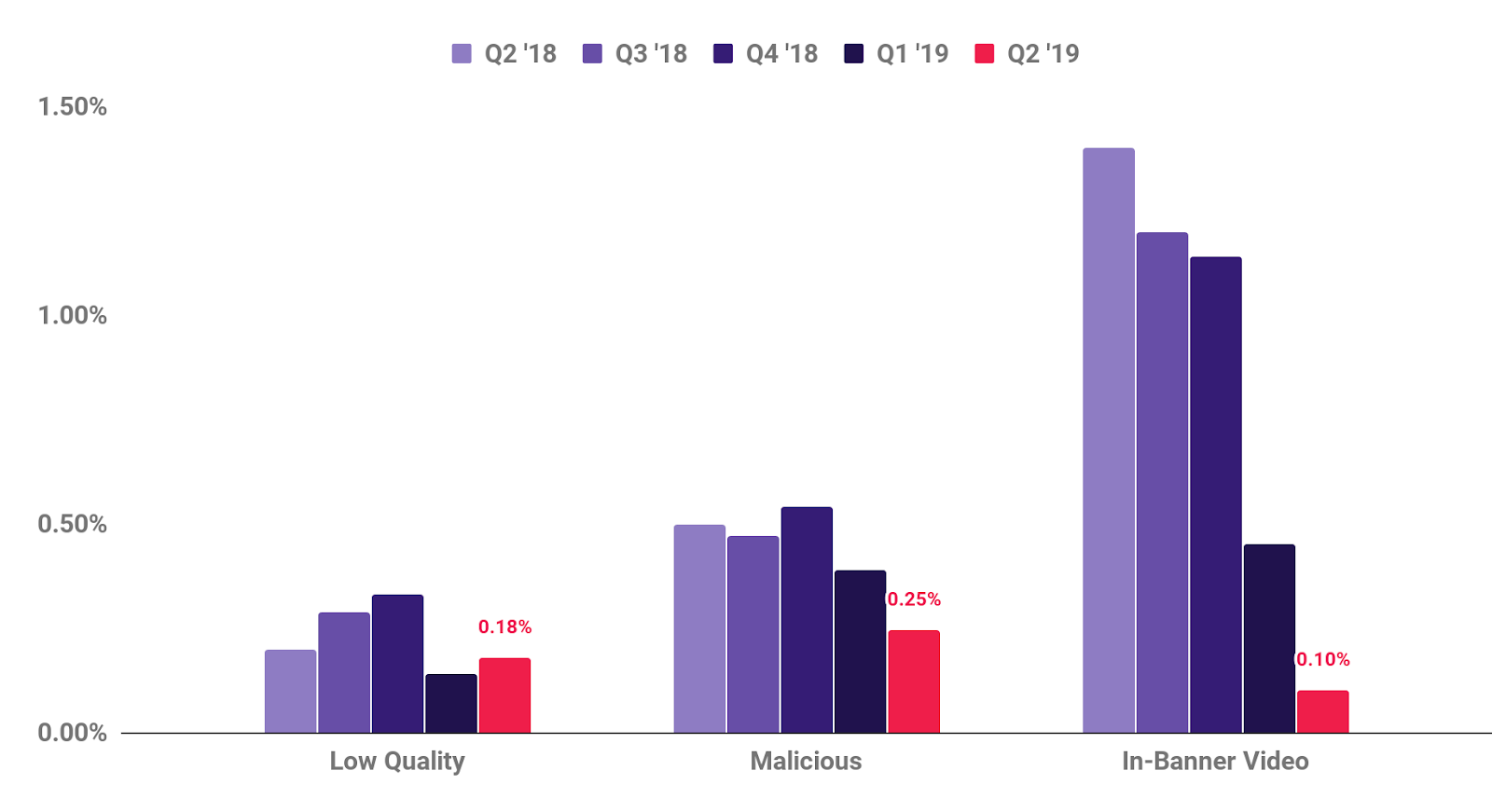
The chart below shows malicious, In-banner video (IBV), and low-quality ads as a percentage of total impressions over the past five quarters. In Q2, we saw a significant drop in malicious ads and In-banner video (IBV) ads. Malicious ads are down from a high of 0.54% in Q4 2018 to 0.25% in Q2 of this year, the lowest rate observed in our five reports. In-banner video ads are also at an all-time low at 0.10% of impressions in Q2, down from 1.40% one year ago. We suspect that if this trend continues, IBV ads will be all but extinct by the end of 2019.
However, this isn’t to say trouble isn’t lurking, given the highly dynamic nature of online advertising. Low-quality ads continues to be problematic with an increase from 0.14% in Q1 to 0.18% in Q2.
What’s driving these declines?
The decline of malicious and in-banner video ads defies a single explanation. However, trends suggestcollaboration efforts from the following could be helping:
The near-universal adoption of ads.txt on top sites, which is driving out arbitrage and unauthorized resale.
Increased vigilance on the part of the SSPs when it comes to ad quality issues
The use of creative-verification solutions to improve industry defenses
Industry initiatives like TAG’s Certified Against Malware program
Better coordination between publishers and ad platforms, which narrows the brief window of time that malvertisers have before their exploits are detected and removed.
What challenges lie ahead?
Even with these improvements, we found thatone in every 200 impressions are marred by a serious security or quality issue. We also found that rates of malicious activity vary significantly based on the day of the week. Impressions served on Sunday are three times more likely to deliver a Malicious payload than those served on Thursday.
Although we are seeing a decrease in malicious and In-banner video ads this quarter, security and quality issues continue to change and evolve. Our data identifies what’s on the rise and what publishers are monitoring and blocking in accordance with their business needs and expectations of their audience. The rate of ads that have audio on startup continue to be a top issue that publishers flag with 92% blocking them from their sites. We are also seeing a large increase of publishers blocking heavy ads (800kbs or higher), Audio on Click, and Audio on Hover. Lastly, Malicious ads remain a fairly concentrated problem, with over 50% of impressions coming from just five providers.
It’s worth it
There are huge disparities in quality across top SSPs. Thus, it’s imperative that publishers thoroughly vet SSPs prior to integration and monitor them on an ongoing basis. Ad quality issues are often highly concentrated. So, an informed publisher can minimize user-experience issues by avoiding poorly performing SSPs – often with little impact to monetization.
The renewed interest of the subscription revenue model has turned heads in the digital publishing industry. Some publishers have found success in pivoting to this revenue model. However, thousands of other publishers are wondering if subscriptions are realistic options for them. While the ad revenue model has been the historical gold standard, dominance from the major platforms and a lack of transparency across the ecosystem has forced many publishers scrambling. So, is one model really better than the other? Or can these models coexist?
Think about any digital subscription service you are currently paying for, right now. What is the first thing that comes into your mind? Netflix? HBO? Perhaps, Spotify, or Apple Music?
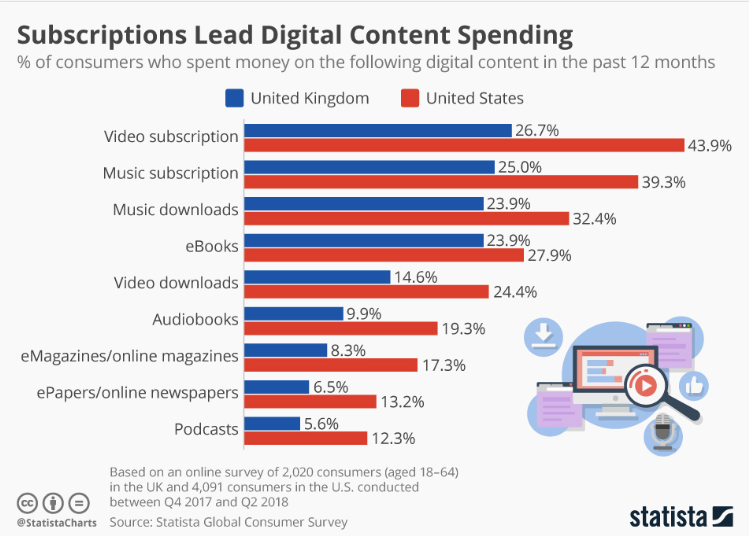
If the first thing that springs to mind is a subscription to a digital publication or news site you are one of about 13.2% in the United States, according to Statista’s Global Consumer Survey. Unfortunately, despite consumers willingness to sign up for subscription based content, news has been one of the most difficult areas to monetize. In part, this is because so many people consume it through social media platforms.
Who will pay for what?
We do see a willingness on the part of audiences to pay for audio and video subscriptions. (Though the jury is still out on how many they’ll pay for in an increasingly crowded market). However, big-name news sites like The New York Times, The Washington Post, The Financial Times, along with just about every other digital publication you can think of wants to shift from advertising based models to reliance on subscript
Of course, some people do pay for digital publication subscriptions. The question is, of course, how many people will pay — and for how many different subscription products. Publication sites, particularly those in the traditional news business, are fighting to compete with each other over who can lock-in the audience segment that is willing and able to pay for content.
Also, philosophically, the subscription revenue model at scale is essentially splits the internet into two categories: online users who can afford (or are willing to pay for) content, and online users who can’t (or won’t). Certainly there are other concerns about the subscription model. However, the overarching problem is that many users visiting your website cannot or will not pay for a subscription.
The basics of monetization
Back in the prime-print days, publications would hire a sales team to target relevant companies, wine-and-dine these companies, and sell them advertising space in their paper. Now that publishing has transitioned to digital, direct advertising relationships have been intercepted by ad tech companies and social media platforms.
These days, programmatic networks and platforms dominate digital advertising. Programmatic advertising removes the relationship factor of ad sales. Instead, exchanges are done electronically, often through the new middlemen of digital advertising: Google, Facebook, and Amazon. They claim ownership of these valuable advertising relationships.
Marketers are retargeting to reach the audience they once found in print publications and reaching them other ways. They believe that they don’t need to advertise in The Wall Street Journal, because they can find Wall Street Journal readers on Facebook.
Print revenue is declining fast and a great deal of digital advertising is no longer being sold directly by publications. This leaves publishers searching for other methods to monetize their content.
Subscriptions do solve that problem. They allow publishers to directly monetize their audiences again. The model also has fewer middlemen and is a more stable, less-disruptable business.
Some large-scale publications ask readers to pay a monthly fee to view some or any of their content at all. The problem is, few have been able to make that work and many visitors are frustrated when they hit a hard paywall or run out of metered views. And, knowing that we can’t expect readers to subscribe to several sources for similar information, large-scale publications compete against one another for subscription revenue. While some niche publications have been able to create a sustainable subscription model, they still face the issue of subscription fatigue.
If the consumers won’t pay, who will?
Publishers produce content and need to earn revenue to continue doing so. Readers engage with this content yet many don’t want to pay for it. It’s a dead-end cycle. So, who pays?
Luckily, advertisers still want readers’ attention just as much as publishers do. And advertisers are willing and able to pay for it. This is a classic win-win-win model. Readers don’t have to pay, publishers get paid to produce content, and advertisers reach desirable audiences. We continue circling back to an ad based model because it is the only revenue model that benefits every party involved.
The disruption of the ad revenue model in the digital publishing industry has caused great shifts. Publishers cannot continue running a business as they always have. They have to balance consumers desire for free content with the need to monetize it. With major platforms dominating the digital advertising world, the weight lies on publishers and advertisers to work together and explore creative ways to make the ad revenue model work for everyone.
Transparency will be critical to make things work. As users increasingly become sensitive to privacy and the value of their data, platforms are finally on the back foot.
Publishers that understand the value of each of their visitors will those ultimately primed to succeed. Recent advances in machine learning and personalization enable new understanding as well as increasingly valuable offerings. This may finally allow us to bring balance back to a historically successful revenue model for both advertisers and publishers.