To date, only a few publications have offered an ethical framework for decentralized social technologies (DSTs) ‒ blockchain, Web3, and Fediverse. The collapse of FTX, a cryptocurrency futures exchange using blockchain methodology, alarmed many. Its absence of records, accounting controls, and transparent decision-making processes highlights the need for new governance guidelines across new technologies.
As a result, the Justice, Health, and Democracy Impact Initiative, a collaboration between Brown University School of Public Health and the Edmond & Lily Safra Center for Ethics at Harvard University, has offered up a foundation for ethical and social experimentation with DSTs. Their new report, Ethics Of Decentralized Social Technologies, unpacks the transformation of DSTs, their impact, built-in mechanics, and downstream consequences. Importantly, it offers lessons learned and insights into how decentralized social technologies can be developed and implemented ethically and responsibly.
Ethical framework
The Justice, Health, and Democracy Impact Initiative examines AI ethics and bioethics frameworks to identify DTS best practices. Employing AI ethics includes asking fundamental questions like how to use the data to generate predictions and how institutions will use the predictions. AI ethics also includes basic questions about who makes these decisions, sets the timeline, and establishes the criteria.
In addition, bioethics looks to find the middle ground between identifying risks and modifying them while continuing the work unless deemed unsafe. Importantly, bioethics technologists structure their practice in four stages. A safety net is also essential to the process, with each layer providing safety guarantees to support safe experimentation.
Be precise about goals and offering validations;
Have governance structures to oversee the design and evaluation of experiments;
Publicly report what happens, what works, what doesn’t, and any unintended results; and
Have precise mechanisms for democratic oversight developed in collaboration with public democratic organizations.
Constitutional moments
The report also examines whether the DST ecosystem exemplifies a constitutional moment ‒ a pivotal point of transformation. The U.S. Constitution, written in the late eighteen century, reflects the U.S. economic, demographic, technological, and social structure of its time. However, new technologies (i.e., Industrial Revolution, air travel, and the biomedical revolution) emerge and cause transformation in the structure of society.
Constitutional moments do not mean we need to write a new Constitution but a framework to navigate and experiment with new technologies and social platforms. While blockchain technology is often celebrated for decentralized networks (because they are less likely to marginalize one community over another), they can also create divisions. These divisions can include social bias in their datasets. And training on them will replicate and intensify these patterns. Therefore, we must carefully examine the ethical practice of new technology to ensure that decentralized technologies also bridge communities and build a connected society.
The Justice, Health, and Democracy Impact Initiative acknowledges that this is just the start of the ethical DTS landscape. The report highlights the importance of ensuring user privacy and data protection and the need for transparency and accountability in developing decentralized social technologies. It also emphasizes the importance of fostering a diverse and inclusive community and ensuring that decentralized systems are accessible to all and beneficial to society.
Artificial intelligence chatbots such as OpenAI’s ChatGPT and Microsoft’s BingGPT have generated lots of buzz lately, much of it centered around how helpful or harmful these tools might be for media companies. While the helpful camp welcomes the benefits of assisting reporters with initial research, aggregating data and performing basic copy editing, others argue that these programs may also accelerate the spread of misinformation and fake news sites, which can compete with legitimate publishers for readers’ attention and advertising.
While newsrooms have been using AI tools to some degree for years, the technology has recently become more advanced and widespread, making it harder to determine whether copy was written by a human or generated by a bot. Publishers committed to industry standards and best practices need to find ways to stand out from lesser quality websites.
Oddly enough, even ChatGPT agrees that publishers need to find ways to distinguish themselves from non-human creators. When asked how digital publishers can stand out from AI-generated content, it responded:
“As AI-generated content becomes increasingly prevalent, media companies must find ways to differentiate themselves in the marketplace. While AI can produce articles and other types of content at a rapid pace, there are certain aspects of digital publishing that only a human touch can provide.”
What are those human touches? Fact-checking, vetting sources and objective reporting, to name a few. As a legitimate digital publisher, you already do these things, but do you get credit for them?
Here are three initiatives designed to help media companies stand apart from artificial content and get more credit for their good work.
Showcase your commitment to journalism standards and ethics
As more publishers use AI tools, questions may arise about whether they followed journalistic standards during the content creation process.
The Journalism Trust Initiative (JTI) is a certification program launched by Reporters Without Borders (RSF) to help quality media outlets demonstrate their commitment to creating transparent, ethical journalism. The program includes certification against the JTI Standard – a set of transparency standards developed to measure media outlets’ production of trustworthy content.
“It’s really important to be able to distinguish between trusted news and misinformation,” said Beth Potter, Ph.D., U.S. regional manager for JTI. “We as journalists are not marketing ourselves well enough. We need to stand up as a group and let the world know we have rules and policies in place that lesser-quality content providers do not have.”
The three-step JTI certification process includes a self-assessment, a public disclosure in the form of a Transparency Report and a third-party audit to confirm the organization’s adherence to the JTI Standard. Once certified, media outlets can display the JTI mark to let advertisers know they are committed to following industry standards that lead to the creation of trustworthy content.
Recognize your industry connections and memberships
Quality media outlets often take an active role in the industry and participate in groups like Digital Content Next and the Alliance for Audited Media to promote quality media and industry standards.
Trust.txt is a framework developed by non-profit organization JournalList to help organizations earn recognition for their relationships with trusted industry organizations and associations. Similar to Ads.txt, publishers place a Trust.txt file on their websites that publicly lists industry memberships, owned domains and social media accounts. Industry organizations are also encouraged to create a file listing their members. The goal is to help search engines recognize the legitimate connections between media companies and industry associations.
“A great many of us depend on unreliable mechanisms to find reliable news online,” said Mark Stencel, executive director of JournalList. “Tech companies shouldn’t be the ones who decide what is and what is not ‘news.’ Journalism organizations should. JournalList’s Trust.txt files are a simple and efficient way to make that possible.”
Get certified for creating balanced, reliable content
Brand safety has been an increasing concern as advertisers find ways to prevent their ads from running on websites that don’t align with their brand values or create misleading content.
Ad Fontes Media developed its interactive Media Bias Chart® in response to increases in misinformation and media polarization. By creating a methodology to rate sources for reliability and media bias, Ad Fontes offers a tool to help advertisers and consumers find trusted sources of news and information. The group rates everything from websites, linear and connected TV, YouTube channels, podcasts and newsletters.
“When people say they don’t trust media, they lump quality news sources with those that create questionable content,” said Vanessa Otero, CEO and founder of Ad Fontes Media. “We want to elevate quality publishers and showcase their good work and commitment to transparency.”
The Alliance for Audited Media recently partnered with Ad Fontes to create a custom media bias chart featuring AAM-audited publishers, which Otero says tend to be among the most reliable, trustworthy sources Ad Fontes rates across the news landscape.
“Advertisers use the chart to create inclusion lists based on media bias and reliability ratings,” Otero said. “The chart helps advertisers support reliable and trustworthy sources while safeguarding their brands.”
Advertisers also use our AAM Audited Domain List, a list of digital publishers who have completed the AAM Digital Publisher Audit, to create inclusion lists and direct more of their investment toward publishers that have been vetted by a third party. The audit gives media companies another tool to help stand out for their adherence to industry standards and best practices for sourcing website traffic.
The future is in publishers’ hands
As AI technology continues to evolve, it will only continue to become more challenging to separate content written by humans from articles generated by chatbots. It’s even challenging for ChatGPT, which when asked about its ability to identify AI-generated content, replied:
“As an AI language model, I can analyze and generate text, but I cannot determine with 100% accuracy whether a piece of content was generated by a human or an AI system.”
While publishers may not be able to prevent the spread of chatbot-sourced content, they can control how their websites appear to readers, advertisers, and search engines. By implementing industry initiatives, publishers can do something the chatbots can’t do: prove that they are committed to standards and best practices and provide transparency about how their content was sourced and developed.
For a decade, artificial intelligence (AI) has enabled digital media companies to create and deliver news and content faster, to find patterns in large amounts of data, and engage with audiences in new ways. However, with much hyped recent announcements including ChatGPT, Microsoft’s next-gen Bing, and Meta’s LlaMA, media outlets recognize that they face significant challenges as they explore the opportunities the latest wave of AI brings.
In this second story in our two-part series on the evolution of AI applications in the media business*, we explore six challenges that media outlets face around AI tools, from the misuse of AI to generate misinformation, errors and accuracy, to worries about journalistic job losses.
Misinformation
While it has been used by media companies for various purposes over the last 10 years, AI implementations still face challenges. One of the biggest is the risk of creating and spreading misinformation, disinformation and promoting bias. Generative AI could make misinformation and disinformation cheaper and easier to produce.
“AI language models are notorious bullshitters, often presenting falsehoods as facts. They are excellent at predicting the next word in a sentence, but they have no knowledge of what the sentence actually means,” wrote Melissa Heikkilä for MIT Technology Review.
Generative AI can be used to create new content including audio, code, images, text, simulations, and videos—in mere seconds. “The problem is, they have absolutely no commitment to the truth,” wrote Emily Bell in the Guardian. “Just think how rapidly a ChatGPT user could flood the internet with fake news stories that appear to have been written by humans.”
AI could also be used to create networks of fake news sites and news staff to spread disinformation. Just ask Alex Mahadevan, the director of MediaWise at the Poynter Institute, who used ChatGPT to create a fake newspaper, stories and code for a website in a few hours and wrote about the process. “Anyone with minimal coding ability and an ax to grind could launch networks of false local news sites—with plausible-but-fake news items, staff and editorial policies—using ChatGPT,” he said.
Errors and accuracy
Julia Beizer, chief digital officer at Bloomberg Media, says the biggest challenge she sees around AI is accuracy.
“At journalism companies, our duty is to provide our readers with fact-based information. We’ve seen what happens to our discourse when our society isn’t operating from a shared set of facts. It’s clear AI can provide us with a lot of value and utility. But it’s also clear that it isn’t yet ready to be an accurate source on the world’s information,” she said.
Thus far, AI content generators are prone to making factually-inaccurate claims. Microsoft acknowledged that its AI-enhanced Bing might make errors, saying: “AI can make mistakes … Bing will sometimes misrepresent the information it finds, and you may see responses that sound convincing but are incomplete, inaccurate, or inappropriate.”
That hasn’t stopped media companies from experimenting with ChatGPT and other generative AI. Sports Illustrated publisher Arena Group Holdings partnered with AI startups Jasper and Nota to generate stories from its own library of content which were then edited by humans. However, there were “many inaccuracies and falsehoods” in the pieces. CNET, which also produced AI-written articles and came under scrutiny for factual errors and plagiarism in those pieces.
Francesco Marconi, longtime media AI advocate and co-founder of AppliedXL, said that though AI technologies can reduce media production costs, they also pose a risk to both news media and society as a whole.
“Unchecked algorithmic creation presents substantial pitfalls. Despite the current uncertainties, newsrooms should monitor the evolution of the technology by conducting research, collaborating with academic institutions and technology firms, and implementing new AI workflows to identify inaccuracies and errors,” he said.
“The introduction of generative summaries on search engines like Google and Bing will likely affect the traffic and referral to publishers,” Marconi said. “If search engine users can receive direct answers to their queries, what motivation do they have to visit the publisher’s website? This can impact news organizations in terms of display ads and lead generation for sites that monetize through subscriptions.”
Filter and context
The amount of data and information created every day is estimated around 2.5 quintillion bytes, according to futurist Bernard Marr. With the rise of generative AI models, the growth of information available to digital media companies and the public is exponential. Some experts predict that by 2026, 90% of online content could be AI-generated.
It presents a new challenge, according to Marconi. The explosion of data from IoT has created a world where there is too much of it. “We are now producing more information than at any other point in history, making it much more challenging to filter out unwanted information.”
A significant challenge for journalism today is filtering and contextualizing information. News organizations and journalism schools must incorporate computational journalism practices, so that journalists are also responsible for writing editorial algorithms in addition to stories.
“This marks an inflection point, where we now must focus on building machines that filter out noise, distinguish fact from fiction, and highlight what is significant,” Marconi said. “These systems are developed with journalistic principles and work 24/7 to filter out irrelevant information and uncover noteworthy events.”
Replacing journalists
AI-powered text generation tools may threaten journalism jobs, which has been a concern for the industry for years. On the other side is the longstanding argument that automation will free journalists to do more interesting and intensive work. It is clear, however, that given the financial pressures faced by media companies, the use of AI to streamline staffing is a serious consideration.
Digital media companies across the U.S. and Europe are grappling with what the potential of generative AI may mean for their businesses. Buzzfeed recently shared that it planned to explore AI-generated content to create quizzes, while cutting a percentage of its workforce. Last week, CEO of German media company Axel Springer Mathias Doepfner candidly admitted that journalists could be replaced by AI, as the company prepared to cut costs.
There is a valid concern regarding job displacement when considering the impact of AI on employment, Marconi agreed—with a caveat. “Some positions may disappear entirely, while others may transform into new roles,” he said. “However, it is also important to note that the integration of AI into newsrooms is creating new jobs: Automation & AI editors, Computational journalists, Newsroom tool managers, and AI ethics editors.”
Potential legal and ethical implications
One of the other biggest challenges digital media companies and publishers will face with the rise of AI in the newsroom are issues around copyright and intellectual property ownership.
ChatGPT and other generative AI are trained by scraping content from the internet, including open-source databases but also copyrighted articles and images created by publishers. “This debate is both fascinating and complex: fair use can drive AI innovation (which will be critical for long-term economic growth and productivity). However, at the same time it raises concerns about the lack of compensation or attribution for publishers who produced the training data,” according to Marconi.
Under European law, AI cannot own copyright as it cannot be recognized as an author. Under U.S. law, copyright protection only applies to content authored by humans. Therefore, it will not register works created by artificial intelligence.
“AI’s legal and ethical ramifications, which span intellectual property (IP) ownership and infringement issues, content verification, and moderation concerns and the potential to break existing newsroom funding models, leave its future relationship with journalism far from clear-cut,” wrote lawyer JJ Shaw for PressGazette.
Questions remain
While AI is not new, it is clearly making an evolutionary leap at present. However, while media companies may have been slow to adopt technology in the early days of the internet, today’s media executives are keen to embrace tools that improve their businesses and streamline operations. But given the pace at which AI is evolving, there’s still much to learn about the opportunities and challenges it presents.
Currently, there are some practical concerns for digital media companies and large questions still to be answered, according to Bloomberg’s Beizer. She questions how the advancement of these tools will affect relationships: “If we use AI in our own content creation, how should we disclose that to users to gain their trust?”
Wired has already made the first step by writing a policy that places clear limits on what they will use AI for and how the editorial process will be handled to ensure that a quality product is produced.
Beizer also poses the question of “how publishers and creators should be compensated for their role in sourcing, writing and making the content that’s now training these large machines?”
While in some eras, media companies have been swept along with the tide of technological change, with AI media executives are clearly grappling with how to embrace the promise while better managing the impact on their businesses.
From simple chatbots to generative content creation tools, artificial intelligence has become a force to be reckoned with for digital media companies. But while interest has heated up lately, artificial intelligence (AI) has already been employed by media companies for about a decade. Among other things, AI has long enabled journalists to analyze large amounts of data, extract insights, and identify patterns and trends. It also offers ways to engage audiences through personalized experiences and recommendations.
However, while it is not a new phenomenon, AI has come a long way since 2014 when some of the first media companies started using it for journalistic purposes. In this two-part series, we explore the evolution of AI use in the media, what’s different now, the opportunities that it offers publishers, as well as challenges including the misuse and abuse of AI, errors and accuracy, and concerns about job losses for human journalists.
AI + journalism
The news industry has witnessed three phases of AI innovation over the past decade: automation, augmentation, and generation, according to Francesco Marconi, computational journalist and the co-founder of real-time information company AppliedXL. “During the first wave, the focus was on automating data-driven news stories, such as financial reports, sports results, and economic indicators, using natural language generation techniques,” Marconi said.
In that first wave, AI offered a way to free journalists from menial or repetitive tasks so they could engage in more complex, high-impact, and investigative journalism. It was touted as a way to save organizations time and money by automating the production of certain types of news stories based on data.
During the second wave, the emphasis shifted to augmenting reporting through machine learning and natural language processing to analyze large datasets and uncover trends, Marconi explained. AI was a tool for journalists to use to analyze large amounts of data, text, video and images, to help them identify trends, patterns or outliers.
During this period, digital media companies also began experimenting with chatbots to help journalists tell stories differently. Chatbots simulated human conversations by responding to specific questions with pre-programmed answers. Early examples included Harvard Business Review’s Slackbot, and AccuWeather’s chatbot for Facebook Messenger that took questions from users and provided weather-related answers.
AI today
The third and current wave is driven by the AI generative movement, powered by large language models, which are capable of generating narrative text at scale.
In recent days, digital media companies have been experimenting with and examining how they can use ChatGPT and generative AI. Last month, Jim Mullen, chief executive officer at Reach PLC, told the Financial Times his company had set up a working group to examine how the tool might be used to assist journalists to write short news stories or compile coverage of local weather and traffic.
For media companies that have used AI for years, this new crop of AI has been interesting to watch. While ethical and quality uses are well-established, some of the current applications are still a work in progress.
One early adopter, Bloomberg Media, has used AI for more than a decade. Their deployment uses natural language processing (NLP) and machine learning to extract information from documents, including detecting people, companies and organizations found in the text of their stories. In addition, they also extract insights to help reporters find news about companies or sectors they cover.
“Like most consumers, I’ve been enchanted by the latest crop of AI tools. Tools like ChatGPT and Midjourney are showing us how much creativity these tools can unlock,” said Julia Beizer, Chief Digital Officer at Bloomberg Media.
“But alongside the enchantment, I’ve felt a fair bit of unease. These are early, very public experiments and we are seeing in real time how easy it is for unproven tech to get the facts wrong. This should be a reminder to all of us – particularly those of us in the journalism business – how important the work we do is,” she said.
The difference in today’s AI
For digital media companies, AI is different now for a number of reasons. Newer generative AI models have broader capabilities because of increased computational power, which means models can process larger amounts of data faster. There have been improvements in NLP, which has allowed AI to generate more nuanced language.
And, in recent years, AI tools have become more accessible for digital content companies. The current crop requires far less tech savvy and investment because they’re open-source.
“Initially, AI in the newsroom was limited to big newsrooms with significant resources,” explained Marconi. “However, with the widespread availability of AI infrastructure, such as open-source models and APIs, the technology is now accessible to every newsroom. This broad accessibility will also bring major challenges as the news industry rushes to adopt new standards and workflows.”
Bloomberg’s Beizer believes that the big difference right now is creativity. “The best technology feels like magic. It fades to the background so all you’re left with is the experience. ChatGPT is a simple interface over one of the most powerful pieces of technology we’ve seen,” she said.
So what’s new?
Given the leap forward in ease of use, AI may create new opportunities for those willing to adapt and innovate in this rapidly changing landscape.
“The economics of the media business are changing dramatically. AI has substantially reduced the cost of production” such as including editing, story writing, and creating multiple versions. “But newsgathering and fact-checking still necessitate specialized knowledge and infrastructure that technology companies lack,” Marconi said.
He added that media companies have an opportunity to become a major player in the AI space. That’s because they possess valuable assets for AI development: the text and image data for training models and ethical principles for creating trustworthy systems.
Advances in technology have disrupted the media industry for many years. According to Beizer, generative AI is only the latest chapter. “What I believe has changed this time around is that we are now mature digital companies with digital businesses to protect and grow. This time around, I have no doubt that our industry will rise to the occasion of thoughtfully exploring this disruption from all its angles – and setting the right strategies for our businesses and quality content to flourish,” she said.
Opportunities ahead
There are valid concerns about whether generative AI will be used to flood the market with content in the future. However, reputable media outlets will find that there are responsible applications of AI that will actually allow them to double down on the quality of their journalism and provide better content recommendations and experiences.
For Beizer, the biggest opportunity at the moment is “focusing our companies on what matters most: our customers… In this moment, we should lean even harder into building direct relationships with those users, getting to know what they want and delivering that value. We have the biggest opportunities in the kind of differentiated value that a chatbot cannot provide – analysis, novel points of view, human connection, nuanced reporting and writing. We should deprioritize anything that isn’t that. The future of our business depends on it,” she said.
However, as AI becomes more sophisticated, there are other promising applications for journalists. Imagine an AI-based tool that could help with large projects that newsrooms could never have enough staff to do, or one that checked facts, style, and grammar.
Marconi sees the evolution of AI in recent years as the foundation for the next phase of AI in journalism, which he believes will come to fruition over the next decade. He calls it artificial journalistic intelligence, where machines are able to automate news gathering and production, resulting in improved accuracy, efficiency, and impartiality, he said.
“Nonetheless, humans will continue to play a significant role. Creating editorial algorithms requires human supervision. As a result, in this new era, transparency and auditing of algorithms will become critical functions of newsrooms in the future,” he said.
In part 2, we look at challenges and concerns around generative AI, including the misuse and abuse of AI, errors and accuracy, legal and ethical issues, and concerns about job losses for human journalists.
The many profound possibilities for creators leveraging artificial intelligence have been quietly heating up over the last decade. So, what really changed in the past few months? Certainly, the clever roll-out of ChatGPT only months after DALL-E 2 has thrown gas on the burner. Right now, press coverage and industry chatter are mostly focused on uncovering real-world applications offered by generative AI, which are exciting to be sure. However, wise publishers will heed lessons learned from past experiences in which their data were scraped and take an active role in preserving their business value.
“Scraping the web” is a term as old as the web itself. It’s no secret that Google’s core business was built by crawling companies’ servers to train its search engine to find and deliver satisfying results across the vast world wide web with speed and precision. The result: Google now plays the role of gatekeeper for much of the web.
The reality is that any publisher who made the radical decision not to allow Google’s crawler to do its thing would quickly become almost impossible to find online. Giving Google the free right to crawl your site is the cost of business to exist on the open web today.
Just last week Google began testing blocking news properties in Canada. As Campbell Clark wrote for the Globe and Mail earlier this week, “It’s not a threat, of course. Sometimes people just wake up with a horse’s head in their bed.”
This is yet another stark example of Google’s power. No individual publisher has the bargaining power to opt out and impact Google’s business. So no one does.
It’s not actually that different from the way in which Facebook built its social media platform into a digital advertising juggernaut. After many years scraping and collecting user data across the web and its partners – from far beyond the walls of its garden – Facebook began using AI to leverage its massive data warehouse appropriately named “The Hive” in a manner that is irreversible. Publishers are only now learning how all of this data was used, and abused, through lawsuit discovery and leaked documents.
Importantly, as was uncovered through one of these leaked documents, Facebook engineers used the metaphor of ink spilled into a lake to describe what happens to a person’s data once it makes its way into the Facebook’s data warehouse:
“We’ve built systems with open borders. The result of these open systems and open culture is well described with an analogy:
Imagine you hold a bottle of ink in your hand. This bottle of ink is a mixture of all kinds of user data (3PD, 1PD, SCD, Europe, etc.) You pour that ink into a lake of water (our open data systems; our open culture) … and it flows … everywhere. How do you put that ink back in the bottle? How do you organize it again, such that it only flows to the allowed places in the lake?”
This brings us to generative AI – 2023’s hot topic. It’s unequivocal that the Large Language Models are being trained by ingesting the work of newsrooms across the web. To better understand this fact, consider that Google disclosed that a whopping 15% of Google’s daily searches are completely new searches.
Now think about that for a moment: The most likely trigger for a novel search is an unfolding news event. That means the simple fact that these searches occur was triggered by the work of news media. And, as we know, Google monetizes answers. Particularly when confronted by a new query, Google’s machine learning algorithms lean into authority brands – those deemed likely to provide a trustworthy response. Guess who those are? You can see by looking at the top results presented by a search around breaking news: the results are called “top stories” and you guessed it: they come from media brands.
No one should doubt that a similar level of interest, intelligence, and impact on generative AI will be instigated—and answered—because of the work product of the news media, particularly given the role of Large Language Models in their training and operation.
So, if the output of newsrooms, writers, artists, and media companies were not available to scrape, what would happen to the quality of 2023’s much-hyped generative AI?
Copious effort and investment go into the creation of premium content. The use of premium content to train AI models is akin to fueling your machine with gasoline you “found” in someone else’s garage. It doesn’t inherently mean that the machine is not powerful, or useful. But that fuel was not free to create. If your machine can’t run without it, something is not quite right with the system.
Given Facebook’s metaphor, the publishing world may need to serve notice to OpenAI and its ilk before they can make the claim that the ink flow can no longer be reverse engineered. Let’s hope it is not already too late.
In November, DeviantArt rolled out an HTML tag so that an artist can inform web robots not to crawl their images to train art-generating AI. Media companies need to consider whether the right course of action is to launch a similar tag, which tells bots not to crawl and train their AI with publishers’ work. Of course, like many technical issues on the open web, this would only rein in the good robots and would not solve for bad bots.
But it is important that we make a start, before too much ink has spilled.
While evergreen issues around trust and a focus on the audience experience peppered the first in-person DCN Next: Summit since 2020, emerging opportunities – and concerns – around generative AI were also focal at the event. Held at the Fort Lauderdale beachfront Conrad Hotel, the 2023 summit hosted a wide range of speakers from inside and outside the DCN membership to discuss the business and future of media, brand mission, omnichannel strategy, consumer preferences, and the impact of the challenging economic and regulatory climate.
Surveying the regulatory landscape
DCN CEO Jason Kint kicked off the event with a focus on current key regulatory issues that impact digital media. He emphasized that the focus must remain on aligning content experiences, advertising behavior, and data usage with consumer expectations. He also looked at the current state of antitrust regulation.
As Kat Downs Mulder, SVP and GM of Yahoo News put it: media brands have a responsibility, in asking consumers for their information through sign-ons, “to be protective of our asks and thoughtful about what we request.”
Shoshana Zuboff, author of the book The Age of Surveillance Capitalism
Kint’s points were hammered home by Shoshana Zuboff, Harvard Business School professor and author of the book The Age of Surveillance Capitalism. Zuboff delineated the history of privacy erosion leading to tech companies’ engagement in a “secret massive scale extraction of human data” and how regulation is a driving factor in reining it in.
The current drive towards antitrust and reining in the dominance a few players have over the ad market was a focal point for Utah Republican Senator Mike Lee, who addressed attendees via Zoom. He discussed a bill he is reintroducing “in a few weeks with bipartisan support,” which is designed to restore and protect competition in digital advertising and improve advertising transparency.
“Unfortunately, big tech behemoths like Google have inserted themselves as middlemen into this relationship, extracting monopoly rents not just on their own properties, but from every corner of the entire internet ecosystem.”
How brand focus empowers growth
The impact of emerging regulation is far from the only challenge media executives currently face. Speakers touched on inflation, supply chain disruption, European conflict, U.S.-China tensions, the ongoing impact of Covid, climate concerns, labor challenges, the erosion of trust in institutions, and the fight for free speech.
However, Almar Latour, CEO, Dow Jones and The Wall Street Journal publisher (pictured at top) said that challenges like these actually drive brands closer to their mission. For his brands, that mission is to go deep with products to provide truth relevant to different aspects of the business world, he added. This strategy is one he believes will lead to subscription growth.
Producing great products consumers love and return to over and over is indeed a driving factor in subscription strategy, as illustrated in a discussion between Julia Beizer, Bloomberg Media CEO and chief digital officer and Mulder. She noted that consumers value connecting with authoritative voices in brand podcasts and newsletters.
Bloomberg Media CEO and chief digital officer Julia Beizer, & SVP and GM of Yahoo News Kat Downs Mulder in conversation with Axios’ media reporter Sara Fischer.
Indeed, building an infrastructure on the foundation of staying true to one’s brand is key to success, according to Bonin Bough, Group Black co-founder and chief strategy officer.
Brand, however, is not some vague marketing tool. Scott Mills, BET president and CEO said that maximizing brand requires a comprehensive data-driven ecosystem encompassing linear, streaming, and digital platforms.
Advocating for truth and accuracy
Maximizing brand value requires providing consumers with a source of much-needed, trustworthy information – particularly when others seek to tamp it down and create a void that is often filled with dis- or misinformation.
Scott Mills, president of BET
Addressing Florida’s Department of Education rejection of the AP African American History course, Mills noted that such actions will “drive us to allocate more of our resources or more of our attention to ensuring that our community—and people who value and respect our community—have access to accurate information.”
Clearly, the need for accurate information is a global one, though journalistic approaches and press freedoms vary widely. In his work as the manager for East and Southern Africa at the organization Journalists for Human Rights, Dr. Siyabulela Mandela has found that offering training to local journalists not only empowers them, but helps their work better serve local communities. He said that improving journalism’s role of providing checks to those in power is critical at a time when “there seems to be a shift from more democratic ways of doing things towards more totalitarian ways.”
Dr. Siyabulela Mandela, Journalists for Human Rights
Mandela advocates for an approach that enables Western journalists to reframe stories in East and Southern Africa and the Middle East with a more contextual focus on human rights by leveraging his organization’s local knowledge base. He favors the idea of a collaborative exchange program for mutual training with journalists from East and Southern Africa. Each, he pointed out, has much to learn from each other.
Evolving with the times
In addition to providing content that continues to address the needs of audiences, speakers discussed how innovation in storytelling provides creative and impactful ways to engage and inform audiences.
For Emblematic founder and CEO Nonny de la Pena, that means finding new ways to use virtual reality. Nicknamed “the godmother of VR” de la Pena illustrated techniques and showed behind the scenes insights into how some of the most powerful VR stories have been created. However, despite her enthusiasm, she said that given the fact that creators of misinformation often leverage powerful tech, it is essential to establish immutable provenance for footage to make it difficult to manipulate.
Alice McKown, publisher and CRO of The Atlantic
Encompassing non-traditional strategies to engage new audiences requires portfolio diversification, noted Alice McKown, publisher and CRO of The Atlantic. While the company has digitized its entire archive of 30,000 articles from its 165 years, it also has expanded efforts into creating new ways to leverage its IP, including immersive art exhibits, video, podcasts, book publishing, and events.
Hannah Yang, Chief Growth Officer, New York Times
The National Geographic also has instituted strategies to evolve with the times while staying true to the brand’s core attributes. The magazine still attracts a relatively small, but incredibly loyal following, according to editor-in-chief Nathan Lump. These days, however, National Geographic brand reaches millions of people via social media, the National Geographic Channel on Disney Plus, virtual reality, live events, a travel business, consumer products, books.
Given the many ways that the brand now reaches audiences, Lump pointed out that National Geographic is the biggest it’s ever been in its 135 years. National Geographic boasts 714 million global followers across the major social platforms alone.
For The New York Times, Chief Growth Officer, Hannah Yang told the audience that its impressive subscription growth is achieved through three well-defined missions: a subscription growth mission to meet financial goals; consumer-facing mission offering desired options such as games and cooking; and platform mission to ensure that all parts of the business have the technology and data perspective they need to thrive.
What’s next
“There’s never been a better time to monetize audiences,” noted Alex Michael, managing director of LionTree Group. He stressed the value of omnichannel strategy and bundling while discussing the investment opportunities his company is leaning into this year.
Richard Plepler, founder, EDEN Productions
The power of omnichannel was echoed by a number of speakers, including board member Robin Thurston, Outside Interactive founder and CEO. He said, “The concept of single sign-on omnichannel helps connect the dots and create value.”
Richard Plepler, founder, EDEN Productions and former HBO chairman and CEO, reminded attendees of something he’s advocated for many years: quality over quantity. “More is not better; only better is better. I am not of the belief that tonnage gets you more subscribers – what gets you more subscribers is when brands deliver on their promise.”
As DCN members map out strategies for 2023, innovation and audience focus remain constant. However, to win amidst contemporary challenges developing a seamless omnichannel strategy, while staying to brand mission, will be key to attracting new consumers and retaining existing ones.
Any publisher will tell you how costly it can be to create innovative, attention-grabbing content that resonates with audiences and moves them to engage. But the stakes are even higher when it comes to distributing this content: failing to deliver content effectively can mean depriving it of the attention it deserves, undermining the utility of your initial content investment.
Distributing content is a critical step for publishers and media organizations of all types in delivering quality news and entertainment to audiences and driving revenue through advertising or subscriptions. Yet the channels most often used are noisy environments where user attention is limited and competition is boundless. When not approached strategically, using data as a guide, content distribution can be a laborious, frustratingly inexact science with erratic results.
But publishers are increasingly adopting an effective solution: Artificial Intelligence (AI). Providing immense value in many operational aspects of the newsroom, AI is also transforming how publishers distribute content to maximize reach and performance. Below we’ll look at four key ways in which AI is driving this transformation.
1. Automate content delivery workflows to save time
Frequent and repetitive processes can often be broken down into discreet actions which can be automated to save time.
Consider the example of social media publishing:
Despite the significant changes underway at social media platforms such as Facebook and Twitter in recent times, social media is still one of the preeminent means for publishers to distribute content to audiences, offering an efficient way to reach billions of people of all ages across the globe.
Publishing content to different social platforms is a manual, time-consuming process. It involves selecting the best content to share, creating posts, writing adapted share messages, selecting hashtags, choosing images, analyzing performance and extracting insights for your publication’s social media content strategy. And, of course, all this should be done with specific social platforms in mind (Facebook, Twitter, Instagram, and a growing list of newer platforms). By applying AI, publishers are able to automate this entire process, saving immense time while ensuring content is optimally delivered to audiences across social media platforms.
Another increasingly common example is with email newsletters, a burgeoning area of investment for many publishers. Where applications of AI were previously restricted to send time recommendations, AI is now transforming the entire process of delivering content via email by fully automating the creation, sending and optimization of emails. Publishers are now employing AI to automatically curate, build, send, test and optimize their newsletters, all without requiring human input. The time gained from this level of automation is evident, and can be reinvested into the creation of new, engaging content.
2. Optimize content performance with powerful machine learning
Determining which content will perform best at any given moment, in any given channel, is something that arguably exceeds human ability. But unprecedentedly powerful algorithms can now integrate audience data and real-time trends. This offers the ability to pinpoint which content will attract attention and engagement, and the best time to publish to capture this attention.
By applying AI in this way across key channels, publishers are maximizing their content’s performance:
Machine learning algorithms deliver newsletters with personalized content, sent at optimal times determined by machine learning, to achieve higher open rates and click rates.
AI determines which content is most likely to go viral on social media, and determines the precise optimal post time to gain higher visibility and more user engagement.
Machine learning systems identify which creative elements are likely to generate the most advertising clicks, and tailor ads to viewers on the fly.
AI understands visitor behaviors and personalizes website content for a tailored user experience.
There are many other examples of how AI is transforming the content distribution strategies of publishers and media groups, with exciting new applications of AI surfacing every day.
3. Automatically maximize your content’s lifetime value
A key aspect of any content distribution strategy is knowing when, on which channels, and how often to redistribute existingcontent. In addition to planning and managing the distribution of new pieces, publishers must also constantly think about opportunities to recycle and redeploy content from their archives, whether these are evergreen pieces or seasonal features that can be reused each year. Republishing content in this way is an effective strategy for maximizing the value it can drive across its lifetime.
Publishers can use AI to fully automate this republishing process and ensure that relevant content is reused at the opportune time. One example is the automated resharing of content on social media: AI algorithms monitor current social audience data and trends on each platform, then check a publisher’s content archives to determine which existing pieces should be republished, and the precise moment to generate a new wave of traffic and engagement. Leveraging AI to effectively and automatically manage content redistribution can help publishers squeeze the most return from content over its entire lifespan.
4. Test and learn with AI-driven insights
Running tests is a critical practice to optimize performance over time. But planning and executing tests, collecting and cleaning data, and analyzing results, then transforming them into action has traditionally been laborious. Publishers are now using AI to gain efficiencies with the testing process on various content distribution channels.
Email newsletters are a prime example, given that they have multiple elements available to test such as layout, font, colors, image size, content order, subject line and more. Implementing tests on each email blast, then collating data and identifying trends and larger patterns can be expertly handled by a machine. And in most use cases, AI can be employed to not only collect and analyze test data, but also to automatically iterate and implement improvements based on test results, ensuring content achieves continuous increases in performance.
Unlock content’s full potential with AI-powered delivery
Distribution is a decisive stage of the content life cycle, with the potential to make or break the performance of a piece of journalism. Getting distribution right – and across an increasing number of channels – is time-consuming and requires data and strategy to execute properly.
Fortunately, with AI technology, publishers and media organizations can bypass much of the cumbersome, manual work involved in delivering content at scale. Adopting AI for content distribution can mean more accuracy and consistency than a human can provide, and this enhanced intelligence can have a significant impact on your publication’s bottom line.
About the author
Ashley Kibler is the Marketing Director at Echobox, the leading solution for publishing automation used by 1,500 publishers and media groups worldwide to automate and optimize content curation and distribution.
As artificial intelligence (AI) continues to evolve, we see more and more examples of AI-generated content in our daily lives. It is only a matter of time before brands start to adopt these tools to scale their content creation and power their content marketing strategies. This trend will continue to accelerate as AI gets better at producing quality content.
For publishers, this presents a huge opportunity. Brands will need help distributing the influx of new content, and publishers are in a prime position to provide that assistance. But are we ready? Do we have the infrastructure in place to handle the increased demand?
Only time will tell. But one thing is for sure: the world of brand content is about to get a whole lot bigger, and publishers need to prepare by focusing on strategies to scale their sponsored content programs.
Content is about to get a whole lot bigger, thanks to AI creation
Companies will no longer be limited to having just a few people write their content. Instead, with automated content creation, brands can scale their content quickly and easily – and leverage their content resources to refine the messaging. This means less time spent creating individual pieces of quality content, allowing for more ideas and creativity to be explored on a grander scale. Companies may find themselves communicating with consumers in ways they never thought possible before.
This dynamic change in how brands approach content creation will undoubtedly open up new opportunities and heighten engagement between brands and customers. The content marketing problem will shift focus from resources required to generate impactful content to finding distribution partners that can prove a shift in brand consideration. We expect big changes on the horizon as AI-written content takes on an increasing presence in the market.
Brands will need help distributing all this new content to drive consumer consideration
With the ever-increasing influx of content, brands are truly facing a looming challenge. How can they keep up with the speed and quantity of new content while making sure it has an impact and drives consumer consideration? How will they know which content connects most with consumers?
The answer lies in strategic partnerships with publishers. For brands to be successful, they must find reliable partnerships that allow them to reach their target audiences quickly and efficiently. Brands need experts and strategists who understand how to reach their customers and how to leverage optimization technologies to ensure the right brand content is served to ensure that readers are guided through the buyer’s journey. Reporting will shift from traditional advertising and attribution metrics to content and consideration insights such as lift studies, engagement, and audience insights.
Publishers are uniquely positioned to capitalize on this trend as they have a captive audience
This shift to AI-written content presents an opportunity for publishers to act as mediators between the content and its audience. Publishers have a captive audience and the expertise and experience necessary to ensure that all content reaches the right people in the most efficient manner possible. They can help brands successfully scale their content distribution quickly, efficiently, and accurately so that their message gets out loud and clear. Moreover, leveraging first-party data about their audience enables publishers to provide critical insights into how content is being consumed, as well as its impact on moving readers through their buyers’ journey.
But they’ll need to find innovative ways to scale their operations
We can expect content to explode around us, and for publishers to capitalize on this trend, they need to find effective ways to run their ad operations and make their sponsored content programs scaleable. That means if a publisher relies on manual processes, custom codes, and complex CMSes to run these premium programs they won’t be able to keep up with the sheer volume of sponsored content campaigns thrown at them. To meet the demands of our new digital landscape, organizations must figure out how best to automate their processes to scale sponsored content for brands.
How can publishers prepare for this explosion of content?
To meet the needs of brands adopting AI technology to scale the production of their content, publishers should focus on streamlining in a few key areas:
Campaign setup
Implement their own AI Content tools to suggest variations on existing content that can continually feed into optimization and reporting providing invaluable insight into content performance.
Also, with many publishers running sponsored content through their website CMS, we have found that programs run in this manner cannot meet high demands when sponsored content is sold at scale.
Campaign optimization
Machine learning optimization technology: AI will help draft the content, and publishers can provide content variation recommendations. When you feed this data into an optimization engine, campaign performance will inevitably see a lift and deliver valuable metrics into the type of content that resonates with a brand’s audience.
Opportunity awaits
Taking these steps now can give publishers a major edge in the rapidly changing landscape of brand content distribution. As AI-generated content becomes more prevalent, publishers can capitalize on this trend by finding innovative ways to scale their operations and become strategic mediators between brands and audiences.
Disclaimer: This article was written in part by AI.
Recent history has been filled with challenges within our marketplace and we can expect 2023 to bring its own set of hurdles. At MediaRadar, we are constantly monitoring the marketplace to provide key insights and advice to our clients to help them navigate this ever-changing media landscape. We see numerous new advertising opportunities emerging within the market. However, it is critical for media companies to be ready to capitalize on them at the right time.
Here are six of our predictions for 2023:
1. Rising interest rates will cause accelerated asset sales
Normally in a recession, we can expect to see consolidation of media companies, typically weaker firms looking for scale by pairing. And we will see this. But with rising interest rates and the cost of borrowing up significantly, some well-known companies are going to be pressured to spin-off assets to raise cash and pay down their debt. This may create unexpected industry fragmentation and what may seem like new competition in the marketplace since currently many buys are bundled.
Disney may sell Hulu, or possibly ESPN. Just this week there are rumors Disney might dispatch ABC. Discovery is rumored to be renaming HBO MAX to only MAX. This may signal a desire to spin-off all or some of HBO.
The Dolan family might sell AMC. The economics for small channels has changed. The family paid debt down in the past, when they sold Cablevision (now Altice).
Over the last few years, we have seen SPACs created to acquire well-known media companies like Vice or Buzzfeed. However, some of these investments have registered lower-than-expected valuations and so investors are looking to get out.
2. Retail Media hype is cooling, but it’s also maturing
Last year the IAB Leadership Summit included a presentation with an executive from The GAP. This presentation outlined their plans for a bright ad supported business. The idea was right, but that business is already shut down. We’ve observed dozens of retailers who’ve made big announcements, but have not been able to scale their commerce media businesses.
However, retail advertising isn’t on the decline for everyone. Some retailers continue to make major investments, which are growing. Supermarkets perhaps have the most to gain. They have many ingredients for a successful business model – a captive audience, a strong presence in the local community, their consumers make frequent visits to their websites, and their core business performs at a much higher margin.
Grocery Companies have much to gain by adding a high-margin ad-supported retail advertising to their business model. This is why companies ranging from Walmart to Kroger’s are seeing success through retail media. Traditional media companies can capitalize on the return of ad dollars from failed retail media excursions. However, it is important to note that in certain areas, like CPG and grocery, that retail media is easily here to stay.
3. The Metaverse is not dead
The sense of schadenfreude for Meta (formerly just Facebook) is palpable, but this does not make the idea wrong. I read Neil Stephenson’s revolutionary thriller Snowcrash in university (the book was published 30 years ago), which foretells the metaverse, and more recently Ready Player One. I’m a believer. When the technology is in place, and affordable, it will be the next big thing. There will be an enormous ad business when the metaverse is realized. While I don’t think this will come to complete fruition in 2023, I do think media companies should be keeping an eye on this technology. It will open numerous advertising opportunities as it matures. We can’t let it sneak up on us.
4. ChatGPT will change the business of selling ads
At MediaRadar we observe more than 4.8m brands advertising in the United States. But to prepare thoughtful outreach for so many brands is far too time consuming for any individual ad sales team – at almost any ad-supported media company today. Sales teams don’t have the resources to canvas more than a small segment of the total market. However, ChatGPT will allow mass customization of outreach. We feel this will improve (that is, dramatically multiply) the number of advertisers a sales team could contact. It will collapse the time required by ad sellers to do their prep for marketers and agencies. You can expect more on this topic coming soon from our innovation lab.
5. Government spending is good for advertising
The war in Ukraine is driving advertising spend in key areas like, energy, agriculture, and defense. These will continue to flourish in 2023.
The U.S. government passed two key bills that will significantly impact the media industry. Both are going to drive unprecedented ad spending in the industries and local communities supporting these initiatives. The CHIPS and Science Act is a $250 billion bill that is dedicated to ensuring we no longer face computer chip shortages again. The Infrastructure Investment and Jobs Act. There will be $1 trillion dollars invested to update roads, bridges and tunnels across the U.S. These updates will create employment, travel and business opportunities for Americans – all which will require advertising to spread the word.
6. Sponsorship and exhibitor revenue from live events will be big, despite a looming recession
Our early analysis in Q1 suggests an especially robust market for live events. Pricing of sponsorship is up – often 20-30% above YR 2019 levels. Smart media companies will be creating and selling unique experiences, like NBCU’s BravoCon. Brands are eager to interact with customers in-person and these fun events will bring new advertising opportunities for media companies.
In 2023, we will face numerous challenges. However, there will also be meaningful opportunities for media companies to do well through the recession. When the competition hesitates, there’s room for some to move ahead even faster,
From audience analytics to programmatic advertising and automated story creation, media companies have used Artificial Intelligence (AI) for some time. However, this technology is rapidly maturing and opening up new creative and business possibilities that media executives need to be aware of.
ChatGPT, an AI chatbot, is the current poster child for this robotic reckoning. Garnering a huge amount of column inches in recent weeks, the application can provide detailed answers to questions and prompts. Along with other AI-generated innovations like the portrait app Lensa and OpenArt – a gallery of works created by AI – these tools have inspired the latest wave of discussion about the implications of this technology.
Amidst copious innovation and optimism, concerns have also surfaced around AI-generated content, consent, bias, labeling and regulation, as well as the impact on labor markets. None of these issues are going to go away any time soon. Nevertheless, while media companies and policymakers navigate this unfolding landscape, the roll-out and adoption of AI continues to gather pace.
Artificial intelligence at work in the media
With AI having a real moment right now, this is the perfect time to explore the ramifications for media companies. Here are six uses of AI technologies that need to be on your radar:
1. Driving engagement
One of the most common ways publishers are using AI and machine learning is through AI-powered algorithms which personalize content recommendations.
This can help increase engagement and keep readers on your site for longer. That’s particularly useful if time on site is a key performance metric. Of course, it can also enable you to serve more adds to your audience too.
Personalized recommendation technology has long been the mainstay of platforms like Amazon, Spotify, and Netflix. Now it’s becoming increasingly common for other forms of content too.
One early proponent, The Washington Post, uses AI to personalize the news that they deliver based on readers interests and preferences. It’s an approach they’ve been using for some time across their app, newsletters and now the homepage.
Sign up page for The Washington Post’s “For You” newsletter, highlighting the personalized nature of this product (Dec. 2022)
As Digiday explains, the Post offers a personalized “For You” section on the homepage that taps into information provided during onboarding. At sign-up, subscribers or registered users can select their topic preferences. Recommendations are further augmented by your reading history and other performance data.
It’s an area the Post looks set to double down on, as they and other outlets seek to move to a more tailored content offering and away from the “one size fits all” approach of yesteryear.
One of these models, dynamic paywalls, deploys AI to change free article limits. As a result, users hit the paywall at different times, based on their behaviors and other indicators that help to determine a consumer’s propensity to pay.
“Piano has seen visitors subscribe after a single pageview. Others take much longer to make the decision to convert, while some aren’t likely to ever subscribe at all,” Kaufman observes. In response to this variance, he argues, we need “smarter, more satisfying automation.”
AI can help. New York Media and Neue Zürcher Zeitung (NZZ, Switzerland) are just some of the publishers to adopt this model. They have used AI to determine individual paywalls, based on variables including geography, consumption habits and visit behavior, as well as subject matter and the device being used. Expect more publishers to follow suit.
3. Creating content
Many early newsroom experiments with AI focused on the potential to craft stories that typically follow a predictable formula.
One of the earliest to leverage AI for content creation, The Associated Press (AP) has been using AI since 2014 to generate summaries of earnings reports from publicly traded companies. This allows them to quickly and accurately provide readers with key information, freeing up reporters to do other work. “Prior to using AI, our editors and reporters spent countless resources on coverage that was important but repetitive,” their website notes, adding that this “distracted from higher-impact journalism.”
Alongside freeing up reporters, the technology has allowed AP to create more of this content. Automated story generation has enabled AP to increase the volume of these corporate stories by a factor of 10.
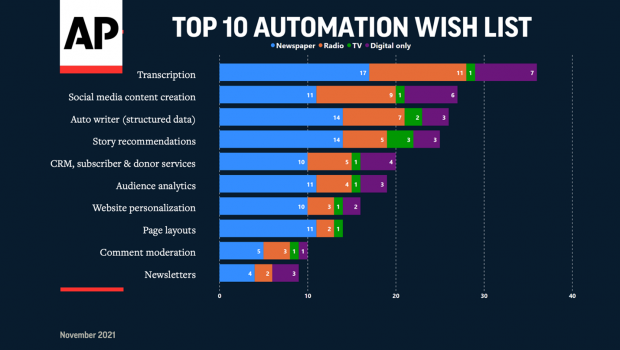
At a simpler level, AI is also being used to liberate resources otherwise hoovered up by resource-heavy work such as interview transcriptions.
AP is currently working with local newsrooms to help them increase their use of AI tools. In a survey asking what would be the most useful use of this technology, automating transcription came top.
Image: via AP
4. Distributing content
A further potential benefit of AI can be seen in its ability to support publishers in their desire to get material in front of audiences – wherever they may be.
POLITICO Europe has used AI to convert two of their popular newsletters, Brussels Playbook and London Playbook into daily podcasts. The audio option gives subscribers another way to consume this content on the go.
This type of technological solution can help publishers manage their resources more efficiently, as well as distribute content to different platforms in a timely and cost-effective manner.
A further mainstream iteration of this idea is also being developed by Google. Dyani Najdi, Managing Director of Video and Display EMEA, has highlighted how the tech giant is experimenting with a tool to reformat landscape videos for YouTube. Viewers will see videos in square or vertical formats, with the shape automatically determined by how you are accessing the platform.
Although currently only available for certain video-ad products, it’s not a big leap to imagine this being used for other content in the near future. If it is, that would be a huge time-saver for many publishers. A further boon is the possibility of this technology opening up new distribution avenues, without the time and expense of repurposing everything.
Where we go from here: two trends to keep an eye on
The manner in which AI is being employed is constantly changing. Its possibilities have sparked discussion about the implications for education, journalism and other creative work, as well as the wider knowledge economy.
Within that, here are two key AI-trends for publishers to closely follow and potentially adopt.
1. Leveling-up content, and ad, personalization
Based on their interests and preferences, AI can personalize the news that publishers deliver to readers. Its usage is only likely to increase and become more ubiquitous.
More than 9,000 publishers use Taboola’s recommendation platform. Earlier in the year, they announced that AI functionality had been added to their homepage techstack. The company said that in beta testing companies such as McClatchy, The Independent and Estado de Minas in Brazil, had seen a 30% – 50% increase in clickthrough rates for homepage sections personalized by Taboola.
Alongside content, AI can also be used to deliver a better ad experience. Publishers like Condé Nast are using machine learning to find patterns that can lead to more personalized and contextual ads. In a cookie-less future this type of approach will be essential if ads are to be targeted and relevant.
2. Improving and streamlining workflows
With cuts being seen across the media landscape, a key challenge for publishers in 2023 will involve maintaining output levels (never mind launching new products and verticals) with fewer staff.
AI may help here, given its ability to be used for A/B headline testing and other forms of predictive analysis. It can also tag and generate content such as business, sports and real estate stories. Or, as seen at Forbes, provide detailed prompts for writers.
It can further support social media and off-platform strategies too. The South China Morning Postsaved resources akin to work done by 3.9 full-time employees by using AI to streamline its social media management.
Meanwhile, in Germany, Frankfurter Allgemeine Zeitung has used AI to help editors understand which stories to put behind the paywall. This matters given their freemium model, and the need to balance free content that drives subscriptions with premium subscriber-only content that readers value.
The big picture
This list of uses is far from exhaustive. To it we can also add important developments such as the ability of AI to help address inequalities (through the automatic creation of audio articles, and work to measure gender disparity in news coverage), as well as the rise of automated fact checking and many others.
Although no one knows how this technology will play out, it’s clear that AI can play a valuable role in helping publishers with their operations. As a result, it is no surprise that key activities unlocked by this technology – such as data analytics and automation – are among the top investment areas for publishers in the coming year.
Previously, as the Knight Foundation has found, “when we talk[ed] about AI in newsrooms, we seem to lean heavily on the newsgathering part of the process and maybe do not pay as much attention to the product or the business side of the ecosystem.”
In 2023, that may begin to change, as we see an overdue shift in the thinking about the role that AI plays in supporting the strategic needs of publishers.
From shaping the content you see (Pink News’ positive news filter), to aiding with translations of new international editions (Le Monde’s digital English language product) and improving your SEO (Summari and other tools), AI is here to stay and increasingly integral to publisher strategies.
Against a challenging business backdrop, as outlets begin to focus more on areas like product, subscriptions and retention, AI’s contribution to a publisher’s success will become more prominent and important than ever.
Faced with challenging economic realities, more publishers are looking to artificial intelligence to improve content performance and ensure that each cent invested generates the maximum return. AI can increase ROI in many ways — two stand out for publishers: optimizing decisions at scale using real-time and granular data, thus leading to better performance and yield, and automating tedious, repetitive tasks, thus reducing expenditures of time and cost required for these processes.
There is a perception that only larger publishers can successfully integrate AI and automation, given their greater financial resources to invest in developing and implementing AI systems. But advances in AI technology mean this is no longer the case. Ready-made, third-party AI solutions require far fewer resources and can be implemented within the existing framework of a publisher’s workflow, producing great benefits for publishers of all sizes.
Let’s examine how AI benefits content distribution strategies in particular and outline five ways publishers are incorporating AI to reduce costs and boost ROI.
AI in action
Newsweek adopted automation to save time on curating and sharing content to social media while boosting reach and performance. By integrating artificial intelligence into its workflow, Newsweek saves over 20 hours per week while doubling referral traffic from Facebook.
“It takes a lot of time out of the day to post new content, recycle a ton of content, and everything else you’re supposed to do in an 8-hour workday,” Adam Silvers, Newsweek’s Associate Director of Strategy explained, highlighting why the team initially turned to automation, and why AI has become indispensable to Newsweek’s workflows: “There’s no question about the benefit.”
Five ways automation can reduce costs for publishers
Scale and enhance teams’ output at no additional cost: Not all publishers have the resources to dedicate staff to managing and optimizing content distribution. For these small teams, AI can be a cost-effective solution to ensure coverage without additional staff investments.
Publishers can automate the entire workflow of distributing content — from selecting content to writing and posting messages at the optimal time — without requiring human involvement. Email — another key distribution channel for publishers — can also benefit heavily from AI, allowing publishers to fully automate the entire process of curating, personalizing, and sending newsletters.
Non-profit news outlet San Antonio Report takes advantage of intelligent automation to power its social media presence without a single staff member dedicated to social media, saving on people costs while generating important online engagement with its content.
Automate to extend coverage without requiring more resources:Large and small newsrooms alike use automation to fill gaps and supplement their existing structures. Publishers such as the South China Morning Post (SCMP) augment their social media teams with automation to save time and cover unsociable hours. With a global audience, SCMP uses automation to ensure 24/7 coverage and remain responsive to trends or stories that break overnight or on the weekend without needing to invest in out-of-hours staff.
Use AI to maintain referral traffic and revenue despite algorithm changes:Facebook is the most important social media platform for publishers by a long shot. Despite news of slowing user growth, Facebook generates the most traffic for publishers from the largest global audience.
Understanding the intricacies of Facebook’s algorithm is therefore vital, especially as the company makes fundamental changes to the way in which content is surfaced. Social media algorithms are constantly changing, from slight tweaks to substantial overhauls. By employing AI technology, publishers can stay responsive to these changes with software that monitors vast datasets to discern patterns and trends. They can react quickly to the findings. Publishers using AI in this way ensure constant and automatic protection against platforms’ algorithm changes that can severely impact referral traffic and, therefore, ad revenue.
Use AI to extend content’s lifespan and value: Every story requires a significant investment to produce, and AI is helping publishers ensure they extract maximum value from each piece by optimizing reach and exposure.
One example comes from social media. Reposting stories on social platforms is a highly cost-effective means of maintaining a robust supply of social content, leveraging a publisher’s archives, and increasing engagement. Our research shows that reposted content offers significant value, gaining an average of 67% of the clicks a piece generated the first time around.
But it is more complex than just reposting the best-performing articles. AI constantly calculates the right time to post (an aspect as important as the content itself in generating engagement) and reshares posts automatically, earning additional exposure at no extra cost.
Use AI to avoid costly guesswork and gain new insights: Understanding your audience is perhaps the single most important element of a social media strategy that drives ROI. AI has a few important uses in this regard.
Publishers like Hello! and The Telegraph run A/B tests on Facebook posts, not only to increase performance but, in the case of The Telegraph, to demonstrate the efficacy of certain stylistic choices, such as a shorter headline.
AI-powered testing can work hand-in-hand with journalists, editorial and social media staff to generate greater ROI from audience development by automating the process or even suggesting subjects to test based on algorithmic analysis.
Publishers are also using AI in a similar way with their email newsletters. AI solutions can run continuous and complex multivariate tests to better optimize emails for individual subscribers, testing everything from the ordering of content to layouts and fonts. In this way, publishers are increasing engagement with their newsletter campaigns — a key aspect of keeping subscription numbers high — without needing to invest more time.
The bottom line
As their cost decreases and use cases multiply, AI solutions will become only more prominent within the industry.
AI technology can fulfill multiple roles: data analyst, social media manager, and audience development manager, to name but a few. By leveraging its power, publishers can generate significant efficiency gains, reduce costs, and free up vital human resources to focus on activities that elaborate their distinct value proposition and ultimately drive ROI.
About the author
Antoine Amann is the Founder and CEO of Echobox, the leading solution for publishing automation used by 1,500 brands worldwide to automate and optimize content curation and distribution.
The publishing industry has undergone a serious transformation in the past five years. It’s moving away from an all-out push for scale and toward earnest efforts to create meaningful relationships built on trust with online readers. It’s not just about eyes on the page. It’s about loyalty.
A loyal audience is more likely to subscribe, attend events, and engage with relevant ads — ultimately increasing revenue. To succeed, newsrooms will, of course, need to rely on the editorial and ethical foundations that have made journalism a pillar of society. But to truly compete with global powerhouses like Facebook, Google, Apple, and Netflix, news organizations need access to data on the same scale that those tech companies have.
To increase loyalty, journalists and editors need to be armed with data and AI-based tools that guarantee a great experience for each visitor every time. These tools tell publishers what topics their readers are interested in and help writers create engaging headlines. These tools also surface the right content to the right person at the right time, whether it’s editorial, sponsored content, or an ad. It’s a tall order. But this marriage of old and new worlds will undeniably fuel the most powerful newsrooms of the future.
Keeping up without compromising
The algorithms that power the world’s most popular social channels master the art of personalization. They give users a never-ending flow of content and ads they find interesting, relevant, and downright addictive. And, perhaps most importantly, they help social media platforms rake in revenue.
According toresearch from Gallup, 45% of respondents said they use social media as their primary way to stay informed on current events, while only 14% said they turn to online news websites. But despite turning to social media the most, respondents also expressed distrust for it. They reported that they’re twice as likely to trust the authenticity and validity of news sites over social media.
This presents the news industry with a monumental task. Publishers need to build sustainable systems that allow them to keep up with the new wave of user experiences ushered in by social media. Thanks to these social platforms, today’s consumers expect personalization from both their editorial and sponsored content. And publishers have to deliver those customized experiences if they want to attract and retain new audiences. But at the same time, they need to maintain the integrity and values that make journalism so important.
The solution to this challenge is strategically designed and applied AI. Publishers can harness the power of massive databases and sophisticated predictive algorithms while maintaining editorial controls.
AI’s role in digital news
Research from Reuters shows that AI’s various use cases are already widely embraced by news industry leaders. A whopping 85% of respondents said AI will play an important role in automated content recommendations and personalization for users, including sponsored content like native advertising. However, it’s not all about content delivery or personalization; 70% think AI plays a significant role in investigating or finding stories through patterns in data. And 81% believe AI can help speed up and automate workflows, like content tagging, interview transcription, and assisted subbing. Meanwhile, 69% believe AI will help with commercial strategies and revenue growth, like identifying “high-propensity” readers or future customers who are more likely to purchase a subscription.
To meet today’s challenges, publishers need a 360-degree approach. In addition to involving engineering and data science teams, it’s critical to involve editors and journalists every step of the way. Ad ops teams will also play a vital role in the AI-powered newsroom since they have the tools to optimize ad campaigns for increased revenue. This comprehensive approach ensures that every player’s needs and perspectives are suited while designing UX and algorithms.
Plus, the insights and best practices offered by editors and journalists are the secret sauce to ensuring that these tools meet ethical standards. Here are a few guardrails and features that can help build ideal AI tools and workflows for the newsroom:
The ability for editors to influence how algorithms make decisions. This involves reviewing and moderating the logic that “teaches” algorithms how to make automated editorial decisions.
The ability for editors to craft “definitions” that dictate the content mix. This way, personalization isn’t able to hide or remove any content areas, regardless of the user’s interest in them.
Allowing AI to power your website ads. Use AI-powered automation to programmatically deliver targeted, personalized ads in the most relevant placements for your audience.
An interface that allows flexible personalization on certain parts of a website, for example, the homepage. Users can see dynamic and personalized content based on their interests and preferences while still allowing curated content based on the news cycle and current events on a local, regional, and global level.
A focus on original content as opposed to syndicated and aggregated content. This helps to reduce information bubbles while staying in line with consumers’ tendency to trust news over social media and other forms of aggregated content.
Better user experience, better business outcomes
In the face of cold and calculated social media algorithms, many of today’s news sites are struggling to keep user attention, drive engagement, and build loyalty. It may be a hard road ahead, but it’s possible to stay in the game while maintaining your journalistic integrity and building scalable, sustainable models.
The newsroom of the future is powered by strategic teams and comprehensive databases that feed highly-specialized algorithms. The result: personalized experiences that rival those of social media and the business metrics to prove it.
About the author
Tim Ruder is the Principal of Audience Development at Taboola. Tim works with editorial teams at premium news publishers, helping them incorporate data and AI-based engagement and personalization solutions into news operations and workflows. His experience in personalization and audience engagement includes working with publishers like the Washington Post, the Los Angeles Times, Hearst Newspapers and many others.